Showing posts with label nazis. Show all posts

Sunday, December 29, 2013

CIA Cannot Confirm or Deny Having Files on Infamous Nazi Doctor

Some things never fail to surprise. And surprise was my reaction to my recent FOIA request at the MuckRock website on a notorious Nazi doctor who had been tried at Nuremberg. The CIA returned a "Glomar" response to my FOIA on Doctor Kurt Blome.


The CIA wrote, "In accordance with section 3.6(a) of Executive Order 13526, the CIA can neither confirm nor deny the existence or nonexistence of records responsive to your request."

Towards the end of the article, and quoted in full, is my appeal of this decision to the CIA. It is published here as a public service, to educate the public about an aspect of the war fought by the "greatest generation," that is not fully explored in a Tom Hanks movie or even a decent World War II history book. (A "no responsive records" on a similar FOIA to the FBI is also being appealed. A FOIA request to the Army has not received any response thus far.)

Glomar responses are considered in cases of "sensitive national security." Just how sensitive a national security issue can it be to admit the CIA has or does not have files on Kurt Blome? For those who are trying to get the truth out of the government on a multitude of different issues, beyond which whistleblowers like Edward Snowden or Chelsea (formerly "Bradley") Manning have been able to provide us, the fact that information more than 60 years old is so sensitive that the government can't admit or deny knowledge of it boggles the imagination.

As readers may or may not be aware, I've been researching the allegations that the U.S. used biological weapons during the Korean War. The charges are still considered valid in China and North Korea, and along with the connivance of the United States in covering up Japanese biological and chemical warfare and medical experimentation in China during World War II, the truth or falsity of these charges are still a hot-button issue in Asia. (My recent article on the subject showed documentary proof that the U.S. was lying, at least in part, publicly about what was going on, and also showed that the U.S. was possibly involved in chemical warfare in Korea as well!)

A South Korean newspaper, The Chosunilbo, responding to Japan's latest provocation -- a visit by Prime Minister Abe to the notorious Yakasuna war shrine, where war criminals from World War II are buried -- reported, "By visiting Yasukuni, Abe has made it clear that he does not intend to back down from a diplomatic and even military confrontation with South Korea and China over the issue of whitewashing his country's wartime atrocities, Tokyo's flimsy colonial claim to South Korea's Dokdo islets and other territorial issues. It is obvious that he will push ahead with his rightwing agenda at all costs."

But what's all this got to do with Nazis, you may ask?

The research took me to the issue of the Nazis' own biological warfare program. According to the Nuremberg trial record, and the few histories on the subject written since, the Nazi doctor Kurt Blome was in charge of the National Socialists' "bacteriological warfare" program. He had built a testing facility in Posen, Poland, reportedly not too different from the Unit 731 facility in Ping Fan. It was captured by the Soviets, but Blome got away. He was later captured by the Americans, and interrogated by the secretive ALSOS group. He was tried as part of the famous Doctors' Trial at Nuremberg, but was acquitted. Some have implicated a deal was made with him for his BW information, and what he could tell the Americans about other Nazi scientists.

My research into the Unit 731 story had led me to track down the intelligence (OSS/Central Intelligence Group) connections of one primary figure involved in the decision to give amnesty to the Japanese BW war criminals, in exchange for getting BW (and other) data from them for use by U.S. scientists working at Ft. Detrick (and likely, too, for the Special Operations Division there, working on poisons and mind control research for the CIA). (This is the subject of an article to come, so I'm not going to give many details on who that intelligence person was.)

So I thought I should at least send a FOIA on Kurt Blome to the CIA. After all, according to historians Ute Deichmann, Linda Hunt, and Tom Bower, Blome had been a candidate for Army's Operation Paperclip, which sought out Nazi scientists to bring to the U.S. (like Werner von Braun). But presumably the U.S. Foreign Office or State Department balked on bringing this Nazi zealot to the America. After he was released from U.S. custody, he was interviewed by Ft. Detrick scientists, and subsequently, was said to be employed by the United States as a "camp doctor" at the European Command Intelligence Center at Oberursel, West Germany.

Now why, I wondered, was a Nazi doctor hired at the largest U.S. interrogation facility in post-World War II Europe? Moreover, why did Blome's trail end there? (A few sources state he was later arrested by the French and jailed, but I can find no clear documentary evidence of this.)

For the record, and I believe the readers' interest, I'd like to quote a bit from the June 16, 1947 closing brief at the Doctors Trial at Nuremberg for the United States of America versus Kurt Blome:
Blome was Deputy Reich Health Leader and Deputy Leader of the Reich Chamber of Physicians and the National Socialist Physicians' Association. He was a close collaborator of [Reich Health Leader, Leonardo] Conti, who was in direct charge of the civilian health service. By virtue of these positions, Blome held considerable power and influence. He knew that concentration camp inmates were being systematically used in criminal medical experiments. 

As the responsible head of bacteriological warfare, Blome personally suggested and carried out criminal experiments in that field. In the same connection he had poisons tested on human subjects and reported to Himmler on this matter.

Blome had full knowledge of the murderous freezing experiments by [SS doctor Sigmund] Rascher, supported his efforts to gain admission as an academic lecturer on that subject, and, as a member of the Reich Research Council, personally issued a research assignment to Rascher for further freezing experiments. He collaborated with Rascher in the Polygal experiments, during which inmates were shot and killed. He also issued a research assignment to Rascher in support of these experiments.

Blome had knowledge of [August] Hirt's [mustard] gas experiments in Natzweiler and furthered his work by issuing an assignment from the Reich Research Council.

As Deputy Reich Health Leader, Blome worked with the murderer [Arthur Karl] Greiser, Gauletier of Warthegan, who among other things assisted in the extermination of Jews in that area of Poland....
Historian, Michael H. Kater, in his book Doctors Under Hitler, said that Blome was one of a number of German doctors who were "instrumental not only in developing and introducing the Nuremberg race legislation but also in creating the severity with which its various enactments affected German Jews and the murderous ramifications thereafter" (p. 182)

Despite the crimes involved here, the story of U.S. government refusal to release records, and particularly obfuscation by the CIA, is nothing new. According to a 2005 Reuters story, "the CIA has refused to disclose documents about its postwar dealings with former Nazis who have not been accused of war crimes but belonged to organizations like the German Nazi party and the SS, congressional officials said. Some of the material is believed to deal with former Nazis who joined the allied Cold War effort against the Soviet Union in Europe, the officials said."

Former New York Congresswoman Elizabeth Holtzman told UPI at the same time as the Reuters article, "I think that the CIA has defied the law, and in so doing has also trivialized the Holocaust, thumbed its nose at the survivors of the Holocaust and also at Americans who gave their lives in the effort to defeat the Nazis in World War II."

What follows is the text of my FOIA appeal to the CIA:
December 12, 2013

Agency Release Panel
c/o Susan Viscuso
Information and Privacy Coordinator
Central Intelligence Agency
Washington, DC 20505

Reference: F-2014-00114

Dear Agency Release Panel:

This letter constitutes an administrative appeal to the Agency Release Panel, such appeal being guaranteed by Section 3.5(e) of Executive Order 13526.

I am writing to appeal the determination by the Central Intelligence Agency (CIA) with regard to my FOIA request filed on October 23, 2013, reference number F-2014-00114, for "all files pertaining to the former Nazi doctor Kurt Blome.”

The CIA response of November 6, 2013 indicated that, in accordance with section 3.6(a) of Executive Order 13526, the CIA could “neither confirm nor deny the existence or nonexistence of records responsive” to my request. CIA’s notification continued, “The fact of the existence or nonexistence of requested records is currently and properly classified and is intelligence sources and methods information that is protected from disclosure by section 6 of the CIA Act of 1949, as amended, and section 102A(i)(l) of the National Security Act of 1947, as amended.” This will be referred hereafter in this appeal by the popular name given to such a rejection, i.e., as a “Glomar” response.

The following are my reasons for appeal:

1) Some information related to cooperation Kurt Blome gave to both the military and intelligence agencies of the US government have already been released and are in the public record, and is further discussed below.

2) In her book, "Secret Agenda: The United States Government, Nazi Scientists and Project Paperclip, 1945-1990" (St. Martin’s Press, 1991), Linda Hunt noted that Kurt Blome had been interrogated as part of the Alsos missions at the end of World War II. Alsos was jointly staffed by the Office of Naval Intelligence, the Office of Scientific Research and Development, the Manhattan Project, and Army Intelligence (G-2), and mandated to investigate enemy scientific developments. The investigation included biological weapons. From the Nuremberg trial, where Blome was a defendant, we know that he was involved in biological weapons research for the Nazi government.

3) The record of Blome’s Alsos interrogation is in the public domain. See Alsos interrogation at the National Archives in the Kurt Blome INSCOM dossier XE001248. Arrest reports: in Blome's Nuremberg arrest file, Record Group (RG) 238, NARS.

INSCOM stands for U.S. Army Intelligence and Security Command.

Blome’s status as an accused defendant in the Nuremberg proceedings is well-known. The records of that trial are public domain, and it is difficult to believe that the CIA has no files or records or reports that discuss Blome in relation to the war crimes charges or the trial itself.

At the trial, it came out that Blome admitted at the Nuremberg Trial that he had been head of an institute in Posen that did research on biological warfare for the Nazis. Experiments had been carried out on Soviet prisoners-of-war as part of this research. See The Nuremberg Medical Trial, 1946/47 (Walter de Gruyter, 2001), p. 56.

4) Kurt F. L. Blome (F. L. for Friedrich Ludwig, the middle names of the same Kurt Blome who is the subject of my FOIA request and this appeal) is mentioned by name in a declassified list of “Foreign Scientist Case Files, 1945-1958”, part of the scientists who signed up to work for the U.S. government as part of Operation Paperclip, or the later Project 63. See URL: http://www.archives.gov/iwg/declassified-records/rg-330-defense-secretary/foreign-scientist-case-files.pdf

5) After Blome was acquitted at the Nuremberg Doctors’ Trial in August 1947, according to Hunt’s book, two months later, “four representatives of Fort Detrick -- the Maryland army base that was also headquarters of the CIA's biological warfare program -- interviewed Blome about biological warfare…. During a lengthy interview Blome identified biological warfare experts and their locations and described different methods of conducting biological warfare.” (p. 180) Blome was ultimately given a position working for the Americans at Camp King interrogation center, Oberursel, West Germany.

The Fort Detrick interrogation is known from Blome’s INSCOM dossier and his Joint Intelligence Objectives Agency (JIOA) dossier, RG 330, NARS.

According to the National Archives website, JIOA was “was established in 1945 as a subcommittee of the Joint Intelligence Committee (JIC) of the Joint Chiefs of Staff (JCS). The JIC served as the intelligence arm of the JCS, responsible for advising the JCS on the intelligence problems and policies and furnishing intelligence information to the JCS and the Department of State. The JIC was composed of the Army's director of intelligence, the chief of naval intelligence, the assistant chief of Air Staff-2, and a representative of the Department of State.”

“The JIOA was given direct responsibility for operating the foreign scientist program, initially code-named Overcast and subsequently code-named Paperclip.” (URL: http://www.archives.gov/iwg/declassified-records/rg-330-defense-secretary/)

Hence, the fact that Blome acted as an “intelligence source” for U.S. intelligence circles is no secret.

6) Some of the information that Blome could have given interrogators has been pieced together from German archives. The German historian, Ute Deichmann in her book, "Biologists Under Hitler" (Harvard Univ. Press, 1996) mentions, as an example of this kind of information, the Wolfram Sievers at the Institut fur Zeitgeschichte (MA 1406/1).

In these diaries, Blome is described as having conducted neutron radiation experiments, as well as making plans to carry out experiments with bacterial pathogens (p. 417).

7) According to BBC television producer Tom Bower in his book, "The Paperclip Conspiracy: The Hunt for the Nazi Scientists" (Little, Brown & Company, 1987), it is public record that Kurt Blome was hired by the U.S. Chemical Corps in August 1951 and certified by U.S. High Commissioner for Germany, John McCloy, as “not likely to become [a] security threat to the US” (p. 254) Bower gives as citation for this material RG 330 JIOA case file, “Blome,” in the National Archives.

8) The Nazi War Crimes Disclosure Act (P.L. 105-246, 5 U.S.C. § 552) mandated that Government agencies, including the CIA, take necessary steps necessary to declassify and open remaining classified records related to Nazi war criminals and criminality. This included “any person with respect to whom the United States Government, in its sole discretion, has grounds to believe ordered, incited, assisted, or otherwise participated in the persecution of any person because of race, religion, national origin, or political opinion, during the period beginning on March 23, 1933, and ending on May 8, 1945, under the direction of, or in association with…. the Nazi government of Germany”.

This law included an exception that would “reveal the identity of a confidential human source, or reveal information about the application of an intelligence source or method, or reveal the identity of a human intelligence source when the unauthorized disclosure of that source would clearly and demonstrably damage the national security interests of the United States.

While there is an exception made similar to that which the CIA claimed in its “Glomar” response to my FOIA request, I would argue from the information above that there is already a good deal about Kurt Blome in the public record that likely is in CIA files, and withholding such information because of a possible revelation re an intelligence or methods source is a moot issue.

While there may be aspects of the request that could still be denied under one or another FOIA exemption, I would ask that the elements of the files and other information from my original request that can segregably be released, be so released.

In conclusion, I ask that the Agency Release Panel reconsider its “Glomar” decision to neither confirm nor deny the existence or nonexistence of records responsive to my request.

I have shown that there is already a documentary of both the interrogation and employment of Kurt Blome by U.S. military and intelligence sources. I have shown that Kurt Blome is known to have been a used as an intelligence and/or methods resource after he came under U.S. custody. I have further shown that some of Kurt Blome’s expertise in scientific matters that may have been of interest to U.S. intelligence, and hence the CIA, has already been made public in German archives.

Finally, I would argue that lacking any reason to consider information on Kurt Blome something subject to a “Glomar” denial, it is also important to consider that it was the legislative intent of the United States Congress, in a law signed by the President of the United States, to release information related to Nazi war criminals or possible criminality by such persons.

According to the CIA’s own website, the Nazi War Crimes Disclosure Act was “the largest congressionally mandated, single-subject declassification effort in history, and a special website at the CIA was set aside to openly display documents the CIA released under this act. (URL: http://www.foia.cia.gov/collection/nazi-war-crimes-declassification-act)

In the spirit of that Act, and of the CIA’s own efforts to release information according to such lawful request and special effort, and given that so much about Kurt Blome has already gone into the public record concerning his activities as an intelligence and/or methods resource, and, finally, given the blood and treasure the citizens of the United States spent in fighting the Nazis, I ask that the “Glomar” exception be removed and my FOIA request appropriately processed.

I look forward to receiving your decision on this appeal in a timely fashion. If you have any questions, or believe discussion of this matter would be beneficial, please contact me or MuckRock News.

Sincerely,

J.K.
My thanks to both Jason Leopold and NSA Archive for their assistance, online and off, for help in understanding the Glomar experience!

[Update, 2/9/2014: In a letter dated January 22, 2014, the CIA responded to my appeal letter with the statement, "Your appeal has been accepted and arrangements are being made for its consideration by the Agency Release Panel."]

Saturday, July 30, 2011

Part 2: Air Force Teaching Guide Minimizes History of Recruiting Nazis

For Part One of this article, which covered the history of various key Nazis brought to work for the U.S. military, and how this history was withheld in Air Force training documents, click here. Both Part One and Part Two of this article take off from an investigation by Jason Leopold at Truthout and documents obtained via FOIA by the Military Religious Freedom Foundation.
* * * * * *
Not Just Rocket Scientists -- the MKULTRA Connection

According to the Air Force "Space History," Paperclip was limited to the operation to move the Nazi rocket scientists. But Paperclip and assorted similar programs brought hundreds of Nazi scientists to the U.S. According to Alexander Cockburn and Jeffrey St. Clair in their book, Whiteout: The CIA, Drugs and the Press (out of print), these included Kurt Blome, "who had tested Sarin nerve gas on prisoners at Auschwitz;" Hermann Becker-Feyseng and Konrad Schaeffer, who conducted hideous experiments on prisoners at Dachau, injecting salt water into the veins, or forcing salt water down the throats of dozens of prisons, all of whom died.

According to Cockburn and St. Clair, "One of the most despicable cases was that of Nazi aviation researcher Emil Salmon, who during the war had helped set fire to a synagogue filled with Jewish women and children. Salmon was sheltered by US officials at Wright Air Force Base in Ohio after being convicted of crimes by a denazification court in Germany."

The list of Nazi scientists goes on and on, especially those employed by the Air Force. Consider the case of Dr. Hubertus Strughold, dubbed the “Father of American Space Medicine.” In 1995, the Anti-Defamation League got Secretary of the Air Force "to remove Dr. Hubertus Strughold's name from the Aeromedical Library at Brooks Air Force Base near San Antonio, Texas.... "Dr. Strughold headed the Third Reich's [Luftwaffe] Institute of Aviation Medicine during the war, which subjected concentration camp inmates to abuse and torture, thinly disguised as 'experiments.'" (X-File fans might remember the character of Conrad Strughold, who was based upon Dr. Strughold.)

Among the most secret of the Paperclip scientists were those brought to Edgewood Arsenal. Investigative journalist Hank Albarelli, Jr., in a fascinating article on Paperclip, wrote about one of the scientists brought to Edgewood as part of Nazi importation program. (Disclosure: I have also co-authored a few articles with Albarelli, and hosted his FDL Book Salon for his landmark book on the killing of Frank Olson, A Terrible Mistake.)
Dr. Friedrich “Fritz” Hoffmann... came to America in 1947 through the Paperclip pipeline. During the war, Hoffmann had been based in Frankfurt and Gatow, a district of Berlin, where he conducted a myriad of chemical experiments for the Third Reich.

In the U.S., Hoffmann was initially posted at Camp Detrick and Edgewood Arsenal, where he continued his work with refining lethal sarin and tabun gases for warfare objectives, utilizing a specially built gas chamber, put together along with Edgewood Arsenal research chief Dr. Seymour Silver, within which countless animals were destroyed, and at least 25 alleged ‘volunteer’ American servicemen were experimented upon. Reports that several servicemen died in these experiments have persisted for decades, but the Pentagon refuses to release any documents concerning the experiments.
Hoffman later turned to LSD experiments at Fort Detrick’s Special Operations Division, Frederick, Maryland. According to Albarelli, "primates would be fed a steady diet of psychotropic drugs in efforts to study various stages of induced 'psychotic behavior.' These experiments would quickly evolve into human experiments conducted among U.S. service personnel at Edgewood Arsenal, Maryland and several federal prisons," including Atlanta federal penitentiary.

Part 1: Air Force Teaching Guide Minimizes History of Recruiting Nazis

Best of the U.S. Air Force - Department of Defense Image Collection - September 1998

Why does the United States Air Force, in their teaching materials provided to ICBM missile combat crew at Air Force Global Strike Command, present such a sympathetic portrayal of former Nazi scientist and SS officer Wernher von Braun, and why does the Air Force limit their discussion about Nazi involvement in the U.S. space program to "only one man," von Braun?

The reason is simple, but shocking to many, as the history has been largely covered-up, or relegated to out-of-print history books: the U.S. missile program, and much of its military science program in the post-World War II period, was imported wholesale from the Nazis, including their leading scientists.

A jaw-dropping new article by Jason Leopold at Truthout discusses the use of Christian religious ideology in the teaching of the Air Force nuclear missile combat crew. As outrageous as that fact is, a further search of FOIA documents linked in the Truthout article shows that the reference to Von Braun in an Air Force slide presentation on "Ethics" is no anomaly. The documents include a revisionist history of the U.S. missile program, presented as a series of readings provided to students in the class that trains the operators of America's nuclear missile arsenal.

According to Leopold, "The Air Force documents were released under the Freedom of Information Act (FOIA) and provided to Truthout by the Military Religious Freedom Foundation (MRFF), a civil rights organization."

(Disclosure: I have worked closely with Jason Leopold on a number of articles at Truthout, including on DoD human experimentation policies, the administration of drugs to Guantanamo detainees, the SERE-linked CIA/DoD torture program, and revelations surrounding DoD's Joint Forces Intelligence Command's aborted search for Osama bin Laden and intelligence about pre-9/11 attack planning that included the World Trade Center and the Pentagon.)

In one of the Air Force documents, titled "Space History," "chapter one" of an "Air University Space Primer," there is a brief discussion of the U.S. recruitment of Von Braun, who went on to become the director of the Development Operations Division of the Army Ballistic Missile Agency and later the head of the Marshall Space Flight Center (MSFC) at Redstone Arsenal, Huntsville, Alabama. The Air Force's track record in covering-up their history with Nazis is on display at Von Braun's biography at the Marshall Space Flight Center website, which mentions his involvement with the development of the V-2 rocket at Peenemünde in Germany.

The MSFC biography cites the use of "forced labor" at the factory, but never mentions that Nazi slave labor from the Dora concentration camp involved over 60,000 slave laborers, or that 20,000 of them -- Jews, Russian prisoners, Poles, French partisans, and more, including an African-American U.S. soldier -- died in the underground Mittelwerk V-2 rocket factory, where Von Braun was a key figure, some of them publicly hanged for "sabotage." The site only notes, "Scholars are still reassessing his role in these controversial activities."

According to the Air Force's "Space History," "German rocket development... between 1932 and 1945 involved only one man, Wernher von Braun." The Air Force deletes from history Arthur Rudolph, the Operations Director and engineer at Mittelwerk, another key Nazi brought to the United States after World War II as part of a top secret program known as Operation Overcast, and later Operation Paperclip. As we shall see, he is only one figure among scores disappeared from the Air Force record, which presents Paperclip as primarily an operation to bring Von Braun and a few co-workers to America and save precious technology from falling into the hands of the Soviets. Moreover, outrageously, it is presented as a religious decision.

Arthur Rudolph and Operation Paperclip

According to a website that documents the history of the Dora concentration camp:
Faced with shortages of labor, Arthur Rudolph, the chief V–2 production engineer, in a memo of April 12, 1943, recommended that the missile program at Peenemünde adopt the exploitation of SS camp labor like that he saw at an aircraft factory. The first prisoners arrived at Peenemünde on June 17. Following the Royal Air Force bombing of the site, von Braun, technical director of the V–2 project, chaired a staff meeting on August 25 that recommended producing missiles underground with camp labor.

Rudolph became technical head of V–2 production at the underground Mittelwerk factory; he and von Braun requested that the SS provide more prisoners for V–2 production, most clearly in an August 15, 1944, memo in which von Braun described his trip to the Buchenwald concentration camp to select prison workers and arrange their transfer to Dora....

Despite the complicity of some engineers, the United States did not include the engineers in the 1947 Nordhausen trial or any other war crimes trials. As later US citizens, von Braun and Rudolph later earned awards for work on the Saturn V launch vehicle that took men to the moon.
By 1950, Rudolph, safe in the United States, became director of the Pershing Missile program at the Ordnance Guided Missile Center at Redstone Arsenal. Meanwhile, ignored was Rudolph's interrogation file. After his capture his interrogator assessed Rudolph, a later recipient of the US Army's Decoration for Exceptional Civilian Service, as documented in former CNN reporter Linda Hunt's book, Secret Agenda - The United States Government, Nazi Scientists and Project Paperclip, 1945 to 1990 (large PDF): "100% NAZI, dangerous type, security threat... ! ! Suggest internment." (Emphasis in original.)

Rudolph subsequently became the project director of the Saturn V rocket program.

But later, in the 1980s, an Office of Special Investigations investigation at the Department of Justice uncovered his Nazi connections and his role in the slave labor at Mittelwerk, and he fled the U.S. His case became a cause célèbre. The Germans held a bogus investigation, clearing Rudolph, and granting him German citizenship after his U.S. citizenship was taken from him.

Von Braun, of course, was famously a major Nazi figure, despite attempts to minimize his role under the Nazis. According to Hunt, Von Braun "had joined the SS at the personal behest of SS chief Heinrich Himmler and had risen to the rank of major." He conspired with other major figures to withhold information from U.S. officers, so that the U.S. interrogator screening the rocket scientists for trustworthiness before they left Germany, judged granting these criminals security clearances was "an obvious absurdity."
American officers in Europe were trying to locate V-2 rocket diagrams they believed were still hidden in Germany. When asked about the documents, von Braun told the Army he knew nothing about their location. Dornberger later told von Braun's brother that Army officers didn't trust von Braun and that officers had even told him that von Braun had lied to them. Von Braun then sent a map to his family in Europe showing the location of a burial place where sketches stuffed in a cigarette box were hidden. He told them to deliver the map to Dornberger's wife, since the general still was being held in a British POW camp. The way this scheme was supposed to work, the documents then would be located and given to German scientists, who would turn them over to von Braun when they arrived in the United States under Paperclip.

U.S. officers reported that von Braun "apparently intended to use the location of certain hidden documents as a bargaining lever with U.S. officials."
But, according to a Powerpoint presentation given to students in the Air Force rocket crew program, Von Braun is quoted as saying he and his colleagues gladly gave Nazi rocket documents to the U.S. "because we felt that only by surrendering such a weapon to people who are guided by the Bible could such an assurance to the world be best secured." (According to the Wikipedia webpage on Von Braun, he quote is attributed to an interview with Mike Wallace in a television biography of Von Braun in the late 1950s-early 1060s.)

The Air Force portrays Von Braun as "pressured" by the Nazis to work on their missile program. But the documentation shows Von Braun was an adamant Nazi, "joined the SS at the personal behest of SS chief Heinrich Himmler and had risen to the rank of major" (Hunt).

Rudolph and Von Braun were only part of the Mittelwerk Nazi rocket scientists transferred by Paperclip. General Walter Dornberger, the head of the entire V-2 program was also brought to the U.S. According to the Spartacus website, it was Dornberger who recruited Von Braun to the Nazi rocket program, and in 1937 took charge of the secret work at Peenemunde. The V-2 rocket became operational late in the war. From 1944-45, over 5,000 V-2s were fired on Britain. However, only 1,100 reached their target. These rockets killed 2,724 people and badly injured 6,000."

The Atlas missile, the first U.S. ICMB missile, was based on modifications to the V-2 design.

Dornberger was interrogated by the British War Crimes Investigation Unit for the use of slave labor at Mittelwerk, and spent two years in internment in South Wales. But he was released under Paperclip and brought to the United States, where the Air Force used him in the development of guided missiles. He subsequently became a major figure at Bell Helicopters. According to his Wikipedia entry, which cites a 1957 Time magazine article, he also helped develop a surface-to-air missile for the Strategic Air Command.

Another Air Force recruited Nazi was V-2 rocket scientist Kurt Debus, who became the first director of the Kennedy Space Center in 1962, and was, according to Hunt, another "member of the SS, the SA, and two other Nazi groups." He earlier worked as assistant technical director to von Braun at the Redstone Arsenal. Today, the the National Space Club of Florida presents an annual Debus Award "to recognize significant aerospace achievements in Florida."

Tomorrow, Part Two considers the use of Nazi scientists brought to the U.S. as part of Operation Paperclip, expanding the coverage to those used in government military/intelligence programs other than rocket or space science, including the government mind control program known as MKULTRA.

Originally posted at FDL/The Dissenter

Sunday, June 12, 2011

Reposting FDL Book Salon: Robert Jay Lifton's new memoir, "Witness to an Extreme Century"

I had a great time hosting Firedoglake's Book Salon this afternoon. The guest was famous psychohistorian Robert Jay Lifton. Reposted below is the introductory post I wrote for the occasion. Readers should click though to read the entire exchange between myself, Dr. Lifton, and a number of commenters, touching on subjects from mind control and torture, to the Armenian genocide and the legacy of Hiroshima. Co-author with Dr. Lifton on a couple of books, and recently a blogger on the Wikileaks story, Greg Mitchell shows up in a number of the comments.
We are extraordinarily fortunate to converse today with psychiatrist and psychohistorical researcher Robert Jay Lifton. His new memoir, written after 60 years of professional life, is an amazingly fascinating and entertaining book. Dr. Lifton speaks in his persona of a gifted, intelligent, and rational observer and thinker, a self-described disciple of the Enlightenment and a humanist approach to understanding.

Yet Dr. Lifton was more than a mere witness to history. As his book describes it, his experience working with traumatized returning Vietnam veterans transformed the researcher into an activist as well, and he has continued making outspoken criticisms of U.S. military and interrogation/torture policies ever since. In 2004, he was one of the first medical professionals to speak out against the participation of doctors, nurses, and medics in torture by U.S. forces in Iraq, Afghanistan and Guantanamo Bay.

Dr. Lifton’s witnessing was always of an active sort, however, seeking to use understanding and intellect to bring light to some of the darkest episodes in recent history. To visit his work is to descend along with him into the most hellish and evil places in modern times, and his work acts like a kind of Virgilian torch for use by we Dante-like pilgrims, visiting hell to discover our own humanity, no matter what uncomfortable truths might await us.

In his book, Thought Reform and the Psychology of Totalism: A Study of “Brainwashing” in China, one of the most important works of psychology in the 20th century, Dr. Lifton interviews the victims of a massive “thought reform” campaign by the victorious Chinese Communist Party, undertaken in the aftermath of a terrible civil war, and under the blows of the Cold War and Korean War. In the process of this encounter with totalism – the manipulation of mind and personality by preying upon the fear of death, the power of group pressures and interpersonal pressures to produce false confessions, the internal splitting or dissociative properties of the mind, and the inescapable drama of individual identity formation – Dr. Lifton’s analysis made a tremendous contribution to our understanding of extreme psychological states, and extreme modalities of social and historical experience.

There were other such confrontations and discoveries, as Dr. Lifton’s personal intellectual and career journey led him to study another totalistic assault, albeit one imposed by distant technological, yet terrible means, in his study on the victims of Hiroshima, later published as Death in Life: Survivors of Hiroshima. Years later, he wrote, along with Greg Mitchell, Hiroshima in America, an amazing book about U.S. societal reaction to the destruction of the atomic bomb, the psychology of the men who decided to use it, and the collective denial that has captured our society ever since, while the insane destructive fantasy of total nuclear annihilation haunts us still.

Dr. Lifton’s memoir is organized around these fateful encounters, and the works that emerged from them, from the “thought reform” and Hiroshima work, to his massive 1986 study, The Nazi Doctors – about which he speaks at length about the difficult personal toll in undertaking such a work – and his encounters with the traumatized Vietnam veterans, and opposition to the Vietnam War in general (Home from the War: Learning from the Vietnam Veterans).

Dr. Lifton’s work has continued to enlighten in an activist way, from his work on the apocalyptic Japanese cult, Aum Shrinrikyo (Destroying the World to Save It: Aum Shinrikyo, Apocalyptic Violence, and the New Global Terrorism) to the extreme ideology of world domination that arose in U.S. ruling circles following 9/11 (Superpower Syndrome). But his new memoir, while it takes the reader on a journey into the dark territory surrounding “an extreme century” is also a moving personal account of personal development, and of those he encountered along the way.

Accompanied by his supportive and accomplished wife, BJ, and sometimes his children, Dr. Lifton had the good luck to encounter and collaborate with some of the best minds of the last century. Those who seek anecdote about the famous will not be disappointed, as Dr. Lifton describes his relationship with his great mentor, the famous psychoanalyst and theoretician Erik Erikson, his meetings with anthropologist Margaret Mead, his confrontation with Nazi doctor and famed ethologist, Nobel Prize winner Konrad Lorenz, his friendship with novelists Elie Wiesel and Norman Mailer, among other fascinating people who populate his new work.

Dr. Lifton did not remain in an ivory tower. As he explains in his memoir, stirred by the protests of the 1960s, he became an activist, and was twice arrested for civil disobedience against the Vietnam War. At his Wellfleet, Massachusetts home, he initiated a series of yearly meetings, beginning in 1966, and still continuing today, drawing together an idiosyncratic collection of academics, clinicians, artists and thinkers to discuss what he first characterized as psychohistory, but apparently grew larger into wide-ranging discussions about psychology, history, art, current events, all animated by Lifton’s own personality, rooted in inquiry, honesty, and good humor mixed with intellectual rigor.

As a balance to the dark powers of totalism, which draw upon the deepest roots of human psychological vulnerability and threaten the very planet in its death-defying search for unreachable immortality and omnipotence, Dr. Lifton counterposes a vision of a protean self, of symbolic immortality through embracing the connectivity of all humans throughout time. Proteanism concerns “the self’s capacity to change and transform itself,” its creative capacities, and its many cultural variations.
At a large reception during a conference, a graduate student I didn’t know confronted me in a New York/sixties manner so brash as to be almost charming: “Hey, Lifton, I tried to be a protean man and it doesn’t work.” Again I smiled, this time perhaps with a little more uneasiness. I told him that proteanism was not an absolute – one didn’t have to be changing or reconfiguring one’s psyche every day – but rather a tendency of the self. That was true enough, but I knew it to be only the beginning of an answer. (Witness to an Extreme Century, p. 369)
Modern history has presented us with the gravest questions and dilemmas, but Robert Jay Lifton has presented us with the beginning of some answers, and for this we can be grateful. With that, let’s welcome to Firedoglake, Dr. Robert Jay Lifton.

Wednesday, May 4, 2011

The Partisan Anthem of the Warsaw Ghetto Uprising


One of the submissions in The Nation's contest on the Top Ten Protest Songs Ever. According to Wikipedia:
"Zog Nit Keyn Mol" (Yiddish: זאָג ניט קיין מאָל) (also referred to as "Partizaner Lid" or "Partisan song", though it shares this title with other works) is the name of a Yiddish song written in 1943 by Hirsh Glick, a young Jewish inmate of the Vilna Ghetto. The song is considered one of the chief anthems of Holocaust survivors and is sung in memorial services around the world. During World War II, it was the anthem of various Jewish partisan brigades.

The lyrics Glick wrote were later set to music by Dmitri Pokrass. The music was actually written earlier than the lyrics, in 1935, for the song "Одесская Походная" (Odessa March), also known as "То не тучи - грозовые облака" (those aren't just clouds - they are storm clouds) about the Russian Civil War. That song was first performed by the well known Soviet Jewish singer Leonid Utyosov.

Hirsch was inspired to write the song by news of the Warsaw Ghetto Uprising.
Note, one of the commenters at YouTube reports the front page of the NY Times in the video is a fake.

As for protest songs, my vote is for Bob Dylan's "Masters of War".

Lyrics to "Zog Nit Keyn Mol" (from Wikipedia page linked above)
Never say this is the final road for you,
Though leaden skies may cover over days of blue.
As the hour that we longed for is so near,
Our step beats out the message: we are here!

From lands so green with palms to lands all white with snow.
We shall be coming with our anguish and our woe,
And where a spurt of our blood fell on the earth,
There our courage and our spirit have rebirth!

The early morning sun will brighten our day,
And yesterday with our foe will fade away,
But if the sun delays and in the east remains –
This song as password generations must remain.

This song was written with our blood and not with lead,
It's not a little tune that birds sing overhead,
This song a people sang amid collapsing walls,
With pistols in hand [1] they heeded to the call.

Therefore never say the road now ends for you,
Though leaden skies may cover over days of blue.
As the hour that we longed for is so near,
Our step beats out the message: we are here!

[1] The actual words used are "with naganes in the hand", a reference to either the Nagant M1895 pistol or the Mosin–Nagant rifle, both widely used in the Soviet Union and both having a reputation for ruggedness, making them especially fitted for the conditions of partisan life.
H/T Greg Mitchell

Sunday, March 6, 2011

"Operation Paperclip: CIA Denial of Coddling Nazis Far From the Truth"

I hope readers didn't miss H.P. Albarelli's second part of his series on Operation Paperclip: CIA Denial of Coddling Nazis Far From the Truth.

Albarelli, the author of A Terrible Mistake: The Murder of Frank Olson and the CIA’s Secret Cold War Experiments, is a meticulous researcher, and his examination of the wide-ranging influence of the U.S. importation of Nazis after World War II, and the influence on a number of U.S. enterprises, not least the CIA/DoD operations at Edgewood Arsenal and the MKULTRA progams, is highly worth reading.

From the beginning of Albarelli's article: 
In the second part of his investigation, Hank Albarelli peels off another layer of the ongoing Operation Paperclip cover up and unveils one of its darker legacies. Working with Paperclip Nazi scientists and building on the results of their often deadly research, the CIA tested LSD psychoactive drugs on almost 7,000 unwitting U.S. citizens over a 20-year period. Those LSD experiments, and Paperclip itself, were among the first manifestations of what became a guiding principle of the Cold War right to the present day, that the ends justify the means.
Dr. Herbert Bruno Gerstner was not the only former Nazi researcher to be brought to Texas by Project Paperclip. When Gerstner arrived, there were already a dozen Nazi aeromedical scientists working at the Air Force’s School of Aviation Medicine (SAM) at Brooks Air Force Base in San Antonio. Among this initial group was one physician who would eventually become widely known and controversial. This was Dr. Hubertus Strughold, today unabashedly considered the “Father of American Space Medicine.” Suspicions loom large today that Strughold’s past wartime involvement in human experiments was overlooked and covered-up by Paperclip officials so that his expertise could be exploited by America’s then burgeoning aerospace program.

When Strughold died in 1986, years after retiring from an illustrious 18-year career with the U.S. government, the Justice Department had only just come around to investigating his wartime activities, an inquiry that eventually went nowhere. Additionally, readers who think Strughold had no links to the CIA should think again. Military and aerospace activities at SAM in the 1950s, and beyond, very much involved the CIA as is well documented in recent years by numerous declassified documents and reports concerning the ultra-secret U-2 spy aircraft program, Projects Idealist and Aquatone, and other espionage activities centered in Texas.

Strughold consistently argued that he knew nothing about Nazi human experiments until after the war ended. “I was against Hitler and his beliefs”, Strughold told one reporter in the 1968. He claimed, “I sometimes had to hide myself because my life was in danger from the Nazis”, but this defense appears trumped-up in light of evidence uncovered by American historian and investigative journalist Linda Hunt. Hunt— whose life was threatened a number of times during her ten-year investigation of Project Paperclip, and who was shot at by an unknown assailant on one occasion— discovered that on October 26 and 27, 1942, Strughold attended a Nazi scientific conference in Nuremberg to discuss “Medical Problems Arising from Distress at Sea and Winter Hardships.”

At the conference, a Nazi researcher, identified as Professor Holzloehner, presented his findings through experiments he conducted on Dachau concentration camp inmates “who were frozen to death in vats of ice water in the camp yard during winter.” According to Holzloehner’s presentation, the human subjects suffered excruciating pain before they died from having various body parts frozen. Linda Hunt also discovered at least five other Paperclip scientists who worked at SAM who knew about the Dachau experiments through their participation at the same 1942 conference. These were Drs. Walter Schreiber, Hans Clamann, Ulrich Luft, Konrad Buettner, and Richard Landenberg.
For more, see Albarelli's article. And here's the link to Part I: CIA’s Denial of Protecting Nazis is Blatant Lie.


Sunday, January 2, 2011

"Faustian Bargains": Jay Katz on the History of Human Medical Experimentation

The following is a reprint of a presentation given during a public meeting of the Advisory Committee on Human Radiation Experiments (ACHRE) by Dr. Jay Katz, a nationally-renowned doctor and ethicist, who was also a professor at Yale Law School. Dr. Katz died in November 2008. The presentation is in the public domain, and reprinted here as a public service.

One of the great problems with the public discussion of these issues is that they remain restricted to difficult to access professional journals, or expensive books generally unavailable to the average person (though the advent of Google Books has changed that somewhat). Keeping the discussion of informed consent and research issues out of the general public discourse has been one of the primary reasons that violations of ethical standards remains such a serious societal problem.

The New York Times obituary for Dr. Katz describes him as "an outspoken public advocate" about ethical rules for medical experimentation and the need for patient consent, who wrote about "the sometimes blurred line between medical ethics and the law" in books such as Catastrophic Diseases: Who Decides What? (1975) (written with Alexander M. Capron). Dr. Katz also served on the Tuskegee syphilis study ad hoc advisory committee that examined the ethical breaches of that study and made recommendations about strengthening informed consent rules and oversight.

Amazingly, this discussion has not been reprinted anywhere, but only appears on the National Security Archives (NSA) site at George Washington University, a real treasure for researchers, journalists and historians. The NSA obtained the Advisory Committee on Human Radiation Experiments (ACHRE) documents after ACHRE was dissolved in October 1995. (Readers trying to access that report from the NSA page will have trouble, as the link apparently changed. The ACHRE Final Report is now available at this link.)

Readers might wish to follow up Dr. Katz's presentation by reading the Truthout article by Jason Leopold and Jeffrey Kaye, Wolfowitz Directive Gave Legal Cover to Detainee Experimentation Program. This article, which includes comments by Prof. Capron, discusses changes to U.S. laws and Department of Defense policies on "informed consent" that took place in the months following 9/11. These changes significantly weakened informed consent rules and policies. Other articles that touch on possible recent government experiments on prisoners in the "war on terror" are also worth reading in light of the issues discussed here, including another recent article by Leopold and Kaye on dubious use of antimalarial drugs (for possible torture) at Guantanamo (and also here), a Seton Hall study on the same, and a Physicians for Human Rights report on CIA experiments on torture.

In the following article, all subheads have been editorially added, mainly to enhance article readability. I have added a few editorial remarks and notations, reformatted line breaks for flow and readability, and quietly fixed a few typos. Finally, I bold emphasized a few portions of the presentation for editorial emphasis.

The day for the presentation, the fourth such public meeting by the ACHRE advisory committee, was Wednesday, July 6, 1994. The place was the ballroom of the Vista Hotel, Washington, D.C.

++++++++++++++++++++++++++++++++++++++++

HISTORY OF HUMAN EXPERIMENTATION

DR. KATZ: I've assigned myself three tasks. I'll try to, of course, be as brief as possible. One is to present to you with some commentary the more significant dates in the history of the regulation of human experimentation; two, to make some comments on the inherent tension in the conduct of research; and, finally, to share with you, albeit most briefly, some of the lessons that I have learned during my 30 years' reflection on this history and the implications for the future regulation of human research.

So first the dates. In my prepared comments, which I hope will be eventually distributed to the Committee, I made some more extensive commentaries on the wonderful presentation of Susan Lederer's. And here because of the constraints of time, I only want to highlight one of the things that she told us during her presentation, namely, and I quote, "that many physicians believe that introducing an explicit requirement for consent would interfere not only with the practice of medicine, but also with the progress of medical science," end quote.

I think in a few words and with an economy of words, she captured one of the most important problems inherent in human research, to which I will come back again and again during this talk, because Susan alerts us here to the fact that investigators' concern that an abiding commitment to informed consent has far-reaching implications for the physician-patient relationship as well as for the conduct of research. And I believe that to this date, these concerns still pervade what is going on in human experimentation.

Early Codes of Medical Ethics as Regards Human Experimentation

Now to the dates: first, 1803. Thomas Percival at the request of the Manchester Infirmary of England published his code of medical ethics which with minor modifications became in 1947 the American Medical Association's first code of medical ethics.

Percival appreciated that medicine must develop innovative therapies in order to advance medical practice and admonish physicians only that in doing so, quote, "The gentlemen of the faculty should be scrupulously and conscientiously governed by sound reason, just analogy, or well-authenticated fact," end quote.

He said nothing about consent. Indeed, he commanded patients that, quote, "their obedience to the prescriptions of their physicians should be prompt and implicit. They should never permit their own crude opinions as to their fitness to influence the attention to them," end quote.

The AMA's code incorporated these instructions to patients. It omitted any reference to the ethics of innovative treatment or to human experimentation.

Eighteen thirty-three, William Beaumont's code, which Susan did discuss. [Editor note: Lederer was at the time assistant professor of the history of medicine at Yale. On May 18, 1994 ACHRE public meeting in the Washington Room at the Ramada Plaza Hotel in Washington, D.C., Dr. Lederer gave a presentation on the history of human experimentation in the United States. Regarding William Beaumont, she said:
One of the most famous instances of nontherapeutic human experimentation in the 19th century was the study of human digestion conducted by Army physician William Beaumont in the 1820s and 1830s. This story may be familiar to many of you, but it's an important milestone.

Beaumont was called in to treat a French-Canadian trapper, Alexis St. Martin, who had received a gunshot wound to the abdomen. Unable to close the wound, Beaumont realized his unprecedented opportunity to study the process of digestion in a living human being. In an unusual step, he actually contracted with St. Martin for permission and cooperation in his experimental program. St. Martin agreed in exchange for board, lodging, and $150 a year to assist and promote by all means in his power "such philosophical and medical experiments as the said William shall direct or cause to be made on or in the stomach" of him.

Now from all accounts, Beaumont and St. Martin had a difficult relationship. (Laughter.) St. Martin, who found many of the experiments uncomfortable -- these include, for example, tying a piece of meat on a string and putting it into the fistula and timing the digestive powers. St. Martin was often absent for projected periods of time, and Beaumont greatly resented the apparent ingratitude of his often recalcitrant subject. At no point, however, were there public criticisms voiced about these experiments and there was great interest in them.

Before the Civil War, such contractual arrangements between subjects and experimenters were unnecessary when white physicians used slaves as research subjects. In some instances physicians advertised and purchased blacks for the sole purpose of experiment.
Much more on medical experimentation on Black Americans in the early history of the United States can be found in Harriet A. Washington's book, Medical Apartheid. -- End editorial note.]

Three, 1865, Claude Bernard laid down his principles for the ethical pursuits of human experimentation. He enjoined the medical profession from doing anything that may be harmful to patients.

Bernard limited his focus to situations in which patient care, innovative therapy, and therapeutic experimentation become merged, excluding from consideration non-therapeutic research. Throughout he said nothing about patient subject consent.

Four, 1900. The Prussian Minister of Religious, Educational, and Medical Affairs' directive on human experimentation may be the first regulatory action that specifically addressed human experimentation. It set forth that research is prohibited unless, quote, "the person concerned has been clear unequivocally that he consents to the intervention," end quote.

In 1931 the German Reich Minister of the Interior promulgated regulations which were even more stringent and comprehensive than the Nuremberg Code.

Ethical Principles Disregarded

And I will not say more about these interesting historical events except they demonstrate to my satisfactions that we shouldn't pay too much attention to codes of ethics. They are largely being regarded [disregarded?]. Codes of ethics are written to the stars and to the heavens, and they only require meaning if they are surrounded by detailed commentary.

Remember what Rabbi Hillel said when a pagan said, "If you can tell me the essence of Judaism while standing on one leg, then I will join your religion." Rabbi Hillel thought for a moment, stood on one leg, and said, "Do unto others as you do unto yourself. The rest is just commentary. Go and learn it." It's the going and learning it which is the important issue, not the prescription.

And let me here only observe in passing because Susan talked about it at some length that, really, these kinds of principles were disregarded by the European and American research profession.

In the mid-Nineteenth Century, to add just one example, a famous investigator wrote this in an article published in a major scientific journal, quote, "Perhaps others will not be restrained from making further experiments often leading to the complete wrecking of the lives of the persons subjected to them.

"It would add considerably to my peace of mind in respect to the victims' state if these experiments were to spread the conviction" -- that's his experiments -- "that the secondary stage is contagious if they lead to the establishing of such an important truth, the suffering of a few individuals were not too high a price to be paid by mankind," by mankind, mind you, "for the attainment of such a truly beneficial and practical result," end quote.

Nineteen forty-seven, the Nuremberg Code. Since many of you have read my article on -- I hope that some of you have read my article on the consent principle of the Nuremberg Code. [Ed Note: Dr. Katz is most likely referring to his 1992 article, "The Consent Principle of the Nuremberg Code: Its Significance Then and Now."] Therefore, I shall limit myself to the briefest of observations.

The Nuremberg Code

Never before in the history of human experimentation, again, of course, except for the 1900 and 1931-1930 German regulations, and never since has any code or regulation put it so uncompromisingly, quote, "The voluntary consent of the human subject is absolutely essential," end quote.

But there is more. Principally one of the codes then immediately goes on to emphasize not the subjects' capacities to understand, but the investigators' obligation to desist from introducing into the consent process, quote, "any element of force, fraud, deceit, duress, overreaching, or other ulterior form of constraints or coercion," end quote.

The judges of the Allied military tribunal, thus, placed the emphasis where it first belongs, on the physician investigator, and not on the patient subjects, who are so frequently not only mistreated but then further degraded by allegations that they are too anxiety-ridden, too ignorant, too stupid to understand.

The Nuremberg judges did not appreciate the code's radical break with the past. Indeed, before setting forth their 10 principles the court observed that even, quote, "The protagonists of human experimentation agree that certain basic principles must be observed in order to satisfy moral, ethical, and legal concepts," end quote, and that, therefore, their code only lists them once again.

The tribunal had done more than that. Perhaps it was misled by the prosecution's chief medical witnesses and Alexander Ivy and Leo Alexander. Particularly Ivy invoked again and again the authority of the Hippocratic oath for the proper conduct of research since it is, and I quote here Ivy, "the golden rule of the medical profession necessary for the survival of the scientific and technical philosophy of medicine," end quote.

He was quite actually disingenuous in what he had done because he averred that these principles had been accepted by the American Medical Association.

On cross-examination, however, the defense made him admit that the guidelines Ivy cited in his June 1947 testimony had been published only 19 days after the prosecution's opening arguments. It is most likely that Ivy, who had studied the prosecution's pretrial records, reported his views on the ethics of medical experimentation to the AMA's Board of Trustees, who then, in turn, quickly issued their guidelines.

Seven, 1969. The Nuremberg Code was superseded by the World Medical Association's Declaration of Helsinki, which was revised twice. The requirement of informed consent is much less stringently reworded in Helsinki one than in the Nuremberg Code. It is not even listed as a basic principle.

To be sure, the Nuremberg Code requires modification, particularly with regard to research with children and mentally incompetent patients. But here is my question: Should its first principle have retained its majestic force?

New Regulations in the 1960s

Eight, 1962. In the wake of the Thalidomide tragedy, extensive congressional hearings were held on the adequacy of the then existing FDA regulations. Eventually they were revised, now requiring investigators to obtain the consent of human subjects in research with investigational drugs unless the investigators believed that obtaining consent was not feasible or in their professional judgment contrary to the best interests of such human beings. The Lord giveth, and the Lord taketh away.

The ambiguous language of these new consent provisions was never clarified, thus inviting wide variations in the application of the law.

In 1966, following the revelations of the Jewish Chronic Disease Hospital in Brooklyn, Brooklyn's experiments, during which elderly patients were injected with cancer cells to study the rate of rejection of live cancer cells in the wake of these revelations, the FDA regulations on consent were once again tightened.

But old problems remained. Let me only mention two: one, in abrogating the investigators' authority to dispense with consent on grounds that, quote, "the best interests," end quote, of patients required them to do so and in not doing so, doctors continued to wear two hats, that of investigator and that of physician for the patient; two, omitting patients in coma or otherwise incapable of giving consent to be enrolled in studies, sanctioned experiments, and seriously ill and terminally ill patients, even those in coma or close to death.

Nine, 1966, following a series of preliminary policy statements, the Surgeon General, William Stewart, issued three key guidelines which from then on should govern the conduct of human research of grantee institutions.

The guidelines were to assure that: one, the rights involved here of research subjects would be protected; two, investigators would obtain informed consent; and, three, the risks and potential benefits of the investigations would be assessed.

The implementation of these guidelines were vested in a review panel of investigators' peers at the research institutions. The number of lay members serving on these panels was not clearly specified.

Institutional assurances of compliance with the guidelines were mandated. The third guideline, calling for the establishment of what are now called institutional review boards, was most novel in scope. Moreover, it established the policy that the local research community should administer and review its own research practices in compliance with any regulations promulgated by PHS [Public Health Service] or NIH [National Institute of Health].

The Tuskegee Syphilis Study

Ten, 1972. As is often the case, the right hand does not know what its left hand is doing. In this instance, while NIH, PHS debated the scope of the new regulations, the PHS did not reevaluate its Tuskegee syphilis study to determine that the study was in compliance with its guidelines. The study continued for six more years, when it became a cost liability, and then was quickly terminated.

The facts of the study are well-known to you, and I will not give you any details except to remind you that the study started before the Nazi concentration camps, continued once the Nuremberg Code had been promulgated and did so for 25 more years.

In the final report of the Tuskegee syphilis study ad hoc advisory committee, we also made extensive recommendations for the future regulations of research. The cornerstone of our proposal was the establishment of a national human investigation board.

Senator Kennedy introduced a bill that incorporated that idea, but it died in committee. And at various congressional hearings that Senator Kennedy held, representatives of HEW [former Department of Health, Education and Welfare] argued that the department was in the process of drafting new regulations for the protection of subjects of research and that, therefore, it was not necessary to go as far as the Tuskegee syphilis study ad hoc advisory committee wanted to go.

Among recommendations that they were most troubled by, it seems to me, was that we wanted that board to be independent of NIH and PHS. And they wanted to retain authority over the ethical review of research practices.

The Rise of Institutional Review Boards

Eleven, 1974. The publicity surrounding the Tuskegee syphilis study led to the federal regulations for the protection of subjects of research. These regulations strengthen the role of local institutional review boards in supervising the conduct of research, requiring them to be in compliance with the new federal mandate.

Generally the IRBs were required to determine that the risks to the subjects be minimized and be reasonable in relation to anticipated benefits, that the selection of subjects be equitable, and that appropriate informed consent be obtained and documented.

Separate specific regulations also provided additional protection to any research activities that involved fetuses, pregnant women, prisoners, and children. Actually, they came a few years later.

IRBs were also charged to report violations of the regulations to the government, but otherwise no formal mechanisms were put in place whereby the activities of IRBs or investigators would be monitored by the federal government. Initially the regulations applied only to research funded by HEW.

Twelve, 1975. Senator Kennedy, once his bill on establishing a national human education board proved unacceptable to Congress, introduced another bill that created a national commission for the protection of human subjects of biomedical and behavioral research, which was inter alia charged to identify basic ethical principles that should underlie the conduct of human subjects research.

In 1978 the commission published its Belmont report on the ethical principles and guidelines for the protection of human subjects. I shall comment on that report very briefly later on.

Nineteen ninety-one. The federal regulations were amended to include all research involving human subjects conducted or supported or otherwise subjected to regulation by any federal department or agency.

And then, last, 1994. There are a number of bills being drafted on refining the regulations on human research.

Again, I will just say a few words, and I have a little bit more to say about it in my report. There are three other historical facts that should be mentioned here.

Experimentation, Common Law, and Informed Consent

One is that common law judges have really made few pronouncements over the centuries on the conduct of research. Put most briefly, what common law judges have said is that they believe that human experimentation was necessary, talking mainly, really, about innovative therapies, rather than human experimentation in the ways in which we talk about it now.

And they then added that either that kind of investigative activity must not depart too much from common medical practices or to say to doctors when they didn't like it, "Look, you do these things at your peril. Unless you prove the success of your treatment or of your innovative treatments, then you may have to face some unspecified legal consequences."

Two, I should say something more about the history of informed consent. That is the reason why I included the second article of mine in the materials distributed to you.

Let me just only emphasize once again what I've said there, that, really, it must be remembered that the doctrine of informed consent cannot easily be transformed, and surely not without considerable thought, into an ethical medical doctrine that should govern physicians' and physician investigators' disclosure and consent obligations in their interactions with patients and patient subjects.

Recall that the idea of patient economy is not to be found in the lexicon of medicine throughout the millennia of Hippocratic practices and that it only surfaced in medical discourse once informed consent was imposed upon medicine by alien common law judges, you might say by barbarian common law judges.

Three, I should say something about the few comments in a handful of cases made by federal judges about the conduct of research. Again, in my prepared version I've included one case: the LSD experiments conducted by the CIA with completely uninformed Army personnel.

The CIA LSD Experiments

When one of these cases ultimately ended up before the Supreme Court, Justice Scalia writing for the majority concluded that permitting Stanley even to sue the Army would, quote, "call into question military discipline and decision-making." [Ed. Note: This would have been the case of James Stanley, U.S. v Stanley, 483 U.S. 669 (1987), discussed in Ch. 3 of the ACHRE's Final Report. The Supreme Court invoked the Feres Doctrine to dismiss Stanley's case. See the discussion of the government's use of sovereign immunity in these kinds of cases in this 2003  article by James Bovard at The Future of Freedom Foundation. Stanley was "an army sergeant who volunteered in the late 1950s for a program supposedly testing protective clothing. The Army covertly drugged Stanley and many other soldiers with LSD to study the drug’s effects."]

The two eloquent dissents [to the majority opinion in U.S. v Stanley] would have some implications for our work. Justice O'Connor after referring to the Nuremberg Code and its first principle went on to say that, quote, "If this principle is violated, the least society can do is to see that the victims are compensated as best they can be by the perpetrators. I'm prepared to say that our Constitution's promise of due process of law guarantees this much," end quote.

And Justice Brennan concluded his dissent with these words, quote, "The subject of experimentation who has not volunteered is treated as an object example. Soldiers ought not be asked to defend a Constitution indifferent to their essential human dignity," end quote.

While this completes my sketchy account of the history, let me remind you that Susan commented on the fact that throughout this history, some investigators, like Walter Reed and such giants of medicine as Walter Cannon and Sir William Osler, spoke eloquently to the need of obtaining patient subjects' consent.

But whatever the impact of these lonely voices, the fact is clear that neither academic medicine nor the research community has taken the time to explore in any systematic way its obligations to subjects of research. [Emphasis added]

When I arrived on the scene in the early 1960s and began to teach in the area of human experimentation, any literature on the subject barely existed. Henry Beecher would soon in 1966 publish his seminal article on ethics in clinical research, which for years exposed him to considerable criticism and to little praise. [Ed. note: A darker side to Dr. Beecher's work, particularly in relation to LSD experiments conducted by Dr. Beecher related to the CIA's MKULTRA program, see  Alfred McCoy's article, "Science in Dachau's Shadow: Hebb, Beecher, and the Development of CIA Psychological  Torture and Modern Medical Ethics," in the Journal of the  History of Behavioral Sciences, Vol. 43, No. 4, Oct. 2007.]

Again, I have some comments on the Jewish Chronic Disease Hospital case, which illustrated some of my comments. But I will omit them at this time and hopefully will read it in my comments in the next few weeks.

Reading of the Jewish Chronic Disease Hospital case -- by the way, Sullivan, who was a chief investigator in the cancer injection experiments, received the most minimal kinds of sanctions by the Board of Regents of the State of New York.

And there was a rainbow on the horizon because the following year the American Association of Cancer Research elected him vice president of the association and a year later its president, for whatever reasons.

Reading of the entire case illustrates the license physicians have taken in the past with respect to disclosure and consent in therapeutic settings and how readily such license is extended to research practices. Clearly, at least until the mid 1970s, informed consent was not taken very seriously by the medical profession and the medical research community.

Now to point Part 2. Here I must paint with an even broader brush, and I want to bring three issues to your attention with respect to the tensions inherent in human research.

"The obfuscation of therapy and research"

One is the obfuscation of therapy and research. Susan correctly observed that experimentation in medicine dates back to antiquity. Though with exceptions until the age of medical science research was by and large conducted at the bedside with physicians trying their best to learn more about the treatment of disease and at the same time to benefit the patients under their care, human experimentation as we know it today is a creature of the scientific revolution which created a new breed of physician investigators during the mid 1850s. And their activities expanded in exponential fashion following World War II.

Yet, despite a radical transformation, which enlisted patients to serve the ends of science, physician investigators continued to view patient subjects more as patients than as subjects. And having been socialized as physician first, they did not take disclosure and consent very seriously.

After all, throughout medical history patients had been deemed too ignorant to understand medicine's esoteric knowledge. And patient subjects were considered even more incompetent to understand the intricacies of scientific investigations.

Thus, having been acculturated as physicians to exercise considerable authority over the medical decision-making process, they extended this authority to research.

In the process, they overlooked that whatever mandate they enjoyed to make decisions on behalf of patients when solely committed to their patients' interests could not necessarily be transferred to research settings where human beings were also used as means for other ends. Consider Tuskegee. Consider Fernald. [Chapter 7 of the ACHRE report looked at the radiation experiments by MIT researchers on institutionalized children in Massachusetts' Fernald school in the late 1940s and early 1950s.) By what authority could these subjects have been used for science's purposes?

Since our charge to investigate human radiation research takes us back to the 1940s, let me also remind you that the doctrine of informed consent was only promulgated in 1957 and did not receive its first more detailed, though inadequate, construction until 1960.

In that case, decided by the Kansas Supreme Court, the standard for disclosure was based on, quote, "the reasonable physician standard," end quote; that is, disclosures customarily made by physicians.

This, as others and I have argued, is no standard at all since physicians are most apt to follow the Hippocratic command, quote, "to conceal most things from the patient while attending to him, to give necessary orders with cheerfulness and serenity, revealing nothing of the patient's future or present condition," end quote.

It was not until 1972 that Judge Robinson, III of the D.C. Court of Appeals announced that in his jurisdictions, now followed by many others, informed consent must be based on a standard set by law.

He correctly noted that maintaining a medical disclosure standard would make informed consent meaningless or worse, quote, "We sense the danger that what, in fact, is no custom at all may be taken as an affirmative custom to maintain silence," end quote. This needed to be said, let me remind you, in 1972.

Thus, when we evaluate the status of informed consent before the mid 1970s, we must keep in mind that no legal and surely no medical standards existed which in any way could be considered as giving any complete meaning to physicians' obligations to make disclosure for therapy or research. The Nuremberg Code comes closest to doing so.

"Corrupting the Ethics of Medicine"

In short, at least until the mid 1970s, it was the ideology of medical professionalism, its benevolent paternalism, that shaped decisively disclosure and consent practices for therapeutic research.

Indeed, from the perspective of human rights, disclosure and consent practices became further undermined once the ideology of science joined the ideology of professionalism. [Emphasis added]

The quest of so-called value-free science to add advanced knowledge for the benefit of all mankind readily subverted other moral values; for example, the inviolability of human beings to unconsented invasions of their physical integrity.

Two, second tension, the involvement of the state. Until World War II medical research was largely conducted by physicians. The state had little interest in getting actively involved in research.

Susan may correct me, but am I right in saying that the malaria experiments were more the brainchild of the physician Walter Reed than the Army high command?

Even the Nazi concentration camp experiments began innocently enough when Sigmund Rascher asked Heinrich Himmler, for only, quote, "three political prisoners," end quote, so that he could conduct lethal high-altitude experiments.

Rascher had just returned from a medical conference that had discussed the medical problems German pilots encountered after having been shot down at higher than expected altitudes due to the advances in British aviation technology. The request was granted, and the three victims would soon become legions.

In this instance, the ideology of professionalism, the ideology of science, and the ideology of the state became joined, utterly corrupting the ethics of medicine and human decency.

In our own country, the human radiation experiments, the mustard gas studies, and the mind-altering drug research are telling examples of agencies of the state prodding medical science into directions we now deplore.

I can only note in passing that the involvement of the state was vastly different in Nazi Germany than in the United States. In Germany the state ideology that certain lives were not worth living inexorably led to Jews, gypsies, and a smaller number of Russians and Poles as well to be used for research purposes with unparalleled cruelty unheard of in the annals of human research.

But the research was also conducted because of the exigencies of war. The plight of German military personnel in the civilian population required quick solutions for many medical problems: typhoid fever, malaria, burns from incendiary bombs, prolonged exposure to the icy North Atlantic Sea, et cetera.

In our own country during World War II similar concerns, the use of poison, the expected use of poison gas by the Japanese once we invaded their home islands, and during the Cold War fears of what the Russians might eventually do to us, led to agencies of our government to involve scientists and physicians in the war and Cold War efforts.

What happened, however, was not state policy. And, of course, it was never imbedded in a national genocidal policy. This difference is crucial.

Yet, parallels exist between medical research in Nazi Germany and the United States. And the lessons to be learned deserve the critical scrutiny of future historians.

Secret Medical Research

Three, secrecy. Not different, however, is this, that agencies of our government participated in medical research and that they saw to it that the activities would be carried on in secret, unbeknownst for a long time to Congress and the public.

We shall always be indebted to Hazel O'Leary for lifting the veil of secrecy. I cannot put the Secretary's implications better than she did on Pearl Harbor Day of 1993, quote, "We were stranded and clouded in an atmosphere of secrecy," end quote. And then she added, quote, "I call it repression," end quote.

Secrecy has many faces. And here I would like to add in passing that the low-visibility decision-making of local institutional review boards is another form of secrecy which only a national human investigation board can remedy. [Emphasis added]

To return to the 1940s and 1970s, as physicians we participated in the secrecy. We were not innocent victims. We struck our own Faustian bargains.

In our Advisory Committee's deliberations, we should be careful not to make too much of the Cold War mentality. It was there, but its haunting question remains: Why did medical ethics and primum non nocere ["First, do no harm"] prove to be such ineffectual counterweights?

Finally now a few reflections on the lessons learned. The problem that has preoccupied me the most in my work on human experimentation is how human beings can be protected through informed consent, not in the sense of its current formulations, but in the sense yet to be formulated and then faithfully applied.

To do so requires that informed consent be grounded in the principle of respect for person, as bioethicists call it, or respect for individual autonomy and self-determination, as law calls it.

The history of human experimentation demonstrates that, at least until the last 20 years, consent has not been an uncompromising commitment to these principles. A perusal of the literature makes it clear that investigators have placed greater faith in their being, quote, "the guarantors of patient subjects' rights and safety," end quote.

The Nuremberg Code attempted to make a radical break with that tradition, but their pronouncement and the pronouncement by the American judgments on voluntary consent expressed the basic value deeply imbedded in our American jurisprudence: the right of citizens to autonomy and self-determination.

In my review on the regulations on the conduct of research, I have tried to demonstrate that medical science's commitment to individual autonomy continues to remain ambiguous.

The call for balancing the need to advance science for mankind's benefit and to protect the inviolability of subjects of research all too commonly tilts in favor of progress. The evidence for such kind of balancing can be found in the Declaration of Helsinki and in the celebrated Belmont report.

Problems with the Belmont Report

In response to Ruth Macklin's wonderful presentation [Ed. Note: is within the body of text linked to]  of ethical principles in human research,  I already expressed most  briefly my reservations about this report.

I find the Belmont report problematic because it did not state unequivocally that in research with competent subjects, its first principle, respect for person, can never be infringed upon except perhaps for reasons that must first be most clearly and most stringently justified and then also receive public approval. [Emphasis added]

The Belmont report's other two principles, namely beneficence and justice, need deserved consideration, but their place in research with competent patient subjects deserved explication that I was unable to discern in this document. The author's silence to my mind on that issue is telling.

I appreciate that the implications of what I'm setting forth here may be far-reaching. They may impede research by requiring physician investigators to take the time to explain themselves more fully to their patient subjects. They may make some research impossible to conduct because too many patient subjects may refuse to participate.

I do not wish to be seen as too dismissive of these concerns, but if they are concerns and concerns to be taken seriously, perhaps they should lead by invoking the principle of justice to compulsory participation in research by all of us.

As you know, I do not believe that the current federal regulations on the protection of subjects of research go far enough. Again, I set all of that forth in my St. Louis article which you have, and I've made some brief comments here which I will distribute to you. [Ed Note: I'm not sure which article Dr. Katz is referring to. For a list of article he provided the advisory committee, see here.]

The Immorality of Knowing and Not Knowing

I also quote from a recent article published. It is really a quite telling article written by two, at least one I know well, a very sensitive person. It's called "The Immorality of Not Knowing." It's in defense of research. [Ed. Note: Written by Ami Klin and Donald J. Cohan, the article was published in 1994 in Ethics in Child Psychiatry, and can be read currently as a chapter in a book online.]

And let me only quote -- I have some more in my prepared statement -- one very brief paragraph, quote, "There is an ethical responsibility to acknowledge ignorance. There's also an ethical mandate to conduct investigations responsively and respectfully but also unrelentlessly in order to acknowledge the property of those members of society who are most in need of its benefits and who are victimized by research inactions."

And this is my question: How do you reconcile, quote, "the immorality of not knowing," end quote, with the immorality of knowing?

Finally and in conclusion, the revelations of the Nazi concentration camp experiments led to the Nuremberg Code.

The revelations of the carelessness with which Thalidomide was made available to pregnant women then led to the informed consent requirements of the FDA regulations.

The revelations of the Jewish Chronic Disease Hospital cancer experiments contributed to the regulations of research supported by NIH and PHS.

The revelations of the Tuskegee syphilis study led to the federal regulations for protection of the subjects of research.

We are not confronted with the regulations of the human radiation experiments. They date to a time prior to 1974. We would, however, not be true to our responsibilities if we were to rest content of telling only that story without assuring the public that it would be better protected in the post-1995 period.

As I have suggested, we have an obligation to scrutinize contemporary research practices and determine whether we can rest assured that subjects of research are now adequately protected.

Whenever egregious practices, such as stir up the public conscience, surface, as the history of human experimentation amply demonstrated, that has been the time for change to occur. That window of opportunity is open to us and to capitalize on.

I hope that we shall seize this opportunity when writing a final report that not necessarily embodies my views or not necessarily embodies the views of any individual on the Advisory Committee, but that, more importantly, makes the public aware of the tragic choices that must be made when traveling on one road or the other road in the quest to advance science for society's benefit.

Thank you.
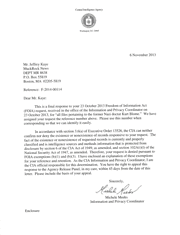
Search for Info/News on Torture

Google Custom Search
Add to Google ">View blog reactions

This site can contain copyrighted material, the use of which has not always been specifically authorized by the copyright owner. I am making such material available in my effort to advance understanding of political, human rights, economic, democracy, scientific, and social justice issues, etc. I believe this constitutes a 'fair use' of any such copyrighted material as provided for in section 107 of the US Copyright Law. In accordance with Title 17 U.S.C. Section 107, the material on this site is distributed without profit to those who have expressed a prior interest in receiving the included information for research and educational purposes. For more information go to: http://www.law.cornell.edu/uscode/17/107.shtml. If you wish to use copyrighted material from this site for purposes of your own that go beyond 'fair use', you must obtain permission from the copyright owner.