Showing posts with label anthrax. Show all posts

Thursday, December 21, 2017

Updated: The Suppressed Report on 1952 U.S. Korean War Anthrax Attack


[Link to download PDF of the document above]

With the U.S. threatening a pre-emptive attack on North Korea for the latter's pressing development of a nuclear warfare capability, it is more imperative than ever that the history of the U.S.-North Korea conflict be made available to the world, the better to assess the claims made by both sides.

While many see North Korea as a dictatorship run by a madman or evil, others see a rational government - dictatorial, yes - that seeks to defend itself against a power that once obliterated its country in war, and threatened it with nuclear weapons. Indeed, even today, the U.S. says it will not forego using nuclear weapons against North Korea and even executes military war games with South Korea that involve practice runs with nuclear bombers almost up to the border of North Korea.

Back in the early 1950s, during the Korean war, until the Soviets began to fly MiGs over the Korean peninsula in defense of the North Koreans, the U.S. had near unconstrained freedom of airspace over North Korea and China, and in particular, dropped hundreds of thousands of tons of Napalm on North Korea, wiping out nearly every city, and contributing to over a million civilian deaths, maybe 15% of the entire population. Because of the relentless bombing, the people were reduced to living in tunnels. Even the normally bellicose Gen. MacArthur found the devastation wreaked by the U.S. to be sickening.

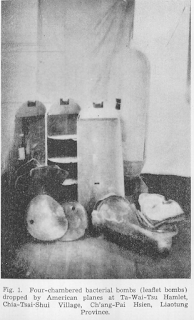
Most controversially, both North Korea and China maintain that the U.S. used biological or germ warfare weapons against both North Korea and China during the Korean War. The U.S. has strenuously denied this. Captured U.S. flyers who told their North Korean and Chinese captors of the use of such weapons were told under the threat of courts martial to renounce such confessions after they were returned to U.S. custody. They all did so.

To convince the world of the truth of their claims, the North Koreans and Chinese, sponsored a purported independent commission, using the auspices of the World Peace Council, gathering together a number of leftist scientists from around the world. Most surprisingly, this commission, which came to be known as the International Scientific Commission, or ISC, was headed by one of the foremost British scientists of his time, Sir Joseph Needham. The ISC travelled to China and North Korea in the summer of 1952 and by the end of the year produced a report that corroborated the Chinese and North Korean claims that the U.S. had used biological weapons in an experimental fashion on civilian populations.

This posting is not meant to examine the full range of opinions or evidence about whether or not the U.S. used biological weapons in the Korean War. It is instead an attempt to publish essential documentation of such claims, documentation that has been withheld from the American people, and the West in general, for decades. I am publishing here Appendices AA and BB from the Report of the International Scientific Commission for the Investigation of the Facts Concerning Bacterial Warfare in Korea and China.

I introduced that report to the world and posted the report itself online back in January 2015. But the report itself is only some 60-odd pages long, and I was unable at that time to post or publish any of the voluminous appendices that documented the claims of the report. (I am reposting the original executive summary report at the close of this post, for reference sake.) The ISC appendices are crucial in assessing the claims made in the report, and the later denials from U.S. and other allied governments, such as Great Britain.

Appendices AA and BB concern claims of air attacks against various villages in Northeastern China in the Spring of 1952. Using the same kinds of insect (fleas, beetles, etc.) and related "vectors" (such as dropping feathers or rodents) that were studied intensely by Imperial Japanese military scientists and doctors as part of the infamous Unit 731 program. In a matter of proven historical record, but still largely unknown in the United States, the Pentagon and U.S. intelligence agencies, with knowledge of scientists working out of the Army's Ft. Detrick chemical and biological warfare labs, gave amnesty to the Unit 731 war criminals, who conducted their biological warfare experiments on live prisoners, who were incinerated after the Japanese scientists were done with them.

In the executive report, the ISC examined claims of a biological warfare attack in the town of "K'uan-Tien, which lies in the southeastern part of Liaotung province near the Yalu River," as well as a number of other "localities in the provinces of Liaotung and Liaohsi." They looked in depth at five "fatal human cases of respiratory anthrax and haemorrhagic anthrax," including "a railwayman, a tricycle-rickshaw driver, a housewife, a school-teacher, and a farmer." They considered the extreme, indeed, unprecedented appearance of this disease in that part of the world, and the fact that respiratory or inhalational anthrax had earlier been the subject of research by Ft. Detrick scientists. The analysis included laboratory examination from the bodies and from insects discovered in the area and believed to be spreading the disease, after being dropped by U.S. aircraft.

The ISC concluded (pg. 34 of the summary report, which can be accessed at end of this post):
On the basis of the evidence presented, and on their own searching and prolonged interrogation of a considerable number of witnesses, both medical and lay, the Commission was compelled to conclude that the delivery of various biological objects contaminated with anthrax bacilli to many places in the two Chinese provinces had taken place, and that this had given rise to a number of cases of a mortal infection hitherto unknown in the region, namely pulmonary anthrax and ensuing haemorrhagic meningitis. Eye-witness statements impossible to doubt indicated American airplanes as the vehicles of delivery of the infected objects.
The U.S. denied all biological warfare charges. They demanded the International Red Cross be allowed to independently examine the evidence and document the charges. But unknown to all, in secret meetings of top U.S. Pentagon, the CIA, and State Department officials, gathered together as the U.S Psychological Strategy Board, agreed that there never would be any independent investigation, as the Eighth Army was conducting operations during the Korean War which if they became known ("e.g. chemical warfare") "could do us psychological as well as military damage.” (See full article here.) The scholars Stephen Endicott and Edward Hagerman found similar evidence of an unwillingness to really examine the North Korean/Chinese/Soviet charges in their 1998 book on the BW controversy.

The controversy has simmered every since.

But convergent evidence of the charges was made in Chapter 13 of the 2006 book Deadly Cultures. Entitled "Allegations of Biological Weapons Use," the chapter was written by Martin Furmanski and Mark Wheelis. While these authors were highly dubious of the claims of U.S. biowarfare, they couldn't discount the anthrax charges. Primarily, they found that the description of inhalational anthrax made at this time - for instance, the wide range of incubational periods reported for the Chinese cases - came before a detailed scientific examination of such cases of anthrax had already been studied. But the ISC description was peculiarly apt and prescient. Furmanski and Wheelis concluded that the deaths documented by the ISC as due to inhalational anthrax had to be real and not faked.

"These results must have been from real human inhalation anthrax cases, since the information did not exist in 1952 to have allowed fabrication using textbook or medical literature sources," Furmanski and Wheelis wrote. (See pg. 260 of Deadly Cultures.)

But I should note, Furmanski and Wheelis in the end did not conclude this was full evidence of biological weapon attack. Indeed, they concluded it must have been of natural origin, though how such a coincidence of widely dispersed, unprecedented appearance of the disease occurred coinicentally with charges of biowar attack.

What they solely relied on for their conclusion was an April 2004 "personal communication" from a U.S. scientist that isolates from the B. anthracis samples from China, which by inference included those from the 1952 putative attack were "subjected to genomic analysis, and all were clearly indigenous to China." Furmanski and Wheelis believe that despite the "highly suspicious" nature of the inhalation anthrax cases discussed in the 1952 ISC Needham report, the genomic analysis proved that the anthrax cases reported to the ISC were of natural origin, and not from a U.S. biological warfare attack.

I have been in touch with all the people involved in this supposed genomic analysis, and while I find it odd that nothing was every published on this genomic or DNA analysis, I will leave a full analysis of the refutation of the ISC report on this score for a future and more scholarly essay. In the meantime, I have decided to publish the ISC documentation as in the West all we ever seem to get are what Cold War scholars publish. Even when critics of the U.S. historical account publish, the actual documentation is thin. This leaves us reliant on the authority of the scholars, which is an extraordinary situation.

[Update, December 21, 2017 - In spring 2017 I contacted U.S. anthrax expert Martin Hugh-Jones, whom Furmanski and Wheelis had referred to in their book as the source of a "genomic analysis" that showed the inhalation anthrax cases in China could not have come from U.S. stocks of anthrax. Professor Hugh-Jones referenced a Chinese scientist, Wang Bingxiang, who worked on bacterial vaccines at the Langhou Institute of Biological Products, who Hugh-Jones said had supplied samples of the 1952 anthrax cases to the Special Pathogens Lab (SPL) at the School of Veterinary Medicine at Louisiana State University.

I subsequently contacted both a U.S. scientist, Kimothy Smith, who Professor Hugh-Jones said worked on the identification of the anthrax strains brought from China to the SPL, and Mr. Wang in China. Neither of them backed up Hugh-Jones' story that the 1952 anthrax strain had been identified, much less worked on. Wang denied knowing anything even about it. Prof. Hugh-Jones subsequently told me in an email, "And as it seems that no one, including the Chinese, have any cultures from the 1952 'incident' (true or false) matters must remain at that. It was a time rife with governmental disinformation, especially by the Chinese & Soviets, so one must be cautious with any personal conclusions."

Professor Hugh-Jones did not reference any possible governmental disinformation from the U.S. side. But the failure to dismiss the inhalation anthrax accounts from the ISC, which Furmanski and Wheelis found so compelling that only the presence of supposed "genomic analysis" - now discredited - could dispel, means that hard evidence indeed exists to prove the presence of U.S. biological warfare attack upon China, and most likely North Korea, during the Korean War.

For his part, Professor Furmanski in correspondence to me maintains for other reasons that the North Korean and Chinese claims of germ warfare attacks were a hoax. He does this for a number of reasons, and seems among them to embrace the fairly recent publication of a Chinese official at the time, Wu Zhili, who had a posthumous publication stating the germ warfare attacks were a "false alarm," one which was then amped up for propaganda reasons into a full-scale campaign around the ostensibly false charges.

Few have embraced my main concerns, which center around the suppression of information in general around this historical incident. I cannot speak to North Korean or Chinese suppression, but I can document and obviously comment about the suppression by the U.S. and its allies, as information slowly is obtained about them. I can also encourage others to pursue original documents and do their own analysis, as I have done.

For his part, despite much professional obloquy, Dr. Needham maintained until the day he died that the U.S. had indeed used biological weapons against the North Koreans and the Chinese. His investigation went far beyond that detailed in this essay, and concerned more than the dissemination of anthrax.

Was there any fraud involved in Chinese, North Korean, or Soviet evidence of germ warfare attacks by the U.S.? I think it's possible there was, just as a suspicious patient might exaggerate symptoms to get the attention of a doctor they fear isn't taking them seriously. The importance of the suppressed ISC report is the attention given to many multiple sources of evidence. Sir Joseph Needham wasn't one of the leading scientists of his day for nothing. He understood the scientific approach to evidence.]

I hope that the publication of this material will lead to a greater effort by U.S. and European media and other commentators to assess the real history of U.S. and North Korean and Chinese relations, the better to counter the claims of the hawkish Trump administration and Pentagon spokespeople, who are threatening to plunge this country, and possibly the world, into a terrible new war, painting the North Koreans as unreasonable and dangerous people. But any fair historical account will see that while not by any means perfect, the North Korean regime has plenty to complain about and fear from U.S. intervention.


[Link to download PDF of the document above]

Original version of this article, without update, was published on April 26, 2017

Thursday, March 24, 2011

Psychologizing Bruce Ivins: Who are the Amerithrax Behavioral Analysis Experts?

The investigation by the "Amerithrax Expert Behavioral Analysis Panel" on "the mental health issues" of accused anthrax mailer Dr. Bruce Ivins purports to have been undertaken with "no predispositions regarding Dr. Ivin's guilt or innocence." Yet the report (PDF here of the released partial redacted version) says the Panel's review of sealed psychiatric records "does support the Department of Justice's (DOJ's) determination that he was responsible.

In a separate article by Marcy Wheeler earlier today, she points out that the report totally accepts the allegation that the anthrax spores originated from flask RMR-1029, and that therefore Ivins had "the motivation and the means" to carry out the attack. Of course, as Wheeler notes, the National Academy of Sciences recently said that there is insufficient scientific evidence to back up DOJ's conclusion regarding this. (Jim White also wrote about the NAS report when it first came out.) Wheeler's article also points out other inconsistencies and illogical aspects of the Panel's report.

I wish to concentrate a bit more on the idea this panel had no "predispositions." Unfortunately, just as the released summary leaves out over 250 pages of the report, including its case narrative and "behavioral analysis and interpretation", that unreleased portion also leaves out the biographies included about the Panel's members. As a result, the lack of presented evidence makes it extremely difficult to comment about the conclusions noted in the Executive Summary regarding Ivins' supposed penchant for "revenge", his purported tendencies towards exploitation and manipulation (as they allege), his being "skilled in deceit", his "obsessions," his "strange and traumatic childhood," and "his desperate need for personal validation," among other post hoc conclusions made by the Panel's authors.

While the lack of evidence makes it difficult to swallow what sounds like character assassination, we do at least have the list of panel members by which to examine the neutral disinterest the forensic psychiatric examination should demand of those who are investigating the background of Dr. Ivins. Instead, what a brief review of the panel's bona fides reveals is an overwhelming stacking of this "expert" panel by doctors and others who are deeply beholden to government interests, and in particular to security agencies, including those involved in bioterrorism security. For such individuals, it is difficult to see that they would buck the position of the FBI and DOJ that Ivins was guilty.

Who are the Behavioral Experts?

As an article at the Los Angeles Times points out, without further elaborating, they weren't all behavioral experts:

The behavioral panel was formed in late 2009 at the suggestion of Saathoff, people familiar with the matter said. Saathoff appointed the remaining panelists: five other psychiatrists, two officials from the American Red Cross and a physician-toxicologist.

The addition of the Red Cross members is curious, especially since Ivins is accused of joining the Red Cross at the time of the anthrax mailings to gain self-importance as an anthrax expert, and to appear "as a prophet and as a defender of the nation" to a woman he was reportedly obsessed with. Indeed, the report has a nine-page appendix dedicated to Ivins and the Red Cross, which has not been published publicly.

In any case, one of the Red Cross personnel is in fact the vice-chair of the Panel, Gerald DeFrancisco, listed as President, Humanitarian Services, American National Red Cross. DeFrancisco is also on the Board of Directors of Research Strategies Network (RSN), the 2008-founded “professional services organization... whose missions support the national security of the United States and its allies.” RSN is the publisher and copyright holder of the Expert Panel's report. The Panel Chair is Dr. Gregory Saathoff, who is also President of RSN, while the Chairman of RSN is former Reagan-era Attorney General Edward Meese.

Saathoff specifically cites "guidance" by Meese in the making of the Ivins report, as well as that of another RSN board member, former U.S. senator Chuck Robb. Among other things, Robb is former President Bush, Jr.'s co-chairman to the Commission on the Intelligence Capabilities of the United States Regarding Weapons of Mass Destruction. He is also on the board of Defense Department-DARPA-linked Mitre Corporation. Other RSN board members are also linked to the military. As far as DeFrancisco goes, it's hard to know what expertise he brings to the Panel, as formerly he worked at AT&T as Vice President of Business Innovation, and Executive Vice President of Broadband & Internet Services, as well as CEO at AT&T Alascom, a $300 million AT&T subsidiary.

The other Red Cross member of the panel is Joseph C. White, listed as Senior Vice President, Chapter Operations, American National Red Cross. White is a banker, the former Chairman and CEO of Boatmen’s Bancshares, and Vice President in Investor Relations at Fleishman-Hillard. He retired from Bank of America. But he was also "chief executive officer of the St. Louis Area Chapter of the Red Cross," when he "was sworn in January 10 [2008] as a member of the Emergency Response Senior Advisory Committee. The committee is one of five panels that advise the Homeland Security Advisory Council (HSAC), which provides recommendations to DHS Secretary Michael Chertoff on homeland security."

Among the actual doctors, we have Dr. Sally C. Johnson, listed as Professor, Department of Psychiatry at University of North Carolina, Chapel Hill. She may be best known as one of the forensic psychiatric examiners of Theodore Kaczynski, but more recently, she testified regarding the fitness of supposed Al Qaeda-linked suspect Dr. Aafia Siddique to stand trial for attempted murder. In her written report on Siddique, "Johnson left a warning... saying that in spite of Siddiqui’s frail and timid appearance – she has weighed as little as 90 pounds – ‘her potential for aggression towards herself or others might be underestimated.’"

Then there is Dr. David Benedek, listed as Professor, Department of Psychiatry, Uniformed Services University School of Medicine. Dr. Benedek has served at Guantanamo, although we don't know in what capacity. He was also acting as an army psychiatrist on the panel which consulted with others about Nidal Hasan in Spring 2008. Apparently, they failed to find him dangerous at that time, for which I can't fault Dr. Benedek, as it is a notorious fact that forensic evaluations of dangerousness are terribly unreliable, eliciting high levels of false positives, and a failure to distinguish who will or won't be dangerous. Unfortunately, the panel's executive summary never refers to this poor forensic record in determining who is or isn't dangerous while they put forth their certain but "circumstantial" evidence regarding the state of mind of the late Dr. Ivins.

Interestingly, Dr. Benedek was on a 2003 panel presentation on "Psychological Reactions to Chemical, Biological, and Radiological Events" at the Annual Meeting of Psychiatry and the Law, along with another military psychiatrist, who was at Guantanamo, Col. Elspeth Ritchie, who was Psychiatry Consultant to the US Army Surgeon General, and involved in psychiatric examinations for the government of at least a few of the detainees to come before the military commissions, including Salim Hamden.

Another panel member, Dr. Ronald Schouten (MD and JD) is listed as Director of the Law and Psychiatry Service, Massachusetts General Hospital, Harvard University School of Medicine. A forensic psychitrist, Dr. Schouten also "served as a subject matter expert for the Biological Threat Classification Program of the Department of Homeland Security and has testified before the Congressional Subcommittee on Prevention of Nuclear and Biological Attack.

And yet another panel member has government connections, as Dr. Anita Everett, listed as Section Director, Community and General Psychiatry at Johns Hopkins University School of Medicine, is a senior medical advisor on psychiatric issues at the Substance Abuse and Mental Health Services Administration in Rockland, Maryland.

The chair of the Expert Panel is Gregory Saathoff MD, who is listed as Executive Director of the Critical Incident Analysis Group (CIAG) at the University of Virginia. An entire article could be spent on Dr. Saathoff and the CIAG, which was founded in the wake of the Waco events. I found it kind of interesting that CIAG's Spring 2001 conference was entitled "Public Responsibility and Mass Destruction: Facing the Threat of Bioterrorism," and considered among the various terrorist possiblities "potential anthrax attack."

But probably most apposite for the point of this article is Dr. Saathoff's links to the FBI.

In 1996 he was appointed to a Commission charged with developing a methodology to enable the FBI to better access non-governmental expertise during times of crisis. In that regard, Dr. Saathoff has since 1996 served as the Conflict Resolution Specialist to the FBI’s Critical Incident Response Group. In this role, he consults with the Crisis Negotiation Unit and the National Center for the Analysis of Violent Crime.

I believe I have set out more than enough information here to challenge the supposed disinterest and lack of "predispositions" that supposedly animated this group of "behavioral experts." In fact, it's hard to believe that any group thus constituted could have or would have challenged the conclusions of the DOJ. Reading the Executive Summary, it's apparent how their case is built on a flimsy and prejudiced analysis, as they consistently refer to "circumstantial" evidence, as they construct a dire portrait of a man who is portrayed as "clever," who "cultivated" a benign presence, while masking his "criminal thoughts."

Since someone saw fit to show the entire report to the L.A. Times, perhaps the government would want to have this report examined by peer-review. It wouldn't be so hard to find individuals not linked to the government, but capable of the requisite security clearances. But then, the government hasn't taken the anthrax terrorism really seriously, leading many to conclude, rightly or wrongly, they have something to cover up. In any case, this latest "expert behavioral analysis" isn't going to convince anyone, as it is stacked with government-linked authorities, many of them to DoJ, DHS, or the Pentagon.

Wednesday, August 20, 2008

Greenwald on the Anthrax Case & Media Subservience to Government Lies

Glenn Greenwald has been reporting in some depth on the FBI accusations that Fort Detrick scientist Bruce Ivins -- dead purportedly by his own hand -- was the sole attacker in the anthrax scare that followed after 9/11. If you haven't already been following Greenwald's coverage on this, then you owe it to read his columns.

In his latest piece, the former civil rights litigator and author of "How Would a Patriot Act? excoriates the servile U.S. press, whose primary role is "to serve government sources and amplify their claims, not to investigate their veracity." For instance, Greenwald describes how even weeks after the FBI claimed they had "solved" the anthrax case, they are still concocting timelines to make the "facts" fit their theory.

From Glenn's latest essay:
Being able to link an accused to the scene of the crime is the centerpiece of any case. That's why the FBI leaked its "administrative leave" theory to the Post and other media, which then spent all day highlighting the "incriminating fact." Yet the FBI's own theory made no sense and was immediately debunked, and so, in response, they just changed their theory to some completely different set of speculations the way political pundits have new "breaking news" every five minutes about who the likely Vice Presidential picks are. Does that behavior allow anyone to have confidence in what the FBI is saying?
The anthrax attacks post-9/11 played a huge role in amping up the terror scare, and consequently, the bellicose actions of the Bush Administration abroad, along with a crackdown on civil liberties at home (warrantless wiretapping, Patriot Act, use of torture, etc.)

The attempt to close the books on the anthrax investigation with the suicide-death of the government's prime "suspect" doesn't pass the smell test. I wish I'd had more time to spend looking into and writing about this essential story. It's comforting that Glenn Greenwald and others are on the job, especially as the big-time media has proven so useless, or craven (please feel free to pick your own modifier).

The Ivins case immediately reminded me of the ancient case of another suspicious Ft. Detrick "suicide," CIA-MKULTRA researcher Frank Olson. Another book on the Olson story, by researcher H. P. Albarelli, is due out later this year. In the meantime, interested readers should check out the series Albarelli wrote for Crime Magazine back in 2002 on the Olson case. And if that weren't enough motivation, consider that both Dick Cheney and Donald Rumsfeld were involved in later governmental efforts to cover-up the truth about Olson's death (as told in a related book published by Gordon Thomas earlier this year).

From the introduction to the Albarelli articles on Olson:
In 1975, 22 years after CIA Scientist Frank Olson allegedly committed suicide by jumping through a closed window on the 10th floor of his room in a New York City hotel in 1953, shocking new details about his death were revealed in the findings of a special Presidential Commission investigating the CIA. The case remained dormant from then until 1996 when Manhattan District Attorney Robert M. Morgenthau opened a new criminal investigation into Dr. Olson's death. Morgenthau's decision was spurred by the startling discoveries of noted forensic sleuth James Starrs of George Washington University, who took on the case at the behest of Olson's family. Following Starrs's many revelations, Morgenthau assigned the Olson case to his newly created Cold Case Unit headed by Stephen Saracco and Daniel Bibb.

Search for Info/News on Torture

Google Custom Search
Add to Google ">View blog reactions

This site can contain copyrighted material, the use of which has not always been specifically authorized by the copyright owner. I am making such material available in my effort to advance understanding of political, human rights, economic, democracy, scientific, and social justice issues, etc. I believe this constitutes a 'fair use' of any such copyrighted material as provided for in section 107 of the US Copyright Law. In accordance with Title 17 U.S.C. Section 107, the material on this site is distributed without profit to those who have expressed a prior interest in receiving the included information for research and educational purposes. For more information go to: http://www.law.cornell.edu/uscode/17/107.shtml. If you wish to use copyrighted material from this site for purposes of your own that go beyond 'fair use', you must obtain permission from the copyright owner.