Showing posts with label Shiro Ishii. Show all posts

Saturday, May 20, 2017

Department of Justice Official Releases Letter Admitting U.S. Amnesty of Japan’s Unit 731 War Criminals

[The following is a portion of an article published initially at Medium.com. The length of the article (over 7000 words) precludes my reposting the full essay here. But approximately half is posted below. Please follow this link to read the entire work.]

Upon my request, both the Department of Justice (DOJ) and the Simon Wiesenthal Center have released copies of a December 1998 letter from DOJ official Eli Rosenbaum to Rabbi Abraham Cooper of the Simon Wiesenthal Center. In the letter, Rosenbaum admitted to Cooper that after World War II the United States government had classified records pertaining to a Japanese military unit that engaged in biological warfare experimentation and field trials on humans.

The letter, one of two released to this author, confirmed the U.S. "essentially assisted Japan in covering up the atrocities perpetrated by the unit.”


In 1998, Rosenbaum was director of DOJ’s Office of Special Investigations (OSI), while Rabbi Cooper was associate dean of the Wiesenthal Center. The occasion for the correspondence was the Wiesenthal Center’s sponsorship of a “Trans-Pacific Video-Conference on Japanese Wartime Atrocities,” held at the Center’s own Museum of Tolerance on August 16, 1998.[1]

Reported briefly in the press at the time [2], Rosenbaum’s letter of December 17, 1998 ended any doubts that the U.S. government had given scientists and military personnel associated with the notorious Japanese biological warfare program of the 1930s-1940s “immunity [from prosecution at the International Military Tribunal, Far East] in return for their human experimentation research data.”[3]

This appears to have been the first time that any U.S. government official admitted publicly and officially that the U.S. had proposed an amnesty for the members of Japan’s Unit 731 and assorted components, known to have murdered thousands of prisoners in illegal biological experiments, and hundreds of thousands of soldiers and civilians in biological warfare operations predominantly in China, but also the Soviet Union, from 1939 until nearly the end of World War II.

While Rosenbaum’s letter was quoted in the press, and in a 2002 Congressional Research Service report, the letter itself, and a November 1998 letter to Cooper also on the subject of Japan’s war crimes, were never released publicly. These letters are now available with the publication of this article, along with supporting documentation that until now was also not available.


This article looks at some of the salient issues in regards to aspects of these new documents, including the motivation for the U.S. amnesty action, the question of experimentation on U.S. and allied prisoners of war (and its possible cover-up), and the question of assigning culpability to those involved. The article concludes with remarks on these matters by both Rosenbaum and Cooper, who were interviewed for this article in Spring 2013. (The delay in publishing this information was occasioned by personal matters.)

Unit 731

Beginning with John Powell’s 1980 article, “Japan’s Germ Warfare: The US Coverup of a War Crime,” and a subsequent article in the October 1981 Bulletin of Atomic Scientists, “A Hidden Chapter in History”, revelations concerning long-hidden or suppressed aspects of Japanese war crimes began to surface in the U.S. and Western press. Powell shocked the American public by writing about and producing documentary evidence of a cover-up of “Japan’s use of biological warfare against China and the Soviet Union.”[4]

The primary Japanese military unit associated with the biological warfare research and production of weaponry was known as Unit 731, although there were a number of other military units also involved. Powell (1981) wrote, “The American government’s participation in the cover-up, it is now disclosed, stemmed from Washington’s desire to secure exclusive possession of Japan’s expertise in using germs as lethal weapons.”

The original promise of amnesty for information was made after a discussion some months after the end of World War II between the Ft. Detrick’s Colonel Murray Sanders and General Douglas MacArthur, according to numerous accounts of Unit 731’s history. The finalization of such a deal, however, took a few years, and was not without controversy within government circles.

Powell (1980) quoted a July 1, 1947 memo from two U.S. doctors associated with bacteriological research that Japanese researchers had thousands of slides of human tissues taken from their experiments on prisoners. The slides and reports from the Unit 731 researchers were available if the U.S. could provide assurances the Japanese doctors and scientists would be saved from war crimes prosecution. The two doctors, Edward Wetter and H. I. Stubblefield argued that since "any 'war crimes' trial would completely reveal such data to all nations, it is felt that such publicity must be avoided in the interests of defense and national security of the U.S."

The vagueness of the language – “it is felt” – appears to indicate their message was something discussed comprehensively in their circle, in particular by scientists from the Army’s Ft. Detrick, which was the center of a major crash program in biological warfare research begun during the war, and intelligence officers.[5]  Ft. Detrick personnel had been in charge of the debriefing of the Unit 731 doctors and scientists, while various documents speak to the sharing of such information with intelligence agencies.

According to Powell, Wetter and Stubblefield furthermore indicated “the knowledge gained by the Japanese from their experiments ‘will be of great value to the U.S. BW research program’ and added: ‘The value to the U.S. of Japanese BW data is of such importance to national security as to far outweigh the value accruing from war crimes prosecution.’”

The furor over Powell’s revelations peaked in the mid-1980s with public controversies over Japanese biological warfare (BW) experiments on U.S. and allied prisoners of wars. Congressional investigators ignored evidence of such experiments on U.S. POWs. It wasn’t until the publication of Linda Goetz Holmes’s book, Guests of the Emperor: The Secret History of Japan's Mukden POW Camp (Naval Institute Press, June 2010) that any mainstream historian accepted such experiments even took place. The entire episode is still ignored in the press accounts of World War II history.

Subsequently, the scandal around Unit 731 appeared to die down publicly, until it was revived approximately a decade later. In 1995, there were two major narratives published on Unit 731 and the U.S. immunity deal. One was an article by Nicolas Kristof in the New York Times. The other was historian Sheldon Harris’s book, Factories of Death: Japanese Biological Warfare, 1932-45, and the American Cover-up.[6]  The publication and controversy surrounding the publication of Iris Chang’s book, The Rape of Nanking, in November 1997, also brought greater attention to the issue of Japanese atrocities during World War II.

Amnesty to Protect Collaboration and to Protect U.S. Biowar “Expertise”

The supporting documentation for this article includes two memoranda for the record from the early 1980s by Norman Covert, then Chief of Public Affairs and historian for the U.S. Army at Ft. Detrick, Maryland. Rosenbaum’s December 17 letter had quoted liberally from the latter of these two memoranda.[7]  While it is worth considering the portions Rosenbaum did not quote, the selection revealed to Rabbi Cooper, taken from Covert’s May 5, 1982 Memorandum for the Record, explained the U.S. rationale for the Unit 731 amnesty:
The Joint Chiefs of Staff decided to keep Top Secret any information about the Japanese Biological Warfare Program. The Joint State, War, Navy Coordinating Committee expressed its desire that the information be retained in US hands exclusively and certainly it should be kept from the Soviet Union....

In the [June 26, 1947] memorandum written by Dr. Edward Wetter and Mr. H. I. Stubblefield[8] for the State, War, Navy Coordinating Committee for the Far East, the decision not to prosecute LTG [Lieutenant General Shiro] Ishii [founder and leader of Unit 731 and the biological warfare program] was discussed. “An agreement with Ishii and his associates that information given by them on the Japanese BW program will be retained in intelligence channels is equivalent to an agreement that this government will not prosecute any of those involved in BW activities in which war crimes were committed.”

.... Scientists in the US program said the information was not of significant value, but it was the first data in which human subjects were described. It indicated the Japanese program reached a level of expertise in 1939 that was never advanced because of lack of resources. Any prosecution of LTG Ishii and his associates would have exposed the Japanese capability in addition to US expertise. It would have been difficult to retain such information in US-only hands in such a case. The Joint Chiefs of Staff and SCAP [Supreme Command Allied Powers] agreed there would be little gained by such prosecution and deferred, offering LTG Ishii immunity in exchange for detailed information. [bold added for emphasis]
The Covert memorandum was certainly a kind of spin, although Mr. Covert himself may not have been aware of the full extent of U.S. crimes. Even so, he admitted to this author in an interview for this article that at the time he wrote the memos he was concerned mainly with “protecting Ft. Detrick[‘s]” reputation. The May 5 memo, and an earlier one Covert wrote on November 17, 1981, were a response to media attention following the Powell disclosures. The November 17 memo was undertaken as a rewrite of the May 5 memo for the purpose of submission to the Secretary of the Army.

“News media was beating me to death on that,” Covert said, referring to the strong response to the Powell articles. “The Memorandum for the Record was to cover your ass, a record of what I had done.”

Covert added there had also been “several legislative requests” for more information on the Unit 731 material as well. He also recalled that the Department of Justice had also contacted him on one occasion during this period, although he did not remember the details. Rosenbaum indicated in his interview that DOJ had likely been involved in some capacity in the postwar discussions surrounding the granting of amnesty to Ishii and associates.

The question of the value of the Japanese data and biological samples is a matter of conjecture, while the controversy over the use of such data (and similar data from the Nazi concentration camp experiments), including use of operational knowledge in purported U.S. germ warfare attacks on North Korea and China during the Korean War, is a separate, though related issue.[9]  At one point, Covert said U.S. scientists found the Japanese research “not of significant value.” He appeared to have gotten this information from speaking to Ft. Detrick scientists still resident in the Frederick, Virginia area. In addition, Covert appeared to give little credence to evidence that came from Soviet sources.

But elsewhere, writing about Ft. Detrick representative Dr. Norbert Fell's interrogation of Shiro Ishii, Covert wrote in his November 17, 1981 memo, "The data on human testing appeared to have significant value to the U.S. BW Research programs at Camp Detrick." Some months later, in his May 5, 1982 memo, Covert concluded, “It is certain the Japanese had a full-scale BW effort and achieved a level of expertise working with many traditional BW agents.”

A later report by Doctors Edwin Hill and Joseph Victor, also from Ft. Detrick, was quite direct when considering the value of getting the Unit 731 data. “Such information could not be obtained in our own laboratories because of scruples attached to human experimentation,” they wrote.[10]

To conclude the discussion on the value of Unit 731’s data, it is worth noting a May 1947 memo from MacArthur’s office to the War Department and Major General Alden Wiatt of the Chemical Warfare Service on the BW human experiments, “confirmed tacitly by Ishii” to interrogators. The memo was obtained by author William Triplett, and also describes the intersection of the amnesty agreement with unnamed intelligence agencies:

"Data already obtained from Ishii and his colleagues have proven to be of great value in confirming, supplementing and completing several phases of U.S. research in BW, and may suggest new fields for future research.... For all practical purposes an agreement with Ishii and his associates that information given by them on the Japanese BW program will be retained in intelligence channels is equivalent to an agreement that this Government will not prosecute any of those involved in BW activities in which war crimes were committed."[11]

MacArthur’s command told the War Department, “valuable technical BW information as to results of human experiments and research in BW for crop destruction probably can be obtained….”

Ft. Detrick’s Norbert Fell resumed interrogations of Shiro Ishii two days after this memo was sent....

[To see the rest of this article, click through to read at Medium.com - Relevant footnotes for portion published here are posted below - JK]

[1] China News Daily, Aug. 14, 1998, http://www.cnd.org/CND-US/CND-US.98/CND-US.98-08-14.html. CNET reported on the conference at the time: URL http://news.cnet.com/2100-1023-214541.html. See also the original announcement of the event by the Simon Wiesenthal Center, archived online at http://web.archive.org/web/19981203135255/http://events.broadcast.com/events/swc/nanjingmassacre/ (all accessed May 14, 2017).

[2] See Stars and Stripes, week of March 15 – 28, 1999, vol. 122, no. 6, reposted online at http://www.geocities.com/Heartland/Plains/5850/deathcamp.html (accessed May 14, 2017).

Reference was also made in a Congressional Research Service report by Gary K. Reynolds in December 2002, “U.S. Prisoners of War and Civilian American Citizens Captured and Interned by Japan in World War II: the Issue of Compensation by Japan,” online at http://web.archive.org/web/20080406073324/http://www.history.navy.mil/library/online/usprisoners_japancomp.htm (accessed May 14, 2017).

[3] Letter, Eli Rosenbaum to Abraham Cooper, December 17, 1998.

[4] Powell’s 1980 article was published in the Bulletin of Concerned Asian Scholars, “Japan’s Germ Warfare: The US Coverup of a War Crime” (Oct.-Dec. 1980, vol. 12, no. 4.) See URL: http://criticalasianstudies.org/assets/files/bcas/v12n04.pdf (accessed May 14, 2017).

Powell’s 1981 article is available online, reproduced as part of the Congressional Record on November 10, 1999, http://www.fas.org/sgp/news/1999/11/feinstein.html (accessed May 14, 2017) Powell died in Dec. 2008.

In the middle 1970s, John Saar at the Washington Post wrote a story, “Japan Accused of WW II Germ Deaths” (Nov. 19, 1976), that described a Japanese documentary by Haruko Yoshinaga, aired by the Tokyo Broadcasting System on Unit 731. “Japanese scientists killed at least 3,000 Chinese prisoners in World War II in bacteriological warfare experiments and escaped prosecution by sharing the findings with US occupation forces…. Press officers at the US Defense and Justice Departments said they had no information on the charges but would investigate,” Saar wrote. (See URL: http://news.google.com/newspapers?nid=1499&dat=19761119&id=5E0aAAAAIBAJ&sjid=XCkEAAAAIBAJ&pg=6053,6138361 - accessed May 14, 2017) But no one in the Western press pursued the story further until Powell published his first article four years later.

The impact of Powell’s expose can be gauged by the fact that 60 Minutes interviewed Powell for an on-air segment, “War Crime,” on April 4, 1982. The transcript for this episode is available beginning on pg. 352 in this large PDF file online: URL http://philippine-defenders.lib.wv.us/pdf/bios/sandy_and_search_for_truth.pdf.

Morley Safer narrated: "During World War II, the Japanese military experimented with germ warfare. Their guinea pigs were Chinese, Russian and American prisoners of war. For a variety of reasons, the American government kept it all a secret."

[5] The U.S. World War II program in both chemical and biological warfare is discussed in Robert Harris and Jeremy Paxman, A Higher Form of Killing: The Secret History of Chemical and Biological Warfare, Random House, 2002.

[6] Nicolas D. Kristof, “Unmasking Horror -- A special report. Japan Confronting Gruesome War Atrocity,” New York Times, March 17, 1995, URL: http://www.nytimes.com/1995/03/17/world/unmasking-horror-a-special-report-japan-confronting-gruesome-war-atrocity.html (accessed May 14, 2017).

Routledge published an expanded, revised version of Factories of Death in 2002. Harris died a few months later.

[7] My thanks to Mr. Norman Covert for sharing certain documents. The attempt to obtain the documents through official channels is a story in itself. A DoD spokesman had referred my query to Fort Detrick. Ft. Detrick’s FOIA office referred me to the National Archives. But the documents did not apparently exist there either. They may or may not constitute documents that Mr. Covert claims were destroyed by order of Ft. Detrick’s commanding officer in 1998.

[8] “Mr. H. I. Stubblefield” was in fact Dr. Henry I. Stubblefield, a bacteriologist who we know, at least in 1954, was on the Chemical Corps Advisory Council, according to an in-house history of Ft. Detrick written by Norman Covert. See URL: http://www.detrick.army.mil/cutting_edge/chapter09.cfm. Coincidentally, along with two other researchers, he had co-authored with Andrew C. Ivy an article in 1934, “Protective Action of Sodium Thiocyanate against Dysentery Toxin (Shiga): An Experimental Study in Dogs and Rabbits.” Ivy was later to be a major figure testifying on medical ethics at the Nuremberg trials.

According to Powell (1980), Dr. Wetter was at the time of the SWNCC memo “Panel Director” of the “Committee on Biological Warfare.” Powell does not say, but it appears likely this was the secret “DEF” committee, the third of three secret committees formed during the World War II years by the National Academy of Sciences and National Research Council. See URL: http://www.nasonline.org/about-nas/history/archives/collections/cbw-1941-1948.html (accessed May 14, 2017). Wetter later went to work as a civilian employee for the Office of the Assistant Secretary of Defense for Research and Development (http://www.archive.org/stream/officialregister1955unit/officialregister1955unit_djvu.txt). According to the 1955 Official Register of the United States, p. 114, Wetter worked in this office as “Executive Secretary, Committee and Panel on Special Operations.”

[9] See Till Bärnighausen, “Data generated in Japan’s biowarfare experiments on human victims in China, 1932–1945, and the ethics of using them,” Japan's Wartime Medical Atrocities: Comparative Inquiries in Science, History, and Ethics, Taylor and Francis, 2010.

On the Korean War allegations, see Stephen Endicott & Edward Hagerman, The United States and Biological Warfare: Secrets from the Early Cold War and Korea, Indiana University Press, 1998.

[10] Op. cit., Bärnighausen, p. 97.

[11] See William Triplett, Flowering of the Bamboo, Woodbine House, 1985, pp. 241-250.

[To see the rest of this article, click through to read at Medium.com]


Sunday, November 1, 2015

Google Publishes Free Ebook Facsimile of Famous Soviet 1949 War Crimes Trial of Unit 731

"Question: So it would be correct to say that all persons brought to Detachment 100 for experimental purposes, were doomed to die.
"Answer: That is so."

-- Page 325, Materials on the Trial of Former Servicemen of the Japanese Army Charged with Manufacturing and Employing Bacteriological Weapons
Google Books is to be congratulated for shining a light on one of the most heinous and yet still largely unknown episodes of World War II, via the free publication for the general public of the English language version of the materials released on the 1949 Khabarovsk War Crimes trial. Published originally by Moscow's Foreign Languages Publishing House in 1950 (see full title above), "Materials" documents the examination of the use of biological weapons and illegal human experimentation, including thousands of "terminal" experiments, by members of the Japanese military unit most closely identified with this program, Unit 731.

Written off by some as a Stalinist "show trial" -- and there undoubtedly are some elements of that here -- the facts examined at Khabarovsk have been established to be true by Western historians. "Materials" is divided into pages of documentary proof, testimony by the accused and various witnesses, the state prosecutor's case, statements by the defendant's attorneys, and of course the verdict itself. I have personally found the reading of this trial material to be one of the most amazing and emotional experiences I've ever had. You cannot read this book and be unaffected.

It may be of interest to readers to know that none of the criminals indicted and convicted were executed for their crimes, though some did die in captivity. The majority were released early, as the USSR in the 1950s trying to win political points with the post-WWII Japanese state.

The question remains: why has the worst use of biological weapons and illegal human experiments, even dwarfing the crimes of the Nazis, gone mostly unremarked for almost three generations?


The ramifications of the decision by the Japanese government to research bacteriological or "germ" warfare on prisoners, killing thousands of them via inoculation of biological toxins, and then wage biological warfare across China and parts of the Soviet Union in the 1930s and 1940s, are still resonant in Asia today. It is not unusual to hear in Chinese or North Korean propaganda references to the crimes of Unit 731. An article by AFP, and published in Feb. 2015 by Japan Times, documents the fact that "70 years on, Unit 731’s wartime atrocities fester in China’s memory."

The actions of the Japanese emperor and his Army to unleash biological warfare -- led by the infamous general Shiro Ishii -- went unremarked during the Toyko War Crimes trials at the end of World War II. The reason for this was likely due to the established fact that the U.S. made at the time a secret agreement to amnesty all the personnel involved in Japan's Unit 731, "Detachment 100," and other assorted BW experimental and operational units, with the aim of gathering all the data gathered by Japan's illegal human experiments and operational experience with biological weapons for itself.

The Soviets, stymied in their attempt to get the matter brought up at the Tokyo trials -- the U.S. dragged its feet on even letting the Soviets interview BW chief Ishii, who was under house arrest by the Americans -- turned to their own separate trial of captured personnel from Unit 731 and the Kwantung Army, spurred on by popular resentment against the Japanese imperialist army and the dreaded Kampetei, who had kidnapped hundreds of Soviet and Chinese citizens for terminal use as guinea pigs in the Unit 731 dungeons at Pingfan, Manchuria. At moments, the anger of those in attendance at trial is even noted in the proceedings.

Some of the documentary material regarding the decision by the International Military Tribunal for the Far East (IMTFE, or Tokyo War Crimes trials) not to pursue biological warfare charges against the Japanese have been published digitally online at a special site dedicated to the Tokyo trials by the University of Virginia Law Library.

The information obtained by the Americans, and, if some reports are true, in some cases the personnel, went to the U.S. Army's biological weapons labs at Fort Detrick, Maryland. (According to the official military historian at Ft. Detrick, years later documents about Unit 731 were destroyed by order of Ft. Detrick's commander, leading to Congressional action to release what documentation still existed.) During the Korean War, the Chinese and the Soviets claimed the U.S. tested use of such materials during limited biological warfare operations against North Korea and China. Famously, captured U.S. airmen confessed to such use after interrogation (leading to the "brainwashing" scare pushed by the CIA and the U.S. media in the 1950s and 1960). The U.S. strenuously denied using biological weapons, but the accusations remain, and the evidence is still being sifted, much of it still classified after 60 years.

Indeed, for historians, both amateur and professional, finding original materials, such as the prosecutor's examination of the general leading the Kwantung Army's BW unit during WWII, was next to impossible, unless you had the money and perspicacity to search out rare copies of the printed version of selected materials. Now, thanks to a review of the copyright legality of publishing this material, initiated at my request, Google has published this important historical text for all readers to use. I am grateful to them, and hope that the general availability of this important original documentation will facilitate greater recognition of the crimes that took place during World War II, and throw greater light on the aftermath of the Unit 731 episode, one that reaches far across the historical divide to allegations of the use of biological and chemical weapons today.

For further reading: Here are two articles of interest. The first from a bioethics journal, "The West's dismissal of the Khabarovsk trial as 'communist propaganda': ideology, evidence and international bioethics."

The second article is a 2001 article in The Japan Times, which recounts the trial itself: "The trial of Unit 731". The following is an excerpt from that article (the link to Harris's book is added):
Russians aware of the atrocities in Harbin were outraged. Josef Stalin responded by ordering trials of his own. On Dec. 25, 1949, the trial of Unit 731’s doctors began, with orders to finish by the end of the year, before implementation of a decree reinstating the death penalty in the Soviet Union. Stalin apparently feared that Japan might execute Soviet prisoners of war if the physicians were hanged in Khabarovsk, Permyakov said.

Nevertheless, the proceedings “were not a show trial on the Stalinist model,” said Sheldon Harris, the American author of “Factories of Death: Japanese Biological Warfare 1932-45.”

“It was a strange affair, having the trial take place in Khabarovsk rather than in Moscow or Leningrad,” Harris said. “However, the evidence presented at the trial was reasonably faithful to the facts. It was discredited in the U.S. and elsewhere because of the notoriety of earlier show trials in the U.S.S.R. Nevertheless, the [U.S.] State Department and MacArthur’s people were in a panic that some evidence would come out at the trial that there were American POWs who were [victims of] human experiments.”

Monday, October 21, 2013

Man Who Sought Truth in Mass Murder Teigin Case Dies in Tokyo

FORGET FORGET FORGET

"But something is wrong, very wrong..."

The Google Alert notified me a few days ago that, according to The Japan Times, a 54-year-old Japanese man, Takehiko Hirasawa, died alone and unheralded in Suginami Ward, Tokyo. Cause of death is unknown. When the crime that obsessed him most of his adult life occurred, he had not yet been born. He was not yet the son of two fathers. He was not yet the head of the Society to Save Sadamichi Hirasawa.

He was no one any of you were likely to have heard of. (I see The Wrongful Convictions Blog noticed Takehiko's death, though.) Nor would you likely have known about those who died in the criminal events that pursued Takehiko's conscience, all 12 of them. Nor was the story of his adopted father, sent to death row where he would never be executed, even after over 30 years, likely known to many of you, as past crimes fade like letters written upon a mystic writing pad.

The date of the crime was January 26, 1948. It was by all accounts a most extraordinary event. The intervention of the Americans into the Tokyo police investigation was documented by William Triplett in his 1985 book, The Flowering of the Bamboo. The crime story made the U.S. press over the years, only to repeatedly slip and slosh back into the inky depths of press oblivion.

Here's what went down: in the western Tokyo district of Shinjuku, 16 people had been at a Tokyo branch of the Teikoku Ginko bank (abbreviated as "Teigin"). It was closing time on a wet afternoon, the streets muddy, the city still reeling from the massive incendiary bombings by the Americans less than three years before. Now the Americans were the occupiers. Japanese imprisoned abroad during the war were still trickling back into Japan. Some of them were war criminals. Some had belonged to a notorious but ultra-secret military unit involved in biological warfare experimentation and operations.

"And now I look him in his face. It is round, very round. Like an egg."

Much later... Much, much later, decades later, we would learn the U.S. had a hand in covering up this BW unit, known as Unit 731. (Actually, there turned out to be many such units scattered throughout the Japanese Army, and included contacts at prestigious universities and medical schools.) We learned that thousands of prisoners had been experimented on, inoculated with disease, shot with poisoned bullets, exposed to germ bombs, forced to impregnate each other with syphilis, subjected to vivisection (dissected alive).

Only later, much, much later, would we learn that Japanese biological warfare operations would kill hundreds of thousands in China during World War 2. It was by far the greatest sustained use of BW in warfare up to that time, but it was hidden, giving the lie to the supposed truth that no huge conspiracy could ever succeed for long. (For most scholarly treatment of the entire historical event, though still incomplete on its own, see Sheldon Harris's book, Factories of Death: Japanese Biological Warfare, 1932-45 and the American Cover-Up.)

FORGET

"This serum is very strong and if it touches your teeth or gums it can cause great damage. So please listen and watch carefully as I demonstrate how to swallow the serum safely."

A man came to the bank. He wore an armband that identified him as a health official. He said he was a doctor. There had been a dysentery outbreak and he was working with the Americans to prevent an outbreak. Would each bank worker please take the specially-derived antidote please? The workers looked at the bottles the "doctor" had brought. They were marked in English "First Drug" and "Second Drug." They drank, and within minutes, 12 were dead. The "doctor," who also drank from the bottles but apparently was unfazed by their contents, disappeared with a small amount of cash. One woman staggered into the street and gathered the attention of stunned pedestrians.

The investigation was huge, and the Tokyo press, like all reporters, were hungry for a big story. The Japanese cops went to the Americans, who still controlled censorship over the Japanese press in Jan. 1948. Would they help suppress this story? They would, replied the Americans. (See Triplett's documents at the rear of his book.)

"Now drip the liquid onto your tongues."

FORGET FORGET FORGET

There was one other wrinkle. The cops were getting tips. According to sources, the killer was linked to Unit 731 (or perhaps an affiliated unit). This was inconvenient to say the least, because only months before, the U.S. had solidified a deal with Gen. Shiro Ishii, the head of Unit 731, and his associates and workers, to hide the evidence of their crimes in exchange for extensive debriefings about what they had discovered about using BW agents on humans. They were also getting slides of human tissues from Unit 731's experiments, at least 8,000 such slides, which were sent on to researchers at Ft. Detrick.

The Americans knew, too, that some of the experiments had likely been conducted on U.S. and British POWs at Mukden POW camp, and possibly other sites. They had kept the whole affair out of the Tokyo International Military Tribunal, even as similar crimes were being prosecuted at Nuremberg. But the "Teigin Incident" threatened to blow the whole story.
Commander in Chief, Far Eastern Command (May 47): "Data already obtained from Ishii and his colleagues have proven to be of great value in confirming, supplementing and complementing several phases of U.S. research in BW, and may suggest new fields for future research.... the only known source of data from scientifically controlled experiments showing the direct effect of BW agents on man.... The BW information obtained from Japanese sources should be retained in intelligence channels and should not be employed as 'war crimes' evidence."
But the tale of the bizarre bank killings wouldn't die. The press kept at it. The police needed to find someone to charge with the crime. They found someone. Sadamichi Hirasawa, a painter and sometime pornographer who had no experience with the military or chemistry, unless it was on how to mix a drink. He was interrogated for hours on end and confessed, though he swiftly withdrew his confession as coerced. Too late. Evidence was concealed at trial. The confession was ruled valid by the court. In the end, Sadamichi Hirasawa was sentenced to death.

But that was not the end of the story. There were appeals, denials of appeals, and after many years, a decided policy by the Japanese government never to sign an actual death warrant for Sadamichi's hanging. Appeals and decades both passed. Hirasawa died on Japan's death row in 1985. The New York Times noticed the event.

He was 95 years old, and maintained his innocence to the end. Long before he died, in 1962 a famous Japanese writer, Tetsuro Morikawa, founded a Society to Save Hirawawa. According to Triplett, "The Society filed sixteen appeals for retrial and four appeals for pardon. All had been rejected."

Astoundingly, when his health failed, Tetsuro had his son Takehiko become adopted by Sadamichi, as the latter needed "relatives" if further appeals were to be pursued. In fact, as The Japan Times story makes clear, there was still an active appeal on file, which may (or may not, as the vagaries of the law go) be moot now that Takehiko is dead.

And so it was that Takehiko Morikawa became Takehiko Hirasawa. (Morikawa died in 1983.)
"-- and now I see everyone rushing for the sink, for the tap, for the water, and now I am rushing for the sink, for the tap, for the water, and now I see people falling to the floor... people coughing, people retching, people vomiting, and now I can feel people pushing past me... and now the light is leaving us, leaving us here..."

VERGESSEN FORGET

But perhaps the reader wants to know why Takehiko's death has any significance now. I cannot tell the reader that. It is already written: in the news about threats of use of biological and chemical weapons by terrorists, by the forgotten tales of use of such weapons by the U.S. and their allies, by some small number of historians who will not let the truth die.

Even a portion of the U.S. government got into the act, late in the game then, long ago now, as judged by many for whom 9/11 "changed everything."  With 9/11 it seemed as if a veil descended on all that went before it, erasing much of history, so those in power could get away with their crimes.

But before 9/11, in 1999, there were hearings. Sen. Dianne Feinstein, who castigated Edward Snowden for the release of documents showing U.S. wrong-doing, helped sponsor the Japanese Imperial Army Disclosure Act of 1999. More information to come out. But not the name of the man who killed a dozen innocent people in one of the strangest poisoning killings on record. That name is not known. Could it have been Sadamichi Hirasawa? Takehiko Hirasawa spent his life trying to prove it was not so.

Takehiko Hirasawa is dead, following his mother by almost a year. The police have ruled out foul play, although it is clear the investigation has not even been completed. Japan is rearming. The US is telling us to fear BW from Syria and Iran (see this Washington Post article from October). The US is pushing experimentation on children to develop an anthrax vaccine to "protect" the US from biological weapons attack.

The victims at the Teikoku Ginko bank call out to us across the decades.

"I am falling, I am falling, I am falling into the grey-ness, I am falling, falling and falling away, away from the light...."

FORGET FORGET FORGET

[The italicized text is taken from David Peace's novelization of the Teigin Incident, Occupied City. The text in bold is from a document reproduced in the appendix to Triplett's book, labelled as from the War Crimes Office, Judge Advocate General's Office, US War Department. -- This posting was cross-posted at The Dissenter/FDL]

Sunday, September 8, 2013

US Covered-Up for Decades the Largest Use of Biological & Chemical Weapons in History

Crossposted from The Dissenter/FDL

There are many reasons why one should oppose the military action against Syria being planned by the Obama administration. But given that the action is being trumpeted as a righteous response to the alleged use of chemical weapons by the Syrian government, there is one reason to oppose the U.S. action that carries with it more than the usual amount of painful irony.


It is difficult to know how to introduce this subject, as it is so dark and evil, and the U.S. population has been lied to for so long about it, that I fear the initial reaction very likely can only be shock and denial. And yet, the crimes to which I am about to refer are quite well documented, and were themselves the focus of a Congressional bill in 2000 directing the National Archives to specially search for and release the relevant documentation. The deaths involved are said to approach half-a-million souls, and the injuries of many are still ongoing.

Kept "Top Secret" in "Intelligence Channels"

Here, in summary, are the primary facts. As you read this, remember that the U.S. government not only amnestied those involved in the following war crimes, but paid them for the information they could provide, and in some cases hired them. The decision was made by the Joint Chiefs of Staff, the State Department, and possibly the new CIA and the new president, Truman. The idea for the deal was prompted by General Douglas MacArthur, military doctors at Ft. Detrick, and officials in the U.S. Chemical Warfare Service. It was famously decided that all that you are about to read now would be kept as "top secret," not to be released outside "intelligence channels." And it wasn't... for about 35 years.

From the time the Japanese Imperial Army occupied Manchuria (in the early 1930s) until the end of World War II, its special Unit 731, and dozens of associated units, engaged in wide-scale lethal experiments on biological and chemical warfare, including the use of poisons for assassination purposes and the wide-scale use of herbicides. These experiments were conducted on thousands of prisoners, estimates ranging from 3000 to 20,000 POWs and civilian prisoners. The exact number may never be known.

Many of these prisoners were experimented upon without anaesthesia and by way of vivisection. The prisoners at the central Unit 731 facility at Pingfan in Manchuria were incinerated in crematoria after the military doctors were done with them. As I recently was able to derive by research into Soviet documents, some of the prisoners -- called "marutas" or "logs" by Japanese researchers and military officials -- sent for lethal experimentation by Unit 731, Unit 100, and like facilities were military or intelligence agency prisoners who could not be trusted to remain silent about the torture they had received from Japanese interrogators.

As did the Nazis, Japanese researchers conducted experiments on malaria, syphilis, and on freezing. (Japanese and German collaboration on these programs was likely closer than previously thought.) Male prisoners were forced to rape female prisoners in order to inoculate them with venereal disease. Other prisoners were forced to stay outside in sub-zero temperatures, as part of Japanese military frostbite experiments. Some prisoners were tied to stakes and had munitions loaded with bacteria exploded nearby them, the shrapnel embedding itself in their exposed skin. Other prisoners were tricked into taking food or medications that had cyanide, hallucinogenic substances, and opiates.

Though the US government specifically denies it, some of the prisoners were also US POWs held at Japan's Mukden POW camp, and possibly other camps as well. (An academic book on the subject was published by Naval Institute Press a few years ago.)

Large-scale Use of Biological Weapons in War Was Covered-Up

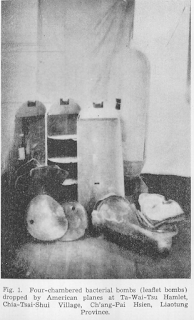
But the experiments were only part of the crimes, as the Imperial Army implemented the use of the bacteriological weapons against the Chinese and Soviets during World War II, killing, according to recent estimates, somewhere between a quarter and half-a-million people with plague, typhoid, and other diseases, and leaving others injured for life. Japan bombed cities with specially constructed bacterial bombs, as part of a plan that included well-poisonings, the release of infected rats and fleas (bred specially for the purpose), and other forms of mass inoculations.

After World War II and the blanket amnesty for all the BW researchers, who were led by Kwantung Army Lt. General Shiro Ishii, British and Canadian researchers have alleged that some of the Japanese personnel were utilized in a campaign of biological warfare by the United States during the Korean War. The issue is still hotly debated today, and the U.S. still keeps secret today many documents related to that war.

The crimes of Unit 731 and assorted entities, the U.S. amnesty of those involved, and collaboration with Ishii and others in collecting the "scientific" information taken from the murder of thousands, would have remained secret forever, had it not been for the conscience of a few of those Japanese scientists and technicians involved who came forward to talk to Japanese researchers in the mid-1970s. In America, the revelations were due to the tireless work of journalist John W. Powell, who used FOIA extensively to document the case of the U.S. cover-up, publishing in 1981. Even so, the subject has never entirely entered the mainstream of U.S. consciousness.

Japan's Use of Chemical Weapons in China

[This section on chemical weapons has been augmented from the original posting, taken from a 9/11/13 version of this article posted as a diary at Daily Kos.]

The crimes of the Japanese Imperial Army were not limited to bacteriological weapons. They also used chemical weapons extensively in China from 1937 until 1945, according to declassified US records. None of the Japanese military hierarchy tried after the war for war crimes were charged with use of chemical or bacteriological weapons. Those involved were protected by the U.S. military and amnestied for any crimes. The knowledge of the weaponry involved, including that derived through lethal experiments, was sent to Ft. Detrick, the CIA, and other "intelligence channels."

If anything, the size of the chemical war and the damages and fatalities wrought thereby are even more secret today than Japan's biological weapons program. A diligent search finds very, very little published in English on this issue. One prominent exception is Yuki Tanaka's article, "Poison Gas: the Story Japan Would Like to Forget," in the October 1988 Bulletin of the Atomic Scientists. The Japanese researcher also unearthed evidence of the cover-up of the CW war crimes at the trials of Japanese Imperial officers after WWII, noting that because chemical warfare and bacteriological warfare were linked in the same treaties that banned them, to prosecute on chemical warfare experiments and tests would have been "difficult to bring up... while covering up the use of bacteriological warfare."

There's no question the U.S. knew of such crimes, as Col. Thomas Morrow, who worked for the International Prosecution Section of the Tokyo war crimes department sent two different memos to the Chief Prosecutor on exactly this subject, detailing the use of specific poison gases, and a discussion of casualties. But Morrow was unexpectedly sent back to the U.S., and his reports classified and put away for decades.

The scope of the chemical war unleashed in China can be ascertained by the damage left afterward. According to Nationalist Chinese sources in Taipei, approximately 700,000 chemical munitions were left abandoned in China after World War II. The Chinese government says that approximately 2,000 people still die each year from encounters with such ordinance. An ongoing clean-up of the chemical mess, in part paid for by Japan, is still ongoing in 2013.

Discoveries regarding the scope of the chemical warfare experiments and operational use of the weapons are still ongoing. A 2005 article in the UK Independent announced the discovery of a huge Japanese chemical weapons plant "20 miles south-east of Hulun Buir city in the far north of Inner Mongolia." Covering approximately 40 square miles, a Chinese researcher said, "It may be the largest and best-preserved gas experiment site in the world. We've found more than a thousand pits that were used for experiments, as well as trenches and shelters for people and vehicles."

When recently, for a longer article I am writing relating to this subject, I asked DoD for official response to these issues, the DoD spokesperson referred me to Ft. Detrick's public affairs office. The official at Ft. Detrick said they had no knowledge of these events and could not comment, all relevant material having been sent to the National Archives years ago. Meanwhile, a former official at Ft. Detrick confirmed to me a statement that he made to historian Sheldon Harris in 1999 concerning the destruction of records on Unit 731 at Ft. Detrick occurring as late as 1998. I'll have more to say about that in the future, but meanwhile those interested can pursue the matter at this link from the Congressional Record.

U.S. Record Makes It Impossible to Trust Their Statements on Chemical or Biological Warfare Dangers

The final point concerns the relevancy of the material above with the aims of the U.S. government to bomb Syria for the purported use of chemical weapons. The argument is simple. The actions of the U.S. government for decades on the matter of biological and chemical weapons demonstrate that it cannot be trusted on this matter. The government was intimately involved with cover-ups on the use of these weapons. Their cover-up is likely still ongoing.

Recently, the Washington Post published an article by Joby Warrick on possible dangers from Syrian use of biological weaponry. The story is specious on its own account, but it is also telling that Warrick never refers to any of the facts I've related above about the U.S. history with Unit 731.

Furthermore, as awful as the material involved here is, it must be assessed in the context of other U.S. criminal activities associated with biological and chemical warfare, from the lies told about WMD, leading to the 2003 invasion of Iraq, to experiments done on U.S. citizens, to the facilitation of chemical weapon attacks by other countries, e.g., Saddam Hussein's Iraq.

Certainly, the videos released on the Internet, most lately with the imprimatur of Congressional Intelligence committees, contain scenes of ghastly deaths that are frightening to watch. The constant bombardment of propaganda from media and government sources, not least supposed "liberal" or "progressive" politicians, is meant to achieve a sense of urgency and fear in the population that will allow at the least acquiescence towards the military's new war actions in the Middle East.

I hope that bringing up the history of the United States in relation to the largest operational use of biological and chemical weapons in history will give pause to those who are otherwise credulous of U.S. intentions. The record is clear: the U.S. has lied and covered-up when it comes to biological and chemical weapons, and government sources cannot be trusted, certainly not when the bulk of their information is kept secret from the public.

Search for Info/News on Torture

Google Custom Search
Add to Google ">View blog reactions

This site can contain copyrighted material, the use of which has not always been specifically authorized by the copyright owner. I am making such material available in my effort to advance understanding of political, human rights, economic, democracy, scientific, and social justice issues, etc. I believe this constitutes a 'fair use' of any such copyrighted material as provided for in section 107 of the US Copyright Law. In accordance with Title 17 U.S.C. Section 107, the material on this site is distributed without profit to those who have expressed a prior interest in receiving the included information for research and educational purposes. For more information go to: http://www.law.cornell.edu/uscode/17/107.shtml. If you wish to use copyrighted material from this site for purposes of your own that go beyond 'fair use', you must obtain permission from the copyright owner.