Monday, September 23, 2013

A Psalm for the Prisoners in Guantanamo

The following is from the Book of Psalms in the Old Testament. This 88th psalm is taken from the New Revised [English] Standard Version.
1  O Lord, God of my salvation,
when, at night, I cry out in your presence,
2   let my prayer come before you;
incline your ear to my cry.

3   For my soul is full of troubles,
and my life draws near to Sheol.
4   I am counted among those who go down to the Pit;
I am like those who have no help,
5   like those forsaken among the dead,
like the slain that lie in the grave,
like those whom you remember no more,
for they are cut off from your hand.
6   You have put me in the depths of the Pit,
in the regions dark and deep.
7   Your wrath lies heavy upon me,
and you overwhelm me with all your waves.

8   You have caused my companions to shun me;
you have made me a thing of horror to them.
I am shut in so that I cannot escape;
9   my eye grows dim through sorrow.
Every day I call on you, O Lord;
I spread out my hands to you.
10   Do you work wonders for the dead?
Do the shades rise up to praise you?
11   Is your steadfast love declared in the grave,
or your faithfulness in Abaddon?
12   Are your wonders known in the darkness,
or your saving help in the land of forgetfulness?

13   But I, O Lord, cry out to you;
in the morning my prayer comes before you.
14   O Lord, why do you cast me off?
Why do you hide your face from me?
15   Wretched and close to death from my youth up,
I suffer your terrors; I am desperate.
16   Your wrath has swept over me;
your dread assaults destroy me.
17   They surround me like a flood all day long;
from all sides they close in on me.
18   You have caused friend and neighbor to shun me;
my companions are in darkness.
When I read this, I thought immediately of the Guantanamo detainees, shuttered away from humankind, terribly far from family and friends, subject to beatings, force-feedings, endless interrogations, profound isolation, sleep deprivation, forced drug injections, emotional abuse. While the poet appears to have written the psalm to express the desolation that can overcome any human being borne down by the suffering of human life and loss, it appears specially apposite to the condition of the detainees, still locked in indefinite detention, prisoners of an arbitrary, capricious and cruel regime.

And we, this society as a whole, is to blame for their suffering, by failing to stand witness, for failing to demand human decency stand before one's own tremulous fears. May any deity that be forgive us our weaknesses.

May this prayer reach the God of those who despair in the US prison meant to symbolize the supposedly omnipotent reach of the US war machine.

Sunday, September 8, 2013

US Covered-Up for Decades the Largest Use of Biological & Chemical Weapons in History

Crossposted from The Dissenter/FDL

There are many reasons why one should oppose the military action against Syria being planned by the Obama administration. But given that the action is being trumpeted as a righteous response to the alleged use of chemical weapons by the Syrian government, there is one reason to oppose the U.S. action that carries with it more than the usual amount of painful irony.


It is difficult to know how to introduce this subject, as it is so dark and evil, and the U.S. population has been lied to for so long about it, that I fear the initial reaction very likely can only be shock and denial. And yet, the crimes to which I am about to refer are quite well documented, and were themselves the focus of a Congressional bill in 2000 directing the National Archives to specially search for and release the relevant documentation. The deaths involved are said to approach half-a-million souls, and the injuries of many are still ongoing.

Kept "Top Secret" in "Intelligence Channels"

Here, in summary, are the primary facts. As you read this, remember that the U.S. government not only amnestied those involved in the following war crimes, but paid them for the information they could provide, and in some cases hired them. The decision was made by the Joint Chiefs of Staff, the State Department, and possibly the new CIA and the new president, Truman. The idea for the deal was prompted by General Douglas MacArthur, military doctors at Ft. Detrick, and officials in the U.S. Chemical Warfare Service. It was famously decided that all that you are about to read now would be kept as "top secret," not to be released outside "intelligence channels." And it wasn't... for about 35 years.

From the time the Japanese Imperial Army occupied Manchuria (in the early 1930s) until the end of World War II, its special Unit 731, and dozens of associated units, engaged in wide-scale lethal experiments on biological and chemical warfare, including the use of poisons for assassination purposes and the wide-scale use of herbicides. These experiments were conducted on thousands of prisoners, estimates ranging from 3000 to 20,000 POWs and civilian prisoners. The exact number may never be known.

Many of these prisoners were experimented upon without anaesthesia and by way of vivisection. The prisoners at the central Unit 731 facility at Pingfan in Manchuria were incinerated in crematoria after the military doctors were done with them. As I recently was able to derive by research into Soviet documents, some of the prisoners -- called "marutas" or "logs" by Japanese researchers and military officials -- sent for lethal experimentation by Unit 731, Unit 100, and like facilities were military or intelligence agency prisoners who could not be trusted to remain silent about the torture they had received from Japanese interrogators.

As did the Nazis, Japanese researchers conducted experiments on malaria, syphilis, and on freezing. (Japanese and German collaboration on these programs was likely closer than previously thought.) Male prisoners were forced to rape female prisoners in order to inoculate them with venereal disease. Other prisoners were forced to stay outside in sub-zero temperatures, as part of Japanese military frostbite experiments. Some prisoners were tied to stakes and had munitions loaded with bacteria exploded nearby them, the shrapnel embedding itself in their exposed skin. Other prisoners were tricked into taking food or medications that had cyanide, hallucinogenic substances, and opiates.

Though the US government specifically denies it, some of the prisoners were also US POWs held at Japan's Mukden POW camp, and possibly other camps as well. (An academic book on the subject was published by Naval Institute Press a few years ago.)

Large-scale Use of Biological Weapons in War Was Covered-Up

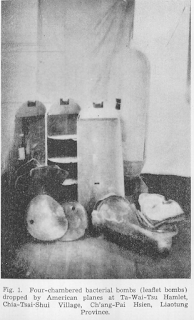
But the experiments were only part of the crimes, as the Imperial Army implemented the use of the bacteriological weapons against the Chinese and Soviets during World War II, killing, according to recent estimates, somewhere between a quarter and half-a-million people with plague, typhoid, and other diseases, and leaving others injured for life. Japan bombed cities with specially constructed bacterial bombs, as part of a plan that included well-poisonings, the release of infected rats and fleas (bred specially for the purpose), and other forms of mass inoculations.

After World War II and the blanket amnesty for all the BW researchers, who were led by Kwantung Army Lt. General Shiro Ishii, British and Canadian researchers have alleged that some of the Japanese personnel were utilized in a campaign of biological warfare by the United States during the Korean War. The issue is still hotly debated today, and the U.S. still keeps secret today many documents related to that war.

The crimes of Unit 731 and assorted entities, the U.S. amnesty of those involved, and collaboration with Ishii and others in collecting the "scientific" information taken from the murder of thousands, would have remained secret forever, had it not been for the conscience of a few of those Japanese scientists and technicians involved who came forward to talk to Japanese researchers in the mid-1970s. In America, the revelations were due to the tireless work of journalist John W. Powell, who used FOIA extensively to document the case of the U.S. cover-up, publishing in 1981. Even so, the subject has never entirely entered the mainstream of U.S. consciousness.

Japan's Use of Chemical Weapons in China

[This section on chemical weapons has been augmented from the original posting, taken from a 9/11/13 version of this article posted as a diary at Daily Kos.]

The crimes of the Japanese Imperial Army were not limited to bacteriological weapons. They also used chemical weapons extensively in China from 1937 until 1945, according to declassified US records. None of the Japanese military hierarchy tried after the war for war crimes were charged with use of chemical or bacteriological weapons. Those involved were protected by the U.S. military and amnestied for any crimes. The knowledge of the weaponry involved, including that derived through lethal experiments, was sent to Ft. Detrick, the CIA, and other "intelligence channels."

If anything, the size of the chemical war and the damages and fatalities wrought thereby are even more secret today than Japan's biological weapons program. A diligent search finds very, very little published in English on this issue. One prominent exception is Yuki Tanaka's article, "Poison Gas: the Story Japan Would Like to Forget," in the October 1988 Bulletin of the Atomic Scientists. The Japanese researcher also unearthed evidence of the cover-up of the CW war crimes at the trials of Japanese Imperial officers after WWII, noting that because chemical warfare and bacteriological warfare were linked in the same treaties that banned them, to prosecute on chemical warfare experiments and tests would have been "difficult to bring up... while covering up the use of bacteriological warfare."

There's no question the U.S. knew of such crimes, as Col. Thomas Morrow, who worked for the International Prosecution Section of the Tokyo war crimes department sent two different memos to the Chief Prosecutor on exactly this subject, detailing the use of specific poison gases, and a discussion of casualties. But Morrow was unexpectedly sent back to the U.S., and his reports classified and put away for decades.

The scope of the chemical war unleashed in China can be ascertained by the damage left afterward. According to Nationalist Chinese sources in Taipei, approximately 700,000 chemical munitions were left abandoned in China after World War II. The Chinese government says that approximately 2,000 people still die each year from encounters with such ordinance. An ongoing clean-up of the chemical mess, in part paid for by Japan, is still ongoing in 2013.

Discoveries regarding the scope of the chemical warfare experiments and operational use of the weapons are still ongoing. A 2005 article in the UK Independent announced the discovery of a huge Japanese chemical weapons plant "20 miles south-east of Hulun Buir city in the far north of Inner Mongolia." Covering approximately 40 square miles, a Chinese researcher said, "It may be the largest and best-preserved gas experiment site in the world. We've found more than a thousand pits that were used for experiments, as well as trenches and shelters for people and vehicles."

When recently, for a longer article I am writing relating to this subject, I asked DoD for official response to these issues, the DoD spokesperson referred me to Ft. Detrick's public affairs office. The official at Ft. Detrick said they had no knowledge of these events and could not comment, all relevant material having been sent to the National Archives years ago. Meanwhile, a former official at Ft. Detrick confirmed to me a statement that he made to historian Sheldon Harris in 1999 concerning the destruction of records on Unit 731 at Ft. Detrick occurring as late as 1998. I'll have more to say about that in the future, but meanwhile those interested can pursue the matter at this link from the Congressional Record.

U.S. Record Makes It Impossible to Trust Their Statements on Chemical or Biological Warfare Dangers

The final point concerns the relevancy of the material above with the aims of the U.S. government to bomb Syria for the purported use of chemical weapons. The argument is simple. The actions of the U.S. government for decades on the matter of biological and chemical weapons demonstrate that it cannot be trusted on this matter. The government was intimately involved with cover-ups on the use of these weapons. Their cover-up is likely still ongoing.

Recently, the Washington Post published an article by Joby Warrick on possible dangers from Syrian use of biological weaponry. The story is specious on its own account, but it is also telling that Warrick never refers to any of the facts I've related above about the U.S. history with Unit 731.

Furthermore, as awful as the material involved here is, it must be assessed in the context of other U.S. criminal activities associated with biological and chemical warfare, from the lies told about WMD, leading to the 2003 invasion of Iraq, to experiments done on U.S. citizens, to the facilitation of chemical weapon attacks by other countries, e.g., Saddam Hussein's Iraq.

Certainly, the videos released on the Internet, most lately with the imprimatur of Congressional Intelligence committees, contain scenes of ghastly deaths that are frightening to watch. The constant bombardment of propaganda from media and government sources, not least supposed "liberal" or "progressive" politicians, is meant to achieve a sense of urgency and fear in the population that will allow at the least acquiescence towards the military's new war actions in the Middle East.

I hope that bringing up the history of the United States in relation to the largest operational use of biological and chemical weapons in history will give pause to those who are otherwise credulous of U.S. intentions. The record is clear: the U.S. has lied and covered-up when it comes to biological and chemical weapons, and government sources cannot be trusted, certainly not when the bulk of their information is kept secret from the public.

Wednesday, August 14, 2013

Amériques

From a time when "America" meant "discoveries - new worlds on earth, in the sky, or in the minds of men."


Composer Edgar Varèse composed Amériques, a monumental though relatively brief symphonic work, between 1918 and 1921, revising it (according to the piece's Wikipedia page) in 1927.

Listen for the sirens! Think of "Rite of Spring" in Manhattan.

Direct YouTube link

Tuesday, August 13, 2013

Japanese WWII Torture Document Eerily Reminiscent of US Torture Program


The following is taken from a 63 year old book published in the early days of the Cold War. Titled Materials on the Trial of Former Serviceman of the Japanese Army Charged with Manufacturing and Employing Bacteriological Weapons (Foreign Languages Publishing House, Moscow, 1950), the book contains trial summaries and testimony from the Khabarovsk war crimes trial in December 1949.

Derided as just another Stalinist show trial at the time, historians have since confirmed the evidence regarding the crimes prosecuted, including deadly biological experiments on prisoners by special units of the Japanese Imperial Army, the most famous of which was Unit 731.

The selection below is one of the exhibits contained in the book, collected in a section labeled “Documentary Evidence.” The book itself has been out of print for decades, and is generally unavailable, except via some few libraries and antiquarian bookstores. The selection included here is on the Japanese Army use of torture. The reader will notice that the Japanese Army demonstrated many of the same techniques and concerns the U.S. showed when it was implementing its own torture program under the CIA and the Department of Defense.

The Japanese torture program included, as described here, use of stress positions, physical attack, and a form of waterboarding. The interrogators were instructed to be aware of possible false information by prisoners in order to get “relief from suffering.” They appeared to also be concerned in the truthfulness of information obtained, and the possibility of deception.

Moreover, the Japanese were quite worried about others knowing about the torture. While they do not outright call for the murder of prisoners, one is left to guess at what “measures must be taken” so that prisoners did not talk of the torture “afterwards.”

The material from the Khabarovsk trial is consistent with that published in a report by the Supreme Commander of Allied Powers on “Japanese Methods of Prisoner of War Interrogation” (June 1, 1946). Techniques described there include: beatings of various sorts (derided, though, as “the most clumsy method”); threats of “murder, torture, starving, deprivation of sleep, solitary confinement, etc.”; psychological threats; water torture, which sometimes resulted in fatalities; attaching a prisoner's thumbs to a “motor car which proceeds to pull him around in a circle until he falls exhausted,” and other tortures. Some Japanese soldiers and officers were prosecuted for war crimes after the war for such inhumane and criminal conduct.

What Made the Khabarovsk Trial Special

What makes the selection from the Khabarovsk trial unique is the degree to which the document discusses the importance of hiding the torture, and how to deal with deception. Interestingly, there is no discussion of producing false confessions.

It is noteworthy, too, to understand that thousands of prisoners who were sent to Unit 731 had also been, or were interrogated and/or tortured, at the site where biological experiments on them were done. All the prisoners were killed after the experiments were completed. The results of the experiments were operationalized in biological warfare campaigns by the Japanese in China that killed, recent estimates claim, perhaps as many as half a million people.

In future stories, I will discuss at much greater length aspects of this material that has gone unreported for years. The reasons for such a lack of historical writing is not lack of interest, but the fact that what materials the Japanese did not destroy were kept classified by the Americans for decades as part of an amnesty deal made with the leaders of the Japanese biological warfare program. The deal included a transfer of data on the fatal human experiments to the U.S. Army and intelligence services. Both the Department of Defense and (most likely) the CIA were involved in the decision to give amnesty to the Unit 731 et al. criminals.

For more information on the deal made between the U.S. and the Japanese described here see Peter Williams and David Wallace, Unit 731: The Japanese Army Secret of Secrets, 1989, Hodder and Stoughton, London; Sheldon H. Harris, Factories of Death: Japanese Biological Warfare, 1932-1945, and the American Cover-up, rev. ed. 2002, Routledge, New York; and Daniel Barenblatt, A Plague Upon Humanity: the Secret Genocide of Axis Japan’s Germ Warfare, 2004, Harper, New York.

The Khabarovsk selection reprinted below appears on pages 235-237 of Materials. I have tried my best to reproduce the material as it is in the book. What is italic or bold here is italic or bold in the book. Extra spacing between letters is as in the printed material. Case has been preserved. Paragraph breaks are by extra lines, while in the book they are by indent.
File No. 48. Pages 90, 112, 113, 124, 125, 126. “Operation Officer's Guide (Part I).” From the files of the Mutankiang J.M.M. 
Translated from the Japanese  
S t r i c t l y  C o n f i d e n t i a l 
Seal: “MUTANKIANG J. M. M.
Received June 14, 1945
Inc. No. 9”
Page 90 
MILITARY INVESTIGATION DIVISION
OF GENERAL HEADQUARTERS 
Copied by Unit
No. 471-MANSHU 
SECRET WAR SERVICE GUIDE 
Page 112  
I n c l o s u re 
Fundamental Rules for Interrogating War Prisoners 
Page 113 
G e n e r a l  R u l e s 
1. The present rules relate to cases of interrogation with the view to obtaining information, but do not relate to the interrogation of criminals. 
2. Persons who have surrendered, deserters, captured enemy spies, those who illegally cross the frontier, crews of aircraft compelled to make a forced landing or of vessels compelled to come to our shores, escaped war prisoners who had formerly served in our army, the inhabitants of districts we have newly occupied, and also civilian refugees from the sphere of enemy influence, except on special matters, are interrogated in conformity with the methods of investigating and interrogating war prisoners.

Page 124 
62. Sometimes, depending on circumstances, it is advantageous to resort to torture, but often this may lead to harmful consequences, and therefore, before resorting to it, it is necessary to carefully consider whether this should be done or not. Furthermore, torture must be applied in such a way as not to lead to bad consequences for us. 
Page 125 
63. Torture, the infliction of physical suffering, must be sustained and continued in such a way that there shall be no other way of relief from suffering except by giving truthful information. 
Torture is advantageous because of the speed with which it is possible with relative ease to compel persons of weak will to give truthful testimony, but there is the danger that, in order to relieve himself from suffering, or in order to please the interrogator, the person interrogated will, on the contrary, distort the truth. 
In the case of persons of strong will, torture may strengthen their will to resist and leave ill-feeling against the empire after the interrogation. 
64. In relation to persons of weak will, torture is usually applied in those cases when the person interrogated does not speak the truth in the face of evidence, but there is full reason to suppose that this person will speak frankly if torture is applied. 
65. It is necessary to bear in mind that the methods of torture must be such as can be easily applied, as will sustain suffering without rousing feelings of pity, and as will not leave either wounds or scars. However, in those cases when it is necessary to create apprehension of death, the harm caused the person interrogated can be ignored, but this must be done in such a way as not to make it impossible to continue the interrogation. 
The following examples of torture may be given: 
1. Compelling the person to sit up straight and motionless. 
2. Putting pencils between the fingers not far from their bases and tying the tops of the fingers with string and moving them. 
3. Putting the person interrogated on his back (it is advisable to raise the feet a little) and dripping water into the nose and mouth simultaneously. 
4. Putting the interrogated person on his side and stamping on his ankle. 
5. Compelling the interrogated person to stand under a shelf that is too low to enable him to stand straight. 
66. In a case when a wound is accidentally inflicted on the person interrogated, it is necessary, taking into account the general situation and the interests of our country, to take resolute measures, taking full responsibility for same. 
67. On receiving testimony as a result of applying torture, it must be ascertained whether this testimony is the result of a desire to avoid further suffering and to please the interrogator; in such cases, some corroboration of the truth of the testimony is necessary. 
Page 126 
68. After the application of torture, it is necessary to convince the person who had undergone torture that the torture applied to him was quite a natural measure, or to take such measures as will induce him out of a sense of pride, sense of honor, etc, not to speak of it afterwards. In the case of persons from whom this cannot be expected, measures must be taken as in the case of those upon whom accidental wounds have been inflicted. 
69. Nobody must know about the application of torture except the persons concerned with this. Under no circumstances must other prisoners know about it. It is very important to take measures to prevent shrieks from being heard.* 
Translated by Senior Interpreter, Master of Historical Sciences
Signed: (PODPALOVA) 
*The rest is omitted. – Trans.

Health Care Professionals Urge Obama to End Forced-Feeding of Guantanamo Hunger Strikers

The following is a press release from Psychologists for Social Responsibility (PsySR), who gathered hundreds of signature and the support of other human rights associations to appeal to the President to stop the forced-feeding of hunger strikers at Guantanamo. The forced-feeding policy by the Department of Defense is blatantly against the policy of health organizations around the world, including the American Medical Association, the World Medical Association (see their Declaration of Tokyo), and the British Medical Association.

DoD is on a propaganda campaign to promote their policy (see here and here). But as this UK Guardian article notes, "Force-feeding policies have never succeeded."
Force-feeding is not a new concern. It fell rapidly out of fashion in 1917 after Irish republican Thomas Ashe unexpectedly died after being fed, and again in the 1970s following IRA hunger striker Michael Gaughan's controversial death. Then, as now, medical professionals and human rights activists raised concern about the dubious use of the stomach tube to suppress hunger strikers. The World Medical Organisation's 1975 condemnation of force-feeding as torturous and degrading seemed to signal an end to the practice. Indeed, one of the key reasons why Thatcher was left with few options but to allow IRA hunger striker Bobby Sands and his fellow prisoners to starve – in the face of politically damaging controversy – was because she knew that force-feeding was no longer ethically viable.
What follows is PsySR's press release:
On August 12th, over 400 health care professionals and human rights leaders sent an urgent appeal to President Obama to order Guantánamo detention camp officials to stop force-feeding hunger strikers, immediately release the detainees approved for release, and make closing Guantánamo his first priority. Now in its seventh month, the hunger strike included 106 detainees at its peak, with as many as 46 of them force-fed.

The letter states that force-feeding mentally competent adults is a violation of medical and nursing ethics, and emphasizes that the method of force feeding in Guantánamo is “exceptionally brutal.” In describing the procedure in which the detainee is forcefully extracted from the cell by several soldiers and strapped into a restraint chair for up to two hours, the letter also notes that “Men weakened by significant weight loss are particularly at risk for serious injury during this regimen.”

Sponsored by Psychologists for Social Responsibility and signed by ten additional organizations, including the Center for Constitutional Rights and Physicians for Human Rights, the letter focuses on the ethical and professional dilemmas of Guantánamo health personnel who force-feed the detainees:

“Health care professionals, including those in the military, must maintain their licenses in good standing, and to do so they must follow standards of good ethical practice. This is not what is happening during the hunger strike.”

Because information is classified at Guantánamo, doctors, nurses and psychologists cannot honor their ethical obligations to confer with independent experts in such dilemmas, and are “constrained from securing the support of their professional colleagues if they experience reprisals for registering a complaint or refusing to participate further.”

The signers urge President Obama to “act immediately before more prisoners die” and argue that as Commander-in-Chief he has the power to immediately stop the force-feeding, release the detainees approved for release, and make closing Guantánamo his top priority.

The full text of the letter with the list of all signers is available online at www.psysr.org/GTMO-Letter.

Wednesday, August 7, 2013

Will Bogdan's Claims of Insufficient Staffing Cause Al Qaeda to Attack Guantanamo?

Jason Leopold, who has been filing requests for government documents like there is no tomorrow, apparently caught Department of Defense censors with their pants down. The result is a rare look into the kind of political shenanigans DoD uses to justify its policies at Guantanamo.

Leopold had requested a copy of the declaration by JTF-GTMO Detention Group (JDG) chief Colonel John Bogdan filed in the litigation surrounding the controversial groin and genital searches of detainees at Guantanamo. He received a redacted version on August 3. But Leopold noticed that the redactions didn't match those of an earlier release of the document in July.

The practice of the groin and genital searches -- including before and after visits to attorneys, to make family telephone calls, etc. -- was overturned by Judge Royce Lamberth in a stinging ruling last month. But the government appealed that ruling and an appeals court reversed Lamberth's opinion pending a full government appeal. The appeals court relied heavily on declarations made by both Bogdan and his US Southern Command superior officer, Marine General John F. Kelly.

Last month I examined the issues behind Kelly's declaration. But Bogdan's declaration was unaccountably sealed. Three days after the appeals court ruling, Leopold filed suit for Bogdan's declaration.

As Leopold described it in an August 6 article at Al Jazeera (emphasis in original):
In response to the court filing, the government on Friday released a partially redacted version of Bogdan's declaration, and argued that the blacked-out passages in the document should remain secret - because they contained sensitive "operational-security information" about Guantanamo.

But it appears government lawyers were unaware that another version of Bogdan's declaration - one that contained a different set of redactions - was publicly released last month, in documents filed with the federal appeals court when the government asked Lamberth's decision to be put on hold.

Redacted passages that the government says needs to remain secret are unredacted in the earlier version filed on the public record as part of the government's appeal. At the same time, some unredacted passages in the declaration submitted on Friday are redacted in the public version of Bogdan's declaration filed with the appeals court last month.
Leopold's Al Jazeera article examines some of the differing redactions, and in general I agree with Steven Aftergood's comments in the story regarding "the subjective nature of the redaction process." However, a close read of all the redactions turns up a couple of odd new attempts at censorship by DoD of some of Bogdan's statements, one of which in particular deserves a closer look.

Insufficient Staffing for Detainee "Movements"?

In a portion of his declaration explaining to the court why Guantanamo commanders cannot consider allowing attorneys to visit their clients at either Camps 5 or 6 -- they currently meet at Camp Echo, about which more below -- Bogdan made a remarkable claim (emphasis added): "As it currently stands, JTF-GTMO cannot support all daily movements with current staff levels, so movements must be prioritized."

The "movements" concern prisoner movements outside their cell to anywhere else in the prison -- to another cell, to see their attorney, to make a call to their family, to go to the hospital or clinic, etc. For an unspecified period Guantanamo authorities ran a "frequent flyer" program, transferring prisoners from cell to cell multiple times a week "to cause sleep deprivation and disorientation."

A SOUTHCOM report on the death of prisoner Adnan Latif last September revealed that the brain-damaged detainee from Yemen was “moved from camp to camp over 67 times" during his stay at Guantanamo. So the issue of movements is not one only related to camp operations, but to the abuse and maltreatment of prisoners there. Indeed, some of these "movements" are initiated by violent beatings by so-called Emergency Reaction Forces.

Bogdan's declaration regarding insufficient staffing levels at Guantanamo was part of the initial release of his sworn declaration last month, but it was censored in the August 3 release to Leopold. The statement was overlooked after the first release, but the retrospective redaction has brought attention to Bogdan's claim.

In the government's response to Leopold's suit, defending the censorship of portions of Bogdan's unclassified declaration, the government claims the redactions concern "procedures and rationales contained in the declaration [which] constitute sensitive information, the public disclosure of which will threaten the operational security and force protection of the Guantanamo facility."

Indeed, the government goes so far as to claim the recent jail breaks at Abu Ghraib and in Pakistan speak to the dangers of a similar Al Qaeda attack on Guantanamo. While over ten years ago Al Qaeda was allegedly able to pull off the suicide bombing of the USS Cole in the port of Aden, but it is very difficult to see how Al Qeada or anyone could attack or pull off a prison break at Guantanamo.

According to Bogdan, the security has been so tight at the camp that if a detainee had been able to meet with an attorney at Camp 6, such a meeting would be forced to end if the detainee had to go to the bathroom. (The government tried to retrospectively censor this fact, too.)

But that was not the case at Camp Echo, and it's ultimately at Camp Echo where meetings with detainees and their attorneys must take place, according to camp officials. The claims about poor staffing levels are very convenient in pushing all meetings to Camp Echo (a claim that did not pass muster with Judge Lamberth, who said in his ruling that accommodations could be made at Camps 5 and/or 6, and the supposed need for lots of searches ameliorated).

I'd guess the poor staffing argument was not something Guantanamo wished to be public, especially at the same time they are pushing as propaganda the very low probability chance of Al Qaeda somehow invading Guantanamo (as if Guantanamo were somehow located somewhere akin to urban Baghdad).

Camp Echo Set Up for... Eavesdropping

According to Bogdan's declaration:
Camp Echo is specifically set up and designated to facilitate meetings with detainees, including legal visits, in a secure and safe environment. The meeting rooms at Camp Echo are specifically designed for attorney meetings and can accommodate up to five people, including the detainee. For example, Camp Echo meeting rooms have restroom facilities for the detainee, which are not available in the rooms at Camp 6.
But Camp Echo was the focus of a big controversy last Spring, when it was discovered that "smoke detectors" in the attorney-client meeting rooms at Camp Echo were in fact "high-tech audio surveillance and monitoring equipment."

According to a subsequent report by the Center for Policy and Research (CPR) at Seton Hall University School of Law, "Following the public discovery of the listening devices, Army Colonel John Bogdan ordered the use of audio in Echo II to be disconnected, but not dismantled." The rooms in question were the same rooms earlier used by the FBI, CIA and other agencies in the interrogation of the so-called "high-value detainees."

In a meeting on the matter at the military commissions, Bogdan "confirmed that there was one infrared camera mounted on the wall opposite 'from where the detainee would be locked in when there was not a meeting,' and another encased point-tilt-zoom camera mounted in a corner." Moreover, at least one video surveillance camera was so sensitive it was "capable of zooming to read 'very tiny writing' on a document used during an attorney-client discussion."

Can attorneys or detainees trust that such monitoring of privileged meetings isn't still taking place? As CPR pointed out in their report, "written Standard Operating Procedures 'neither permit nor forbid' audio monitoring."

In his declaration, Bogdan said he started to implement the new groin/genital search policy in December 2012. In that same month, according to the CPR report, he authorized an intelligence directorate request for an upgrade of the video surveillance cameras at Camp Echo “from an analog to a digital capacity.” Bogdan's story of what he knew and when about the audio and video surveillance doesn't hold water, but for a detailed examination, check out the Seton Hall report.

In summary, it would appear that DoD is trying to hide its argument about supposed staffing difficulties at Guantanamo -- arguments it surely must make to Congress, by the way -- in order to buttress its claim that the only place detainees can meet with attorneys is at Camp Echo, where, conveniently enough, they have bugged all the meeting rooms. They are holding to their arguments despite the fact a federal judge found them seriously wanting.

DoD believes its ace in the hole is the claim of dangerous attacks from Al Qaeda. It's the same message they are playing in the mainstream press, used to justify more funding for anti-terror programs, the ongoing crackdown on whistleblowers like Bradley Manning and Edward Snowden, and to hold off any release of prisoners from Guantanamo Bay.

Nothing about DoD's arguments make any sense. The SOUTHCOM report on the death of Adnan Latif, used to justify the groin and genital search policy, is riddled with holes. Moreover, as Jason Leopold, the most consistent reporter challenging DoD's spin on Guantanamo, has noted (see here and here), the entire regime at the Cuban-sited prison appears to be in a near shambles: SOPs not followed, personnel not trained, accountability totally absent.

The onerous search policy at Guantanamo appears to be mostly a clumsy bureaucratic maneuver to blame the detainees at Guantanamo for the mistakes and failures of command. Any military officer or soldier should be ashamed of such an action. The nation should be ashamed. Meanwhile, dozens of detainees at the facility remain on hunger strike, many of them still force-fed, despite the condemnations of national and world health organizations and human rights groups.

Only a full, transparent, and wide-ranging investigation into Guantanamo and other U.S. detention and interrogation sites -- including an investigation of actions at this point under the Obama Administration -- will provide the opportunity of knowing the truth behind all the spin and lies coming out of the Pentagon and CIA.

Cross-posted from The Dissenter/FDL

Wednesday, July 24, 2013

Thomas Gray's "Ode on a Distant Prospect of Eton College"

Reposted via The Poetry Foundation:
Ye distant spires, ye antique tow'rs,
That crown the wat'ry glade,
Where grateful Science still adores
Her Henry's holy Shade;
And ye, that from the stately brow
Of Windsor's heights th' expanse below
Of grove, of lawn, of mead survey,
Whose turf, whose shade, whose flowr's among
Wanders the hoary Thames along
His silver-winding way.

Ah, happy hills, ah, pleasing shade,
Ah, fields belov'd in vain,
Where once my careless childhood stray'd,
A stranger yet to pain!
I feel the gales, that from ye blow,
A momentary bliss bestow,
As waving fresh their gladsome wing,
My weary soul they seem to soothe,
And, redolent of joy and youth,
To breathe a second spring.

Say, Father Thames, for thou hast seen
Full many a sprightly race
Disporting on thy margent green
The paths of pleasure trace,
Who foremost now delight to cleave
With pliant arm thy glassy wave?
The captive linnet which enthrall?
What idle progeny succeed
To chase the rolling circle's speed,
Or urge the flying ball?

While some on earnest business bent
Their murm'ring labours ply
'Gainst graver hours, that bring constraint
To sweeten liberty:
Some bold adventurers disdain
The limits of their little reign,
And unknown regions dare descry:
Still as they run they look behind,
They hear a voice in ev'ry wind,
And snatch a fearful joy.

Gay hope is theirs by fancy fed,
Less pleasing when possest;
The tear forgot as soon as shed,
The sunshine of the breast:
Theirs buxom health of rosy hue,
Wild wit, invention ever-new,
And lively cheer of vigour born;
The thoughtless day, the easy night,
The spirits pure, the slumbers light,
That fly th' approach of morn.

Alas, regardless of their doom,
The little victims play!
No sense have they of ills to come,
Nor care beyond to-day:
Yet see how all around 'em wait
The ministers of human fate,
And black Misfortune's baleful train!
Ah, show them where in ambush stand
To seize their prey the murth'rous band!
Ah, tell them they are men!

These shall the fury Passions tear,
The vultures of the mind
Disdainful Anger, pallid Fear,
And Shame that skulks behind;
Or pining Love shall waste their youth,
Or Jealousy with rankling tooth,
That inly gnaws the secret heart,
And Envy wan, and faded Care,
Grim-visag'd comfortless Despair,
And Sorrow's piercing dart.

Ambition this shall tempt to rise,
Then whirl the wretch from high,
To bitter Scorn a sacrifice,
And grinning Infamy.
The stings of Falsehood those shall try,
And hard Unkindness' alter'd eye,
That mocks the tear it forc'd to flow;
And keen Remorse with blood defil'd,
And moody Madness laughing wild
Amid severest woe.

Lo, in the vale of years beneath
A griesly troop are seen,
The painful family of Death,
More hideous than their Queen:
This racks the joints, this fires the veins,
That ev'ry labouring sinew strains,
Those in the deeper vitals rage:
Lo, Poverty, to fill the band,
That numbs the soul with icy hand,
And slow-consuming Age.

To each his suff'rings: all are men,
Condemn'd alike to groan,
The tender for another's pain;
Th' unfeeling for his own.
Yet ah! why should they know their fate?
Since sorrow never comes too late,
And happiness too swiftly flies.
Thought would destroy their paradise.
No more; where ignorance is bliss,
'Tis folly to be wise.
-- Thomas Gray, 1742

Tuesday, July 23, 2013

Andy Worthington on Obama's False Guantanamo Promises (Video)

Andy Worthington has posted a video at his website highlighting his comments at a recent rally to free Shaker Aamer. The July 18 rally, called by the Save Shaker Aamer Campaign, was held outside the UK Parliament building in London.

Besides talking about the just cause of discharging Shaker from Guantanamo, the last British prisoner held at the US military prison, who has been cleared by two administrations for release, yet still held indefinitely with dozens of others similarly cleared, Worthington concentrated on the recent promises Obama made to address the prisoners' situation.

Worthington wrote:
It is, of course, outrageous that Shaker is still held, as he was cleared for release under President Bush in 2007, and again under President Obama in January 2010, along with 85 of the other 166 men still held. Opportunistic opposition to the release of prisoners by lawmakers in Congress, and shameful inaction on the part of President Obama are responsible for keeping these 86 men in Guantánamo.

Moreover, there are still no signs that any of the men will be released, even though they have been on a hunger strike to highlight their plight since February, and two months ago President Obama, responding to unparalleled criticism internationally and domestically, promised to resume releasing prisoners.

I can scarcely express my disappointment with President Obama, who should not have promised to resume releasing prisoners if he had no intention of doing so, and who will be remembered for his cowardice and hypocrisy unless he is true to his word.
Andy's disappointment at the machinations over Shaker and the rest of the prisoners, and the ongoing obscenity that is Guantanamo is shared by many human rights workers and attorneys, but evidently not by the Obama administration, which has been been talking a good game (when pinned down) about closing Guantanamo and the need for humane treatment, but since taking over the reins of the prison from the Bush/Cheney administration in January 2009 has done next to nothing to act upon their empty rhetoric.

Here's Andy's video:


Thursday, July 18, 2013

SOUTHCOM Commander Spins Latif Death Investigation to Justify Groin Searches

As reported by Kevin Gosztola in the 17 July Dissenter, a panel of the D.C. Court of Appeals stayed Judge Royce Lamberth's ruling overturning a search protocol at Guantanamo that included groin searches of detainees as much as four times in a single day.

Key to the panel's ruling was a written declaration by JTF-GTMO's parent command (SOUTHCOM) top officer, Marine General John F. Kelly. See detailed press coverage of the legal issues at The Public Record, the Miami Herald and the Washington Post, as well as a new report by the UK charity Reprieve, which details the controversy over the hunger strikes and the abusive practices of the Guantanamo military authorities. (Reprieve attorneys represent a number of Guantanamo detainees.)

Kelly's declaration presents a dishonest picture of the reasons underlying the changes in search protocols, and other policies, at Guantanamo in recent months. He does, however, note that the reason for the changes was the purported suicide of Adnan Latif last September, in addition to a more recent purported discovery of a stash of prisoner contraband. Kelly points out, an Army investigator found that Latif's death was due to an overdose of the antipsychotic medication paliperidone, also known as Invega.

The SOUTHCOM report was declassified and released thanks to a FOIA request from Jason Leopold, who also wrote a deep analysis of it for Al Jazeera. My own analysis of the report was posted at The Dissenter on June 29. An NCIS investigation into Latif's death has not been completed.

Kelly uses Latif's death to spin the conclusions from the SOUTHCOM report, conducted under Army regulation AR 15-6, to make it appear that Latif died because he was able to hide medications in his groin area. He ignores other conclusions and facts enumerated in the report. Let us look at what he says and what the report says.

What Contributed to Latif's Death?

According to Kelly's declaration, the AR 15-6 report "found that Latif hoarded medications and ingested them shortly before he was found unresponsive. Several factors, to include the prohibition against searching a detainee's groin area contributed to the ability of Latif to hoard the medications. The report found that the prohibition against searching a detainee's groin area created 'extraordinary opportunities for detainees to conceal contraband should they choose.'"

Kelly cites a recommendation in the report to reconsider the search policy that prohibits guards "from conducting searches of the area from the waist to above the knee of the detainees."

The declassified report had actually redacted the information about the groin searches, including the recommendation cited, so I am grateful to Kelly for updating us. But he artfully elides much of the content of the report, with the effect that the issue of groin searches is given much more weight than it deserves. The recommendation on searches, for instance, never is mentioned in the reports Executive Summary.

Kelly also gives tremendous credence to the testimony of Col. John Bogdan, the commander of Guantanamo's Joint Detention Group, which runs the prison. This is problematic because the AR 15-6 report blasts Bogdan's regime.

Even more, the report suggests that there was more to Latif's death than has been heretofore suggested by any military source. In the end, the report's conclusions, its failure to seek testimony from other prisoners, and its failure to recommend any accountability measures, mar the work fatally. But as is often the case, the devil we seek is in the details, and those do not bear out Kelly's claims. (I would like to know also where Kelly got the time reference that says Latif ingested the drugs "shortly" before he died. That's not in the declassified section of the report.)

According to the SOUTHCOM report, written by an anonymous "objective senior officer in the rank of Colonel," a number of factors were implicated in Latif's death. Among the various factors listed in the report's Executive Summary none of them included failure to adequately search prisoners.

The Executive Summary lists the following issues (emphases added):

* Guards and medical personnel "repeatedly violate" Standard Operating Procedures (SOPs)

* Guards failed to follow "line of sight" and medication SOPs, "and failed to take remedial measures after ISN156 [Latif] appeared to be sleeping an unusual amount of time. Medical personnel also violated the medication SOP

* Latif's ability to hoard medications (if we accept that is in fact what happened) was due to "inconsistent JDG [Joint Detention Group] and JMG [Joint Medical Group] SOPs" with respect to medication administration; "confusion on the part of guards, corpsmen, leadership (camp, JDG, and JMG) regarding what the SOPs require; and failure to follow medication administration SOP requirements

* Flawed training and procedures for medical personnel.

* The JDG commander (Col. Bogdan), and the JMG senior leadership (presumably including its Commander, Captain Richard Stoltz and Senior Nurse Executive), seemed "largely removed from several aspects of what is going on at the tactical level at the Behavioral Health Unit/Detainee Hospital and the camps.

* Poor communication by leadership "to ensure that their respective detainee operations practices and policies are consistent and synchronized."

* Failure of JTF-GTMO leadership to implement previous recommendations after other detainee deaths.

Later in the report, the SOUTHCOM investigator cites the various failures noted above and directly states, "These failures contributed to the death of ISN156 in that they permitted ISN156 to hoard medications" (p. 66) Nothing similar is said about hiding or hoarding medications in one's private parts. Instead, the report notes various failure to follow SOPs as contributory to Latif's death, as when guards failed to act when Latif supposedly used food to obscure the camera lens used to observe him electronically.

Perhaps General Kelly would like to explain to the full D.C. panel of judges why a more rigorous and intrusive search policy is necessary after Latif's death when the hoarding of drugs is not attributed to search policy in the investigatory report (at least the part publicly released, and summarized without redaction in the Executive Summary). Instead the report attributes the death, at least in large part, to failure to follow SOPs, lax discipline, poor coordination, and an out-of-touch or negligent leadership.

Who Wrote the Email Predicting Latif's Death?

All of that would be damning enough -- indeed, Leopold's article described how the AR 15-6 investigation found that a "widespread breakdown of safeguards" and a "systemic breakdown" contributed to Latif's death. But the report describes other incidents that are not fully explained, and indicate we do not yet have the full story about Latif's death.

The narrative around the failure to maintain the line of sight surveillance of Latif -- an order that encompassed both direct (eyeball) and electronic line of sight observation -- is never adequately explained in the report, seemingly because the crucial sections are highly censored. Indeed, even investigators may have been stymied in finding the truth, as the report notes how a failure by the Watch Commander "to make the line of sight entries into [camp database] DIMS as required by SOP.... did make it difficult after the fact to re-create the immediate events leading up to the point that the guards found ISN156 unresponsive."

In addition, while we know that drugs were simply left in Latif's cell tray (or "splashbox") the day he died, supposedly he never took those drugs as he had already overdosed. But the report notes this kind of SOP violation (leaving drugs unsupervised for a detainee) may have occurred numerous times before. "Similar failures by medical staff over time, to follow the SOP may have contributed to ISN156's ability to hoard medications," the report states.

All of the above would be more than enough to throw grave doubt upon the conclusions of the report, but we also must consider the fact an internal email warning that if Latif was moved he would commit suicide was sent to Col. Bogdan on September 7, 2012 -- the day Bogdan ordered Latif's move from the detainee hospital to a isolation punishment cell in Guantanamo's Camp V. (A medical officer okayed the move at Bogdan's request, even though, as it turned out, Latif suffered from pneumonia and never should have been moved, no matter what his psychiatric condition.)

The report states on September 7, "around 1400, a [one word redaction] analyst from the [four or five word redaction -- possibly Behavioral Science Consultation Team?] arrived with a Force Protection Report indicating [one word redaction] was saying that ISN156 was suicidal and was going to kill himself. [One or two word redaction] recalled asking the analyst whether he knew what method ISN156 intended to use to kill himself. The analyst indicated that he did not know and followed up the exchange with an email."

A footnote notes it was this very warning that prompted the order to place Latif on both direct and electronic line-of-sight surveillance.

The report continues (p. 20): "the JTF-GTMO Cultural Advisor ([three or four words redacted]) also received the same Force Protection Report, in a high priority email at 1430 on 7 September 2012. [One or two words redacted] forwarded the email to COL Bogdan, [two or three words redacted] (the Deputy JDG Commander), and others in a high priority email, adding that 'pushing 156 to the corner never works to our advantage.' COL Bogdan indicated he was not aware of the email until sometime the following day, Saturday."

Elsewhere in the report, returning again to the 7 September "high-priority" email, the report continues: "Although COL Bodgan did not receive the email until the following day, he stated that it would not have affected his decision to transfer ISN156 to Camp V, because ISN156 was known to make 'melodramatic' statements. In this instance, COL Bogdan acted reasonably as he had to address the frequent misconduct by ISN156. On balance, the suicidal ideation did not stand out compared to any of the other instances" (p. 64).

But SOUTHCOM's own report suggests otherwise. Indeed, just how many "high-priority emails" were sent to COL Bogdan or his predecessors warning of a detainee's suicide? It's also worth noting that other news reports describe Latif saying camp authorities were pushing him "towards death every moment." Latif also complained to his attorney David Remes that guards were leaving contraband in his cell by which he could hurt himself. To my knowledge, no investigation into this charge has ever taken place.

SOUTHCOM must release the relevant emails and indicate exactly who sent and received them.

Conclusion

There are other aspects to the Kelly declaration that do not fit what SOUTHCOM'S own investigators found. For instance, Kelly says that he discussed changing the search protocols with Bogdan after he arrived at Guantanamo in November 2012. But the AR 15-6 report stated, "The OIC (Officer-in-Charge) of teh BHU/DH and Camp Iguana indicated that COL Bogdan called the Camp OICs into his office on 24 September 2012 to discuss a modified search program and an implementation process."

We don't know if Bogdan addressed that in his own declaration to the court on the search issue, and Kelly's own declaration ends with a plea to the court not to release Bogdan's statement. Jason Leopold has filed a suit for the release of Bogdan's declaration.

For many years now the military, including its authorities posted to Guantanamo, have shown themselves unable or unwilling to be truthful about events. It seems likely that the SOUTHCOM report went as far as they are generally willing to go to issue criticisms, yet even then it remains what Latif's attorney called it, "a whitewash." It is worth reminding ourselves that no officer in charge has ever been held accountable for promulgating a policy of torture or abuse of prisoners.

We don't know what really happened to Adnan Latif. Congress seems totally uninterested in pursuing it. Mainstream reporters cover mostly the government's spin. Progressive bloggers have abandoned the subject nearly entirely. Human rights attorneys battle on, but fatigue and demoralization lie ahead if the American people continue to ignore the pressing issues of abuse and non-accountability. In an age when domestic drones are operating in U.S. skies, and hunger strikes and onerous conditions of imprisonment spread within U.S. borders, the fight over Guantanamo isn't about only Adnan Latif, or the 166 detainees remaining at the prison, half of whom languish though cleared for release, it's about the fight for human dignity and the rule of law.

Originally posted at The Dissenter/FDL

Search for Info/News on Torture

Google Custom Search
Add to Google ">View blog reactions

This site can contain copyrighted material, the use of which has not always been specifically authorized by the copyright owner. I am making such material available in my effort to advance understanding of political, human rights, economic, democracy, scientific, and social justice issues, etc. I believe this constitutes a 'fair use' of any such copyrighted material as provided for in section 107 of the US Copyright Law. In accordance with Title 17 U.S.C. Section 107, the material on this site is distributed without profit to those who have expressed a prior interest in receiving the included information for research and educational purposes. For more information go to: http://www.law.cornell.edu/uscode/17/107.shtml. If you wish to use copyrighted material from this site for purposes of your own that go beyond 'fair use', you must obtain permission from the copyright owner.