Showing posts with label Joseph Needham. Show all posts

Thursday, December 21, 2017

Updated: The Suppressed Report on 1952 U.S. Korean War Anthrax Attack


[Link to download PDF of the document above]

With the U.S. threatening a pre-emptive attack on North Korea for the latter's pressing development of a nuclear warfare capability, it is more imperative than ever that the history of the U.S.-North Korea conflict be made available to the world, the better to assess the claims made by both sides.

While many see North Korea as a dictatorship run by a madman or evil, others see a rational government - dictatorial, yes - that seeks to defend itself against a power that once obliterated its country in war, and threatened it with nuclear weapons. Indeed, even today, the U.S. says it will not forego using nuclear weapons against North Korea and even executes military war games with South Korea that involve practice runs with nuclear bombers almost up to the border of North Korea.

Back in the early 1950s, during the Korean war, until the Soviets began to fly MiGs over the Korean peninsula in defense of the North Koreans, the U.S. had near unconstrained freedom of airspace over North Korea and China, and in particular, dropped hundreds of thousands of tons of Napalm on North Korea, wiping out nearly every city, and contributing to over a million civilian deaths, maybe 15% of the entire population. Because of the relentless bombing, the people were reduced to living in tunnels. Even the normally bellicose Gen. MacArthur found the devastation wreaked by the U.S. to be sickening.

Most controversially, both North Korea and China maintain that the U.S. used biological or germ warfare weapons against both North Korea and China during the Korean War. The U.S. has strenuously denied this. Captured U.S. flyers who told their North Korean and Chinese captors of the use of such weapons were told under the threat of courts martial to renounce such confessions after they were returned to U.S. custody. They all did so.

To convince the world of the truth of their claims, the North Koreans and Chinese, sponsored a purported independent commission, using the auspices of the World Peace Council, gathering together a number of leftist scientists from around the world. Most surprisingly, this commission, which came to be known as the International Scientific Commission, or ISC, was headed by one of the foremost British scientists of his time, Sir Joseph Needham. The ISC travelled to China and North Korea in the summer of 1952 and by the end of the year produced a report that corroborated the Chinese and North Korean claims that the U.S. had used biological weapons in an experimental fashion on civilian populations.

This posting is not meant to examine the full range of opinions or evidence about whether or not the U.S. used biological weapons in the Korean War. It is instead an attempt to publish essential documentation of such claims, documentation that has been withheld from the American people, and the West in general, for decades. I am publishing here Appendices AA and BB from the Report of the International Scientific Commission for the Investigation of the Facts Concerning Bacterial Warfare in Korea and China.

I introduced that report to the world and posted the report itself online back in January 2015. But the report itself is only some 60-odd pages long, and I was unable at that time to post or publish any of the voluminous appendices that documented the claims of the report. (I am reposting the original executive summary report at the close of this post, for reference sake.) The ISC appendices are crucial in assessing the claims made in the report, and the later denials from U.S. and other allied governments, such as Great Britain.

Appendices AA and BB concern claims of air attacks against various villages in Northeastern China in the Spring of 1952. Using the same kinds of insect (fleas, beetles, etc.) and related "vectors" (such as dropping feathers or rodents) that were studied intensely by Imperial Japanese military scientists and doctors as part of the infamous Unit 731 program. In a matter of proven historical record, but still largely unknown in the United States, the Pentagon and U.S. intelligence agencies, with knowledge of scientists working out of the Army's Ft. Detrick chemical and biological warfare labs, gave amnesty to the Unit 731 war criminals, who conducted their biological warfare experiments on live prisoners, who were incinerated after the Japanese scientists were done with them.

In the executive report, the ISC examined claims of a biological warfare attack in the town of "K'uan-Tien, which lies in the southeastern part of Liaotung province near the Yalu River," as well as a number of other "localities in the provinces of Liaotung and Liaohsi." They looked in depth at five "fatal human cases of respiratory anthrax and haemorrhagic anthrax," including "a railwayman, a tricycle-rickshaw driver, a housewife, a school-teacher, and a farmer." They considered the extreme, indeed, unprecedented appearance of this disease in that part of the world, and the fact that respiratory or inhalational anthrax had earlier been the subject of research by Ft. Detrick scientists. The analysis included laboratory examination from the bodies and from insects discovered in the area and believed to be spreading the disease, after being dropped by U.S. aircraft.

The ISC concluded (pg. 34 of the summary report, which can be accessed at end of this post):
On the basis of the evidence presented, and on their own searching and prolonged interrogation of a considerable number of witnesses, both medical and lay, the Commission was compelled to conclude that the delivery of various biological objects contaminated with anthrax bacilli to many places in the two Chinese provinces had taken place, and that this had given rise to a number of cases of a mortal infection hitherto unknown in the region, namely pulmonary anthrax and ensuing haemorrhagic meningitis. Eye-witness statements impossible to doubt indicated American airplanes as the vehicles of delivery of the infected objects.
The U.S. denied all biological warfare charges. They demanded the International Red Cross be allowed to independently examine the evidence and document the charges. But unknown to all, in secret meetings of top U.S. Pentagon, the CIA, and State Department officials, gathered together as the U.S Psychological Strategy Board, agreed that there never would be any independent investigation, as the Eighth Army was conducting operations during the Korean War which if they became known ("e.g. chemical warfare") "could do us psychological as well as military damage.” (See full article here.) The scholars Stephen Endicott and Edward Hagerman found similar evidence of an unwillingness to really examine the North Korean/Chinese/Soviet charges in their 1998 book on the BW controversy.

The controversy has simmered every since.

But convergent evidence of the charges was made in Chapter 13 of the 2006 book Deadly Cultures. Entitled "Allegations of Biological Weapons Use," the chapter was written by Martin Furmanski and Mark Wheelis. While these authors were highly dubious of the claims of U.S. biowarfare, they couldn't discount the anthrax charges. Primarily, they found that the description of inhalational anthrax made at this time - for instance, the wide range of incubational periods reported for the Chinese cases - came before a detailed scientific examination of such cases of anthrax had already been studied. But the ISC description was peculiarly apt and prescient. Furmanski and Wheelis concluded that the deaths documented by the ISC as due to inhalational anthrax had to be real and not faked.

"These results must have been from real human inhalation anthrax cases, since the information did not exist in 1952 to have allowed fabrication using textbook or medical literature sources," Furmanski and Wheelis wrote. (See pg. 260 of Deadly Cultures.)

But I should note, Furmanski and Wheelis in the end did not conclude this was full evidence of biological weapon attack. Indeed, they concluded it must have been of natural origin, though how such a coincidence of widely dispersed, unprecedented appearance of the disease occurred coinicentally with charges of biowar attack.

What they solely relied on for their conclusion was an April 2004 "personal communication" from a U.S. scientist that isolates from the B. anthracis samples from China, which by inference included those from the 1952 putative attack were "subjected to genomic analysis, and all were clearly indigenous to China." Furmanski and Wheelis believe that despite the "highly suspicious" nature of the inhalation anthrax cases discussed in the 1952 ISC Needham report, the genomic analysis proved that the anthrax cases reported to the ISC were of natural origin, and not from a U.S. biological warfare attack.

I have been in touch with all the people involved in this supposed genomic analysis, and while I find it odd that nothing was every published on this genomic or DNA analysis, I will leave a full analysis of the refutation of the ISC report on this score for a future and more scholarly essay. In the meantime, I have decided to publish the ISC documentation as in the West all we ever seem to get are what Cold War scholars publish. Even when critics of the U.S. historical account publish, the actual documentation is thin. This leaves us reliant on the authority of the scholars, which is an extraordinary situation.

[Update, December 21, 2017 - In spring 2017 I contacted U.S. anthrax expert Martin Hugh-Jones, whom Furmanski and Wheelis had referred to in their book as the source of a "genomic analysis" that showed the inhalation anthrax cases in China could not have come from U.S. stocks of anthrax. Professor Hugh-Jones referenced a Chinese scientist, Wang Bingxiang, who worked on bacterial vaccines at the Langhou Institute of Biological Products, who Hugh-Jones said had supplied samples of the 1952 anthrax cases to the Special Pathogens Lab (SPL) at the School of Veterinary Medicine at Louisiana State University.

I subsequently contacted both a U.S. scientist, Kimothy Smith, who Professor Hugh-Jones said worked on the identification of the anthrax strains brought from China to the SPL, and Mr. Wang in China. Neither of them backed up Hugh-Jones' story that the 1952 anthrax strain had been identified, much less worked on. Wang denied knowing anything even about it. Prof. Hugh-Jones subsequently told me in an email, "And as it seems that no one, including the Chinese, have any cultures from the 1952 'incident' (true or false) matters must remain at that. It was a time rife with governmental disinformation, especially by the Chinese & Soviets, so one must be cautious with any personal conclusions."

Professor Hugh-Jones did not reference any possible governmental disinformation from the U.S. side. But the failure to dismiss the inhalation anthrax accounts from the ISC, which Furmanski and Wheelis found so compelling that only the presence of supposed "genomic analysis" - now discredited - could dispel, means that hard evidence indeed exists to prove the presence of U.S. biological warfare attack upon China, and most likely North Korea, during the Korean War.

For his part, Professor Furmanski in correspondence to me maintains for other reasons that the North Korean and Chinese claims of germ warfare attacks were a hoax. He does this for a number of reasons, and seems among them to embrace the fairly recent publication of a Chinese official at the time, Wu Zhili, who had a posthumous publication stating the germ warfare attacks were a "false alarm," one which was then amped up for propaganda reasons into a full-scale campaign around the ostensibly false charges.

Few have embraced my main concerns, which center around the suppression of information in general around this historical incident. I cannot speak to North Korean or Chinese suppression, but I can document and obviously comment about the suppression by the U.S. and its allies, as information slowly is obtained about them. I can also encourage others to pursue original documents and do their own analysis, as I have done.

For his part, despite much professional obloquy, Dr. Needham maintained until the day he died that the U.S. had indeed used biological weapons against the North Koreans and the Chinese. His investigation went far beyond that detailed in this essay, and concerned more than the dissemination of anthrax.

Was there any fraud involved in Chinese, North Korean, or Soviet evidence of germ warfare attacks by the U.S.? I think it's possible there was, just as a suspicious patient might exaggerate symptoms to get the attention of a doctor they fear isn't taking them seriously. The importance of the suppressed ISC report is the attention given to many multiple sources of evidence. Sir Joseph Needham wasn't one of the leading scientists of his day for nothing. He understood the scientific approach to evidence.]

I hope that the publication of this material will lead to a greater effort by U.S. and European media and other commentators to assess the real history of U.S. and North Korean and Chinese relations, the better to counter the claims of the hawkish Trump administration and Pentagon spokespeople, who are threatening to plunge this country, and possibly the world, into a terrible new war, painting the North Koreans as unreasonable and dangerous people. But any fair historical account will see that while not by any means perfect, the North Korean regime has plenty to complain about and fear from U.S. intervention.


[Link to download PDF of the document above]

Original version of this article, without update, was published on April 26, 2017

Saturday, March 28, 2015

Book Review - "This Must Be the Place: How the U.S. Waged Germ Warfare in the Korean War and Denied It Ever Since"

There is no historical controversy as contentious or long-lasting as the North Korean and Chinese charges of U.S. use of biological weapons during the Korean War. For those who believe the charges to be false -- and that includes much of American academia, but not all -- they must assume the burden of explaining why the North Koreans or Chinese made up any bogus claims to attack the credibility of U.S. forces. Because they had no reason to do that.

It is a historical fact that the United States carpet-bombed and napalmed North Korea, killing nearly 3 million civilians thereby.

In other words, massive war crimes are already self-evident, and if there is any mystery, it is how historical amnesia and/or callous disregard for crimes such as those committed by the U.S. and its allies in Korea, or the millions killed by the U.S. in Southeast Asia, can go ignored today.

But the U.S. media and academia largely ignore evidence of U.S. use of weapons of mass destruction in its wars against independence struggles and for imperial dominance, or hock their wares to support propaganda that claims such crimes never took place. Evidence to the contrary, such as the 1950s International Scientific Commission investigation into U.S. use of bacteriological weapons in the Korean War, or the many confessions under interrogation by U.S. Air Force personnel, were generally suppressed. (I published myself the ISC's summary report earlier this year.)

The suppression of the ISC investigation was, as Chaddock points out, at least in part because ISC chair, Joseph Needham, was not shy in mentioning the connections between the US use of BW in Korea and China and Japanese use of biological experimentation and warfare against China during World War II. This was of high sensitivity to the U.S. as they publicly denied that, having made a deal with Shiro Ishii and the Japanese war criminals of Unit 731 to not prosecute them if US scientists from Fort Detrick and the CIA could get Japanese data and samples -- of human tissues gathered via vivisection! -- and use them for the US's own secretive BW program in the early years of the Cold War.

One man with evident integrity and unwilling to let the truth be buried is Dave Chaddock. His book, This Must Be the Place: How the U.S. Waged Germ Warfare in the Korean War and Denied It Ever Since, is a superb exercise in historical rebuttal. The falsifications and lies and secrets propounded by the U.S. on the issue of its crimes has been going on for decades now. For instance, the U.S. populace did not learn of its government's post-war deal with Nazis, or its amnesty of the Japanese Imperial Army's Unit 731, until nearly 40 years had passed from the time of these events. If the book seems partisan at times, it is understandably the passion of someone outraged at what he has discovered -- just as many who have served in America's imperial wars returned home outraged, and too often broken, by what they had seen and endured.

Chaddock builds on the seminal work of Stephen Endicott and Edward Hagerman, whose 1998 book, The United States and Biological Warfare: Secrets from the Early Cold War and Korea, laid out the best case we have thus far for proving the U.S. BW campaign really did take place. Chaddock takes on Endicott and Hagerman's critics, and has a particularly trenchant critique of the discovery of Soviet documents that indicate the BW evidence was "faked." The documents were oddly serendipitously discovered at the time Endicott and Hagerman were publishing their book. (The actual documents have not been publicly released, if they in fact exist.) Chaddock shows that the Soviet "fake", as presented, could not possibly have covered all the sites and evidence of biological weapons used in as short a time as given to create such a fantastic fraud.

Chaddock also takes on the controversy that surrounded the testimonies ("confessions") of downed flyers interrogated by North Korean and Chinese captors. The flyers' testimony was considered very convincing at the time, and the U.S. scrambled to find a way to discredit it. (The U.S. separated the flyers' upon repatriation, with one group claiming they were tortured, and the other insisting they told the truth. All were threatened with court-martial if they did not recant.)

This Must Be the Place is unique in delving into the actual matter of the U.S. flyers' confessions themselves. Chaddock makes a number of convincing observations. He notices that many of the flyers spoke to their shock at being told the U.S. was involved in germ warfare. One said he was shocked "beyond words," while Air Force Colonel Walker "Bud" Mahurin described how pilots in his command reacted to his revelations surrounding the U.S. "campaign of germ warfare" with looks of "great shock."

There is certainly more that could be unearthed about these confessions, and their aftermath, revelations that would add to Chaddock's heavily documented analysis. For one thing, it is of high interest that Boris Pash, then chief of the Army's Criminal Investigation Division (CID), and formerly a member of the secretive Counter Intelligence Corps (CIC), not to mention the head of security on the Manhattan Project and the leader of the mysterious Alsos Mission, AND also a CIA assassin, was involved in the interrogations of the returned flyers, and the threats to prosecute some of them. Also of high importance is the fact the record of those interrogations have been "lost" by the military.

The CIA and military created a cover-story that the men that confessed to use of BW had been "brainwashed." This so-called brainwashing was then used as an excuse to increase funding in their own mind-control programs, the most famous of which was MKULTRA. The CIA pushed the "brainwashing" story even though, as a memo by then CIA chief Allen Dulles showed the Agency knew there was "little scientific evidence to support brainwashing."

Nevertheless, CIA efforts to push the "brainwashing" charges included recruiting the leading members of a generation (or two) of social science and psychological/psychiatric academics and practitioners, whose experiments on use of drugs like LSD, and on sensory deprivation, and mock torture at government "survival" camps, led ultimately to an institutional use of torture by the U.S. government itself after 9/11. Chaddock details much of this history, and as with other topics he covers, refers readers to ample numbers of sources and references. His bibliography is an important assemblage of modern literature on the entire controversy.

Given the scare campaigns that are still used by the West about use of chemical or biological weapons by any country dubbed "evil" by the U.S., Chaddock's book takes on added relevance, if not urgency.

Chaddock's book is a real treasure. It presents in an entertaining and convincing fashion what Chaddock himself calls the "overwhelming evidence" of BW use by the Americans during the Korean War.

This is a time when independent thinking is in short supply. Curiosity and a zest for fact and truth are not traits highly valued today, particularly not when it comes to politics or historical controversies. But if you are someone who really wants to know the truth, who wants to see what someone who has spent a good deal of time researching this subject has to say, then Chaddock's book is just the thing for you.

Sunday, January 25, 2015

A Lost Document From the Cold War: The International Scientific Commission Report on Bacterial Warfare during the Korean War

This article is the first substantive Internet posting and analysis of a unique Cold War document, the "Report of the International Scientific Commission for the Investigation of the Facts Concerning Bacterial Warfare in Korea and China." The ISC was headed by one of Britain's foremost scientists of his day, Sir Joseph Needham. The report was published by the Chinese government in 1952. The version linked here, printed by Hsinhua's News Agency in Prague, Czechoslovakia does not include hundreds of pages of annexes published in the initial report. Hopefully these will be made available online in the near future.

The charges of U.S. use of biological warfare during the Korean War have long been the subject of intense controversy. The reliance, in part, on testimony from U.S. prisoners of war led to U.S. claims of "brainwashing." These charges later became the basis of a cover story for covert CIA experimentation into use of use of drugs and other forms of coercive interrogation and torture that became the basis for its 1963 KUBARK manual on interrogation, and much later, a powerful influence on the CIA's post-9/11 "enhanced interrogation" program.

While the document embedded below has been the subject of numerous essays and books, the document itself is generally not available to the public. Even those who might wish to study the subject it covers will likely find it quite difficult to obtain. I will explore some of those reasons below. But I will note that while some Cold War scholars have been quick to debunk the ISC report, none have made even the slightest effort to make the original materials available for other scholars or the public to assess for themselves the truth or falsity of their analysis.

At the very end of this article is a bibliography for interested readers.


ISC Report Part 1

ISC Report Part 2

(Cryptome.org picked up my public posting of this document at Document Cloud. It combined the two parts I've embedded here into one 2.6MB posting. For those who wish to use or link to their version, the link is here.)

Why was this report effectively suppressed?

What follows a text transcription of an important section of the report concerning Japanese use of bacteriological weapons against China during World War Two, Allied knowledge about this, and possible use of such Japanese scientific knowledge or techniques, as well as personnel, by the U.S. military during the Korean War.

Back in 1952, such collaboration between the US and Japanese war criminals using biological weapons was top secret, and totally denied by the U.S. But today, even U.S. historians accept that a deal was made between the U.S. and members of Unit 731 and associated portions of the Japanese military that had in fact spent nearly 15 years experimenting on the use of biological weapons, experimentation that included use of human vivisection and barbaric torture of thousands of human beings, most of whom were disposed of in crematoria. In addition, there was collaboration between the Japanese and the Nazi regime on these issues, though that is beyond the matter of this posting today (though see Martin essay in bibliography).

The U.S. collaboration with Japanese war criminals of Unit 731 was formally admitted in 1999 by the U.S. government, though the documentation of that has never been published. I have those documents and will be publishing them very soon.

It is a matter of historical record now that the U.S. government granted amnesty to Japan's chief at Unit 731, doctor/General Shiro Ishii and his accomplices. The amnesty was top secret for decades, until revealed by journalist John Powell in a landmark article for the Bulletin of Atomic Scientists in October 1981.

What came to be known as the Needham report, due to the fact the ISC was headed by the prestigious British scientist, Sir Joseph Needham, came under immediate fire upon release. The report still remains a flashpoint for scholars. A 2001 article by the UK's Historical Association detailed how UN and UK government officials collaborated in attempts to debunk the ISC findings. The UK Foreign Office released memoranda saying that claims of Japanese bacteriological warfare, going back to 1941, were "officially 'not proven.'"

The sensitivity of the material uncovered by the ISC touched two areas of covert US government research. First was the US governments own plans to research and possibly implement germ warfare. The second issue concerned the confessions of U.S. flyers as to how they were briefed and implemented trial runs of biological warfare during the Korean War. The U.S. claimed that the flyers were tortured, and the CIA promoted the idea they were "brainwashed" by diabolical methods, causing a scare about "commie" mind control programs and "menticide," which they used to justify the expenditure of millions of dollars for U.S. mind control programs during the 1950s-1970s.

The U.S. mind control and interrogation-torture programs used experiments on unwitting civilians, as well as soldiers undergoing supposed anti-torture training at the military's SERE schools. I have shown via public records that CIA scientists continued to use experiments on "stress" at SERE schools after 9/11, and believe such research included experiments on CIA and/or DoD held detainees. That such research did take place can be inferred from the release in November 2011 of a new set of guidelines concerning DoD research. This newest version of a standard instruction (DoD Directive 3216.02) contained for the first time a specific prohibition against research done on detainees. (See section 7 (c).)

I believe a strong case can be made that while coercive methods, primarily isolation, was used on the U.S. prisoners of war who later confessed, that their confessions were primarily true. The idea that only false confessions result from torture is in fact false itself. While false confessions can result from torture (as well as less onerous methods, such as the Reid Technique, used by police departments throughout the United States today), actual confessions can also sometimes occur. I have first-hand experience working with torture survivors to know that is true.

It is true that all the POWs who confessed use of germ warfare later recanted that upon return to the United States. But the terms of their recantations are suspect. The recantations were made under threat of courts-martial. The archival evidence of the flyers debriefings have been destroyed or lost due to fire (according to the government). Meanwhile at least one scientist working at Ft. Detrick at the time admitted to German documentary investigators before he died that the U.S. had indeed been involved in germ warfare in Korea. (See video.)

An “actual investigation... could do us psychological as well as military damage"

The charges of U.S. use of biological weapons during the Korean War are even more incendiary than the now-proven claims the U.S. amnestied Japanese military doctors and others working on biological weapons who experimented on human subjects, and ultimately killed thousands in operational uses of those weapons against China during the Sino-Japanese portion of World War Two. The amnesty was the price paid for U.S. military and intelligence researchers to get access to the trove of research, much of it via fatal human experiments, the Japanese had developed over years of studying and developing weapons for biological warfare.

The U.S. strenuously denied such charges and demanded an international investigation through the United Nations. The Chinese and North Koreans derided such offers as it was United Nations-sanctioned forces who were opposing them in war and bombing their cities. But behind the scenes, a CIA-released document I revealed in December 2013 showed the U.S. considered the call for a UN investigation to be mere propaganda.

At a high-level meeting of intelligence and government officials on July 6, 1953, the U.S. was not serious about conducting any investigation into such charges, despite what the government said publicly. The reason the U.S. didn't want any investigation was because an "actual investigation" would reveal military operations, "which, if revealed, could do us psychological as well as military damage." A "memorandum from the Psychological Strategy Board (PSB) detailing this meeting specifically stated as an example of what could be revealed "8th Army preparations or operations (e.g. chemical warfare)."

Charges of chemical warfare by the Americans during the Korean War were part of a report (PDF) by a Communist-influenced attorneys' organization visiting Korea, and their findings were dismissed as propaganda. But the PSB memo suggests perhaps they were right. Other evidence of false stories being spread by the Americans exists.

Not long after I published the PSB document and accompanying article, scholar Stephen Endicott wrote to remind me that he and his associate Edward Hagerman, co-authors of the 1998 book, The United States and Biological Warfare: Secrets from the Early Cold War and Korea (Indiana Univ. Press), had found material themselves that indicated U.S. calls for "international inspection to counter the Chinese and North Korean charges... was less than candid."

Endicott and Hagerman found that U.S. Far East Commander, Gen. Matthew Ridgway, had "secretly given permission to deny potential Red Cross inspectors 'access to any specific sources of information.'" In addition, they documented a State Department memo dated June 27, 1952 wherein the Department of Defense notified that it was "impossible" for the UN ambassador at the time to state that the U.S. did not intend to use "bacteriological warfare -- even in Korea." (p.192, Endicott and Hagerman)

The Khabarovsk War Crimes Trial

The ISC report references the December 1949 war crimes trial held by the USSR in Khabarovsk, not far from the Chinese border. The trial of Japanese war criminals associated with Units 731, 100 and other biological warfare divisions followed upon a near black-out of such issues at the larger Toyko war crimes trials held by the Allies a few years before.

At the time of the Khabarovsk trial, U.S. media and government officials either ignored the proceedings, or denounced them as yet another Soviet "show trial." The Soviets for their part published the proceedings and distributed them widely, including in English. Copies of this report are easier to find for purchase used, though expensive, on the Internet, but no available version appears online, and no scholarly edition has ever been published.

Even so, U.S. historians have been forced over the years to accept the findings of the Khabarovsk court, though the general population and media accounts remain mostly ignorant such a trial ever took place. The fact the Soviets also documented the use of Japanese biological experiments on U.S. POWs was highly controversial, denied by the U.S. for decades, was a quite contentious issue in the 1980s-1990s. While a National Archives-linked historian has quietly determined such experiments did in fact take place, the issue has quietly fallen off the country's radar.

The relevancy of these issues is of course the ongoing propaganda war between the United States and North Korea, the military rebuilding and aggressive stance against Japan, and the overall "Asian Pivot," wherein the Pentagon is reallocating resources to the Asian theater for a possible future war against China.

The history behind the Korean War, and U.S. military and covert actions concerning China, Japan, and Korea, are a matter of near-total ignorance in the U.S. population. The charges of "brainwashing" of U.S. POWs, in an ongoing effort to hide evidence of U.S. biological warfare experiments and trials, has become entwined in the propaganda used to explain the U.S. post-9/11 torture and interrogation program, and alibi past crimes by the CIA and Department of Defense for years of illegal mind control programs practiced as part of MKULTRA, MKSEARCH, ARTICHOKE, and other programs.

The following is a transcribed portion of the ISC report that should be of interest to readers. They are the earliest claims I can find concerning the Japanese BW program, and links to what was then only conceived as a possible cover-up and collaboration by U.S. officials. Needham (who never lost belief in the rightness of what his investigators found) was right then. He and the work of his investigators did not deserve the obloquy and oblivion that awaited their work. This posting is an attempt to right that historical wrong.

**************
The Relevance of Japanese Bacterial Warfare in World War II


No investigation of allegations of bacterial warfare in East Asia could fail to take cognisance of the fact that it was undoubtedly employed by the Japanese against China during the second world war. The Commission was relatively well informed on this subject since one of its members had been the chief expert at the Khabarovsk trial, and another had been one of the very few western scientists in an official position in China during the course of the events themselves. In 1944 it had been part of his duty to report to this government that although he had begun with an attitude of great skepticism, the material collected by the Chinese Surgeon-General’s Office seemed to show clearly that the Japanese were, and had been, disseminating plague-infected fleas in several districts. They were thus able to bring about a considerable number of cases of bubonic plague in areas where it was normally not endemic, but where conditions for its spread were fairly favourable. As is generally known, under normal circumstance, bubonic plague is endemic only in certain sharply circumscribed areas (e.g. Fukien province) out of which it does not spread.

From the archives of the Chinese Ministry of Health one of the original reports dealing with the artificial induction of plague at Changte in Hunan province by the Japanese in 1941 was laid before the Commission (App. ISCC/1). This document is still today of considerable value and indeed historical interest. Official Chinese records give the number of hsien cities which were attacked in this way by the Japanese as eleven, 4 in Chekiang, 2 each in Hopei and Honan, and 1 each in Shansi, Hunan and Shantung. The total number of victims of artificially disseminated plague is now assessed by the Chinese as approximately 700 between 1940 and 1944.

The document reproduced below has, moreover, historical interest. It is known that the Chinese Surgeon-General at the time distributed ten copies among the Embassies in Chungking, and it may well be more than a coincidence that according to the well-known Merck Report of Jan. 1946, large-scale work in America on the methods of bacteriological warfare began in the very same year, 1941. The Commission was happy to have the opportunity, during its work in Korea, of meeting the distinguished plague specialist who wrote the original memorandum from Changte, and of hearing his views on the failure of the Kuomintang Government to follow up the evidence which was already in their hands by the end of the second world war (App.). As is generally known, his conclusions were subsequently fully confirmed by the admissions of the accused at the Khabarovsk trial.

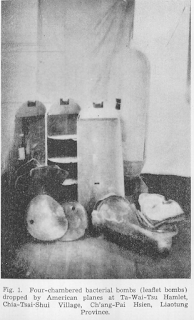
By the publication of the “Material on the Trial of Former Servicemen of the Japanese Army charged with Manufacturing and Employing Bacteriological Weapons” (Moscow, 1950) a wealth of information about the pracdtical work carried out under the direction of the Japanese bacteriologist Ishii Shiro (who was unfortunately not himself in the dock) was made available to the world. It was established beyond doubt that techniques had been employed for the mass-production of bacteria such as those of cholera, typhoid and plague, literally by hundreds of kilograms of the wet paste at a time. Techniques, quite simple in character, had also been used for the breeding of large numbers of rats and very large numbers of fleas, though in practice only the latter seem to have been disseminated. Moreover, the various witnesses were ready to give chapter and verse as to the dates upon which they had proceeded to various Japanese bases in China to superintend the methods of dissemination used. Abundant details were also forthcoming about the special secret detachments (such as the notorious “731”) and their laboratories, pilot plants, and prisons in which Chinese and Russian patriots were made use of with perfect sangfroid as experimental animals. In the course of its work, as will be mentioned below (p. 44) the Commission had the opportunity of examining some of the few remaining specimens of the earthenware “bombs” which were manufactured for Ishii in a special factory at Harbin.

It would seem that the Japanese militarists never abandoned their visions of world-conquest by the aid of biological weapons in general and the dissemination of insect weapons in particular. Before they departed from Dairen they systematically tore out from all volumes of journals in the university and departmental libraries articles which had any connection with bacterial warfare. It should not be forgotten that before the allegations of bacterial warfare in Korea and NE China (Manchuria) began to be made in the early months of 1952, newspaper items had reported two successive visits of Ishii Shiro to South Korea, and he was there again in March. Whether the occupation authorities in Japan had fostered his activities, and whether the American Far Eastern Command was engaged in making use of methods essentially Japanese, were questions which could hardly have been absent from the minds of members of the Commission.

-- From pages 13-14 of the Report of the International Scientific Commission for the Investigation of the Facts Concerning Bacterial Warfare in Korea and China
Partial Bibliography

Daniel Barenblatt, A Plague Upon Humanity: The Secret Genocide of Axis Japan’s Germ Warfare Operation, HarperPerennial, 2005

Tom Buchanan, "The Courage of Galileo: Joseph Needham and the 'Germ Warfare' Allegations in the Korean War," The Historical Association, Blackwell Publishers, 2001

Dave Chaddock, This Must Be the Place: How the U.S. Waged Germ Warfare in the Korean War and Denied It Ever Since, Bennett & Hastings, 2013

Stephen Endicott & Edward Hagerman, The United States and Biological Warfare: Secrets from the Early Cold War and Korea, Indiana Univ. Press, 1998

Stephen Endicott & Edward Hagerman, "Twelve Newly Released Soviet-era `Documents' and allegations of U. S. germ warfare during the Korean War," online publication, 1998, URL: http://www.yorku.ca/sendicot/12SovietDocuments.htm

Sheldon H. Harris, Factories of Death: Japanese Biological Warfare, 1932-45, and the American Cover-up, rev. ed., Routledge Press, 2002

Milton Leitenberg, "New Russian Evidence on the Korean War Biological Warfare Allegations: Background and Analysis," Cold War International History Project, Bulletin 11, 1998

Jeffrey A. Lockwood, Six-Legged Soldiers: Using Insects as Weapons of War, Oxford Univ. Press, 2010

Bernd Martin, "Japanese-German collaboration in the development of bacteriological and chemical weapons and the war in China." Ch. 11 (p. 200-214) in Japanese-German Relations, 1895-1945: War, diplomacy and public opinion (Ed. Christian W. Spang and Rolf-Harald Wippich), Routledge, 2006

John Powell, "A Hidden Chapter in History," Bulletin of the Atomic Scientists, October 1981

Also posted at The Dissenter/FDL

Search for Info/News on Torture

Google Custom Search
Add to Google ">View blog reactions

This site can contain copyrighted material, the use of which has not always been specifically authorized by the copyright owner. I am making such material available in my effort to advance understanding of political, human rights, economic, democracy, scientific, and social justice issues, etc. I believe this constitutes a 'fair use' of any such copyrighted material as provided for in section 107 of the US Copyright Law. In accordance with Title 17 U.S.C. Section 107, the material on this site is distributed without profit to those who have expressed a prior interest in receiving the included information for research and educational purposes. For more information go to: http://www.law.cornell.edu/uscode/17/107.shtml. If you wish to use copyrighted material from this site for purposes of your own that go beyond 'fair use', you must obtain permission from the copyright owner.