According to the document, a "Memorandum of Conversation" from the Psychological Strategy Board (PSB) dated July 6, 1953, the U.S. was not serious about conducting any investigation into such charges, despite what the government said publicly. The reason the U.S. didn't want any investigation was because an "actual investigation" would reveal military operations, "which, if revealed, could do us psychological as well as military damage."
The memorandum specifically stated as an example of what could be revealed "8th Army preparations or operations (e.g. chemical warfare)."
Psychological Strategy Board
The document in question was an enclosure to a memorandum to CIA director Allan Dulles from Horace S. "Pete" Craig. As CIA director, Dulles sat on the PSB board along with the Undersecretary of State and the Deputy Secretary of Defense, or their designated representatives. Craig was CIA and close to Dulles, working for CIA's Advisory Council on "comint" (communications intelligence). He seems to have been Dulles's representative for awhile at Board meetings. He later was a member of the Operations Coordinating Board, President Eisenhower's replacement for the PSB.
The July 6 meeting was attended by Craig, Wallace Irvin, Jr., Erasmus Kloman, and Richard L. Sneider. The group had many intelligence connections. This was not surprising as "psychological warfare" or "strategy" during the heyday of the early Cold War was, as one historian put it, "most of the time understood as synonymous with covert operations".
The PSB itself was meant to coordinate the activities of different U.S. agencies and departments. Controversial and disbanded about two years after it was founded in 1951, according to the Truman Library website, which has an extensive list of PSB holdings, its function was "to authorize and provide for the more effective planning, coordination, and conduct within the framework of approved national policies, of psychological operations."
Board member Sneider was at the time a State Department "policy analyst and intelligence expert" who also associated with the United Nations Association of the United States. Later he became Officer in Charge of Japanese Affairs. By the late 1960s, he was active on Nixon's National Security Council. From 1973 to 1978, he was U.S. ambassador to South Korea.
Irwin worked closely with UN Ambassador Henry Cabot Lodge in shepherding through the latter's "human rights" proposals at the United Nations in the early 1950s. The latter project was organized as a working group within the PSB, with Irwin acting as "Chair". Later, he became a speechwriter for George H.W. Bush, and became ensconced within the foreign policy establishment. He would ultimately become editor for the journal Foreign Policy.
"Ras" Kloman ran the meeting. In a brief telephone exchange I had with Mr. Kloman on November 18, he confirmed he had been with the PSB. He had no memory of the meeting in question, but told me he had been "the principal man on psychological warfare." Ill, and in a nursing home, Kloman declined answering any more questions. He is the only living member of the group who met that summer day 60 years ago.
Kloman had been a World War II Office of Strategic Services operative. He wrote a book about his experiences. An online biography states that Kloman also served in "the Central Intelligence Agency, Department of State, and Foreign Policy Research Institute at Penn, and as a corporate executive for AMAX and IBM. He was a Senior Research Associate at the National Academy of Public Administration from which he retired in 1985."
Trouble Countering Charges of Biological Warfare
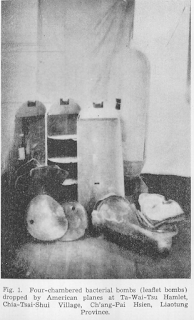
The "memorandum of conversation" -- really the minutes of the meeting -- concerns a discussion of the difficulties U.S. psywar experts were having getting academics to back the government's own propagandistic critique of the World Peace Council-backed International Scientific Commission's (ISC) conclusion supporting Soviet, Chinese, and North Korean claims that the U.S. had used offensive biological weapons in Korea. The situation was crucial because the evidence was backed up by the statements of a number of captured U.S. airmen, including some officers, providing confessions of use of BW, and giving detailed descriptions of who ordered it and how it was done.
The U.S. responded to the airmen's confessions with claims they were coerced, false confessions. Some claimed (with CIA connivance, if not inspiration) the POWs were "brainwashed." The origins of the Bush-era "enhanced interrogation" torture program can be traced in part to CIA and military research meant to counter, supposedly, the possibility of such "brainwashing." But since they knew it wasn't actually "brainwashing," the whole explanation was really a cover story for the creation of a psychologically based torture program.
(For more on the history of the ISC, which was chaired by the famous British historian of Chinese science, Dr. Joseph Needham, click here.)
An Army epidemiologist, Col. Arthur Long, had been asked to submit a report on ISC's work. Long, of course, found the ISC's own report to be a "complete fabrication." According to Long, the problem was "very few of [the ISC]... particular items of scientific 'evidence' could be demolished as such."
So a committee was formed under Detlev Bronk, president of the National Academy of Sciences. But, Kloman bemoaned, the NAS committee had "accomplished very little of substance." Bronk had disappointed them. A letter he wrote to support Long's analysis was, according to Kloman, "pitched in an extremely low key -- so much so as to be of dubious effect." Even U.S. diplomats at the UN refused to promote Bronk's letter.
The State Department sent a "circular airgram," written by Kloman, to US embassies in all the countries represented by the ISC (Italy, France, Brazil, UK, Sweden), asking them to find scientists to refute ISC's report. But the U.S. was having very little luck. Even the British "were pleasant but did nothing."
Kloman was perturbed but somewhat understanding. The ISC scientists were, he said, "politics aside... highly competent people."
The meeting turned towards countering BW claims at the UN, via pushing a U.S. call for an investigation by the United Nations of the Korean charges. (Of course, North Korea and China were at war with UN forces at the time.) Sneider described the different proposals the U.S. was putting forward, condemning the BW charges and calling for an investigation, while analyzing the results of the UN votes on these proposals. But the results of this campaign were "obscure." There was a sense the U.S. had missed an opportunity to more effectively win propaganda points. Sneider told the group the State Department verdict on the anti-ISC campaign was "no victory and no defeat."
The meeting continued with a discussion of "future possibilities" for action, but it ended with a bombshell.
The Dangers of an "Actual Investigation"
The PSB memorandum (PDF link) concluded with a stunning admission of duplicity, and -- I cannot believe but the CIA's censors were asleep at the switch here, to all our benefit -- a revelation about U.S. military actions in the Korean War that from our standpoint in the 2010s have been buried for decades.
Mr. Kloman observed that US policy, while favoring the proposal for an on-the-spot investigation, does not favor an actual investigation. One reason for this, he said, is the feeling of the military that an investigating commission would inevitably come across the 8th Army preparations or operations (e.g. chemical warfare) which, if revealed, could do us psychological as well as military damage. This reasoning assumes that the commission would have authority to examine anything they liked on either side of the battle line."While historians of the Korean War BW controversy will find it fascinating to analyze what this document means in the context of the long-standing feud between those who believe one side or the other, I think what is most important for us today is the reopening of the question of U.S. use of chemical weapons in that war.
Most people are probably unaware that there ever were charges of CW use by the U.S. in Korea. I know I was. Yet as early as March 1952, a Commission of the International Association of Democratic Lawyers (IADL) had visited North Korea to examine charges of war crimes, releasing a report that included documentation of chemical warfare.
"American planes have on various occasions used asphyxiating and other gases or chemical weapons at least since 6th May, 1951," the IADL commission wrote. "The commission took eye witness and expert testimony. Post-mortem examinations and autopsy results argued that some chemical had been used, with a "disagreeable smell, resembling the smell of chlorine.... In the affected area of the city it was noted that grass became yellow brown, objects containing an alloy of copper became blue green and rings of silver became black."
Victims of another alleged attack "felt an itching on the exposed parts of the body.... they observed red spots which grew to a size like haricot beans, which then swelled and were filled with pus." Some had injuries like "second-degree burns but with a much more, serious erosive action and taking a longer time to recover."
Critics of the IADL wrote off their findings as communist, fellow-traveller propaganda. Before long, the main controversy over US war crimes turned to the BW allegations, but the North Koreans have never withdrawn their allegations. In the 2001 Report and Final Judgment on US Crimes in Korea 1945-2001 by the Korea International War Crimes Tribunal, whose indictment was drafted by former U.S. Attorney General Ramsay Clark, the U.S. was found guilty of use of both chemical and biological warfare during the Korean War.
A Circumstantial Case, Records Destroyed
It's worth noting that the Chinese and North Koreans had ample reason to believe the U.S. capable of using biological or chemical warfare. The U.S. then had refused to sign the 1925 Geneva Protocol against use of chemical or biological weapons. The Chinese and Koreans knew the U.S. had amnestied the Japanese scientists of Unit 731, who had undertaken fatal experiments on both BW and CW on prisoners. Indeed, the ISC report had included a chapter on Unit 731.
Moreover, both Chinese and Koreans knew the Japanese had extensively used both biological, and even more so, chemical weapons during the Sino-Japanese War (coinciding in its last years with World War II).
An October 1988 article by historian Yuki Tanaka in the Bulletin of the Atomic Scientists, "Poison Gas: the Story Japan Would Like to Forget," described the CW campaign waged by Japan in China, and how the U.S. helped keep the subject from coming up in war crimes trials at the end of WWII. Meanwhile, the U.S. had become cozy with former Japanese war criminals, now being allowed back into Japanese civil and political life, while former collaborators with the Japanese were members of the U.S. backed Republic of Korea government.
The scope of Japan's chemical war unleashed in China can be ascertained by the damage left afterward. According to Nationalist Chinese sources in Taipei, approximately 700,000 chemical munitions were left abandoned in China after World War II. The Chinese government says that approximately 2,000 people still die each year from encounters with such ordinance. An ongoing clean-up of the chemical mess, in part paid for by Japan, is still ongoing in 2013.
A list of Japanese chemical ordinance and equipment that was captured by the U.S. at the end of WWII was recently declassified, and, revealing here for the first time, documentation shows the chemical weapons were shipped to the Army's Edgewood Arsenal "for detailed study."
Historians
U.S. historians either ignore the subject of chemical warfare entirely, or dismiss the charges of chemical warfare. "The United States did not use gas warfare in Korea although authority to do so was requested by some of our commanders in the field," wrote George Bunn in a 1969 article for the Wisconsin Law Review.
For whatever reason, a Chemical Mortar Battalion was sent from Edgewood Arsenal to the Korean theater, though I could not find evidence they had actually used chemical weapons. Perhaps this is evidence of the "preparations" Kloman alluded to and what Bunn meant by "requested authority." We won't know until the government opens up its archives completely. Meanwhile those who lived through the period are quickly passing from this world.
There are some documented, if circumstantial, pointers to possible CW activities. For instance, according to one document, the U.S. Air Force Psychological Warfare Board had a Biological-Chemical Warfare team under Lt. Col. L. N. Stead.
Meanwhile, it is also a fact that many documents of the Army Chemical Corps, which had responsibility for both chemical and biological weapons, were destroyed after recall from the National Archives in 1956. See Stephen Endicott and Edward Hagerman (York University), "United States Biological Warfare during the Korean War: rhetoric and reality."
Endicott and Hagerman are also the authors of a major analysis of the evidence for U.S. use of biological weapons during in Korea. See The United States and Biological Warfare: Secrets from the Early Cold War and Korea by Stephen Endicott and Edward Hagerman (1999, University of Indiana Press). A totally opposite point of view can be found Milton Leitenberg's "False Allegations of U.S. Biological Weapons Use during the Korean War", in Terrorism, War, or Disease? Unraveling the Use of Biological Weapons (2008, Stanford Security Studies, Anne L. Clunan, Peter R. Lavoy, and Susan B. Martin, eds).
Of course, chemical weapons of a sort were definitely used during the Korean War. The United States extensively used napalm in an extensive bombing campaign that destroyed most of North Korea's cities and killed hundreds of thousands of civilians. According to one source, "During the Korean War, the United States dropped approximately 250,000 pounds of napalm per day." Later, in the late 1960s, the U.S. sprayed the defoliant Agent Orange, also being used widely in the Vietnam War, near the demilitarized zone in Korea.
There is no book detailing the charges or refutation of charges of chemical warfare in the Korean War. It's never alluded to in Seymour Hersh's 1968 book, Chemical and Biological Warfare, nor in any book on U.S. chemical warfare that I've looked at, except perhaps in a very passing way. If I am wrong, I'm hoping someone will point that out to me.
"Whose Sarin?"
Seymour Hersh's article in The London Review of Books, "Whose Sarin?", set off a storm of commentary about his motives, his accuracy, and the significance of the revelations. Hersh claimed the Obama administration had been quick to "cherry-pick" intelligence findings. Obama had "failed to acknowledge something known to the US intelligence community: that the Syrian army is not the only party in the country’s civil war with access to sarin...."
For some reason, Hersh did not bring up the history he knows so well of U.S. secrecy and misdirection when it comes to use of chemical and biological weapons. Failing to do so only weakened his argument in what is otherwise a compelling analysis of events inside the Obama administration after news broke of the August 21, 2013 chemical weapons attack in a neighborhood near Damascus.
But the document and evidence I've laid out above should make anyone think twice, if not three times, about relying on U.S. assurances or propaganda regarding the use of chemical weapons by anybody. U.S. citizens should call for an opening of all archival material, which after 60 or more years cannot constitute a national security threat, though it may be an national shame and embarrassment for the U.S. government.
Crossposted at The Dissenter/FDL



 Posts
Posts


