Showing posts with label Nuremberg Trials. Show all posts

Sunday, December 29, 2013

CIA Cannot Confirm or Deny Having Files on Infamous Nazi Doctor

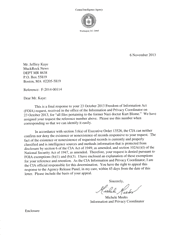
Some things never fail to surprise. And surprise was my reaction to my recent FOIA request at the MuckRock website on a notorious Nazi doctor who had been tried at Nuremberg. The CIA returned a "Glomar" response to my FOIA on Doctor Kurt Blome.


The CIA wrote, "In accordance with section 3.6(a) of Executive Order 13526, the CIA can neither confirm nor deny the existence or nonexistence of records responsive to your request."

Towards the end of the article, and quoted in full, is my appeal of this decision to the CIA. It is published here as a public service, to educate the public about an aspect of the war fought by the "greatest generation," that is not fully explored in a Tom Hanks movie or even a decent World War II history book. (A "no responsive records" on a similar FOIA to the FBI is also being appealed. A FOIA request to the Army has not received any response thus far.)

Glomar responses are considered in cases of "sensitive national security." Just how sensitive a national security issue can it be to admit the CIA has or does not have files on Kurt Blome? For those who are trying to get the truth out of the government on a multitude of different issues, beyond which whistleblowers like Edward Snowden or Chelsea (formerly "Bradley") Manning have been able to provide us, the fact that information more than 60 years old is so sensitive that the government can't admit or deny knowledge of it boggles the imagination.

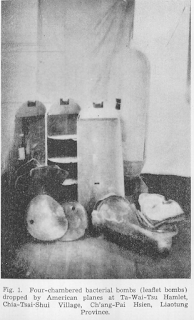
As readers may or may not be aware, I've been researching the allegations that the U.S. used biological weapons during the Korean War. The charges are still considered valid in China and North Korea, and along with the connivance of the United States in covering up Japanese biological and chemical warfare and medical experimentation in China during World War II, the truth or falsity of these charges are still a hot-button issue in Asia. (My recent article on the subject showed documentary proof that the U.S. was lying, at least in part, publicly about what was going on, and also showed that the U.S. was possibly involved in chemical warfare in Korea as well!)

A South Korean newspaper, The Chosunilbo, responding to Japan's latest provocation -- a visit by Prime Minister Abe to the notorious Yakasuna war shrine, where war criminals from World War II are buried -- reported, "By visiting Yasukuni, Abe has made it clear that he does not intend to back down from a diplomatic and even military confrontation with South Korea and China over the issue of whitewashing his country's wartime atrocities, Tokyo's flimsy colonial claim to South Korea's Dokdo islets and other territorial issues. It is obvious that he will push ahead with his rightwing agenda at all costs."

But what's all this got to do with Nazis, you may ask?

The research took me to the issue of the Nazis' own biological warfare program. According to the Nuremberg trial record, and the few histories on the subject written since, the Nazi doctor Kurt Blome was in charge of the National Socialists' "bacteriological warfare" program. He had built a testing facility in Posen, Poland, reportedly not too different from the Unit 731 facility in Ping Fan. It was captured by the Soviets, but Blome got away. He was later captured by the Americans, and interrogated by the secretive ALSOS group. He was tried as part of the famous Doctors' Trial at Nuremberg, but was acquitted. Some have implicated a deal was made with him for his BW information, and what he could tell the Americans about other Nazi scientists.

My research into the Unit 731 story had led me to track down the intelligence (OSS/Central Intelligence Group) connections of one primary figure involved in the decision to give amnesty to the Japanese BW war criminals, in exchange for getting BW (and other) data from them for use by U.S. scientists working at Ft. Detrick (and likely, too, for the Special Operations Division there, working on poisons and mind control research for the CIA). (This is the subject of an article to come, so I'm not going to give many details on who that intelligence person was.)

So I thought I should at least send a FOIA on Kurt Blome to the CIA. After all, according to historians Ute Deichmann, Linda Hunt, and Tom Bower, Blome had been a candidate for Army's Operation Paperclip, which sought out Nazi scientists to bring to the U.S. (like Werner von Braun). But presumably the U.S. Foreign Office or State Department balked on bringing this Nazi zealot to the America. After he was released from U.S. custody, he was interviewed by Ft. Detrick scientists, and subsequently, was said to be employed by the United States as a "camp doctor" at the European Command Intelligence Center at Oberursel, West Germany.

Now why, I wondered, was a Nazi doctor hired at the largest U.S. interrogation facility in post-World War II Europe? Moreover, why did Blome's trail end there? (A few sources state he was later arrested by the French and jailed, but I can find no clear documentary evidence of this.)

For the record, and I believe the readers' interest, I'd like to quote a bit from the June 16, 1947 closing brief at the Doctors Trial at Nuremberg for the United States of America versus Kurt Blome:
Blome was Deputy Reich Health Leader and Deputy Leader of the Reich Chamber of Physicians and the National Socialist Physicians' Association. He was a close collaborator of [Reich Health Leader, Leonardo] Conti, who was in direct charge of the civilian health service. By virtue of these positions, Blome held considerable power and influence. He knew that concentration camp inmates were being systematically used in criminal medical experiments. 

As the responsible head of bacteriological warfare, Blome personally suggested and carried out criminal experiments in that field. In the same connection he had poisons tested on human subjects and reported to Himmler on this matter.

Blome had full knowledge of the murderous freezing experiments by [SS doctor Sigmund] Rascher, supported his efforts to gain admission as an academic lecturer on that subject, and, as a member of the Reich Research Council, personally issued a research assignment to Rascher for further freezing experiments. He collaborated with Rascher in the Polygal experiments, during which inmates were shot and killed. He also issued a research assignment to Rascher in support of these experiments.

Blome had knowledge of [August] Hirt's [mustard] gas experiments in Natzweiler and furthered his work by issuing an assignment from the Reich Research Council.

As Deputy Reich Health Leader, Blome worked with the murderer [Arthur Karl] Greiser, Gauletier of Warthegan, who among other things assisted in the extermination of Jews in that area of Poland....
Historian, Michael H. Kater, in his book Doctors Under Hitler, said that Blome was one of a number of German doctors who were "instrumental not only in developing and introducing the Nuremberg race legislation but also in creating the severity with which its various enactments affected German Jews and the murderous ramifications thereafter" (p. 182)

Despite the crimes involved here, the story of U.S. government refusal to release records, and particularly obfuscation by the CIA, is nothing new. According to a 2005 Reuters story, "the CIA has refused to disclose documents about its postwar dealings with former Nazis who have not been accused of war crimes but belonged to organizations like the German Nazi party and the SS, congressional officials said. Some of the material is believed to deal with former Nazis who joined the allied Cold War effort against the Soviet Union in Europe, the officials said."

Former New York Congresswoman Elizabeth Holtzman told UPI at the same time as the Reuters article, "I think that the CIA has defied the law, and in so doing has also trivialized the Holocaust, thumbed its nose at the survivors of the Holocaust and also at Americans who gave their lives in the effort to defeat the Nazis in World War II."

What follows is the text of my FOIA appeal to the CIA:
December 12, 2013

Agency Release Panel
c/o Susan Viscuso
Information and Privacy Coordinator
Central Intelligence Agency
Washington, DC 20505

Reference: F-2014-00114

Dear Agency Release Panel:

This letter constitutes an administrative appeal to the Agency Release Panel, such appeal being guaranteed by Section 3.5(e) of Executive Order 13526.

I am writing to appeal the determination by the Central Intelligence Agency (CIA) with regard to my FOIA request filed on October 23, 2013, reference number F-2014-00114, for "all files pertaining to the former Nazi doctor Kurt Blome.”

The CIA response of November 6, 2013 indicated that, in accordance with section 3.6(a) of Executive Order 13526, the CIA could “neither confirm nor deny the existence or nonexistence of records responsive” to my request. CIA’s notification continued, “The fact of the existence or nonexistence of requested records is currently and properly classified and is intelligence sources and methods information that is protected from disclosure by section 6 of the CIA Act of 1949, as amended, and section 102A(i)(l) of the National Security Act of 1947, as amended.” This will be referred hereafter in this appeal by the popular name given to such a rejection, i.e., as a “Glomar” response.

The following are my reasons for appeal:

1) Some information related to cooperation Kurt Blome gave to both the military and intelligence agencies of the US government have already been released and are in the public record, and is further discussed below.

2) In her book, "Secret Agenda: The United States Government, Nazi Scientists and Project Paperclip, 1945-1990" (St. Martin’s Press, 1991), Linda Hunt noted that Kurt Blome had been interrogated as part of the Alsos missions at the end of World War II. Alsos was jointly staffed by the Office of Naval Intelligence, the Office of Scientific Research and Development, the Manhattan Project, and Army Intelligence (G-2), and mandated to investigate enemy scientific developments. The investigation included biological weapons. From the Nuremberg trial, where Blome was a defendant, we know that he was involved in biological weapons research for the Nazi government.

3) The record of Blome’s Alsos interrogation is in the public domain. See Alsos interrogation at the National Archives in the Kurt Blome INSCOM dossier XE001248. Arrest reports: in Blome's Nuremberg arrest file, Record Group (RG) 238, NARS.

INSCOM stands for U.S. Army Intelligence and Security Command.

Blome’s status as an accused defendant in the Nuremberg proceedings is well-known. The records of that trial are public domain, and it is difficult to believe that the CIA has no files or records or reports that discuss Blome in relation to the war crimes charges or the trial itself.

At the trial, it came out that Blome admitted at the Nuremberg Trial that he had been head of an institute in Posen that did research on biological warfare for the Nazis. Experiments had been carried out on Soviet prisoners-of-war as part of this research. See The Nuremberg Medical Trial, 1946/47 (Walter de Gruyter, 2001), p. 56.

4) Kurt F. L. Blome (F. L. for Friedrich Ludwig, the middle names of the same Kurt Blome who is the subject of my FOIA request and this appeal) is mentioned by name in a declassified list of “Foreign Scientist Case Files, 1945-1958”, part of the scientists who signed up to work for the U.S. government as part of Operation Paperclip, or the later Project 63. See URL: http://www.archives.gov/iwg/declassified-records/rg-330-defense-secretary/foreign-scientist-case-files.pdf

5) After Blome was acquitted at the Nuremberg Doctors’ Trial in August 1947, according to Hunt’s book, two months later, “four representatives of Fort Detrick -- the Maryland army base that was also headquarters of the CIA's biological warfare program -- interviewed Blome about biological warfare…. During a lengthy interview Blome identified biological warfare experts and their locations and described different methods of conducting biological warfare.” (p. 180) Blome was ultimately given a position working for the Americans at Camp King interrogation center, Oberursel, West Germany.

The Fort Detrick interrogation is known from Blome’s INSCOM dossier and his Joint Intelligence Objectives Agency (JIOA) dossier, RG 330, NARS.

According to the National Archives website, JIOA was “was established in 1945 as a subcommittee of the Joint Intelligence Committee (JIC) of the Joint Chiefs of Staff (JCS). The JIC served as the intelligence arm of the JCS, responsible for advising the JCS on the intelligence problems and policies and furnishing intelligence information to the JCS and the Department of State. The JIC was composed of the Army's director of intelligence, the chief of naval intelligence, the assistant chief of Air Staff-2, and a representative of the Department of State.”

“The JIOA was given direct responsibility for operating the foreign scientist program, initially code-named Overcast and subsequently code-named Paperclip.” (URL: http://www.archives.gov/iwg/declassified-records/rg-330-defense-secretary/)

Hence, the fact that Blome acted as an “intelligence source” for U.S. intelligence circles is no secret.

6) Some of the information that Blome could have given interrogators has been pieced together from German archives. The German historian, Ute Deichmann in her book, "Biologists Under Hitler" (Harvard Univ. Press, 1996) mentions, as an example of this kind of information, the Wolfram Sievers at the Institut fur Zeitgeschichte (MA 1406/1).

In these diaries, Blome is described as having conducted neutron radiation experiments, as well as making plans to carry out experiments with bacterial pathogens (p. 417).

7) According to BBC television producer Tom Bower in his book, "The Paperclip Conspiracy: The Hunt for the Nazi Scientists" (Little, Brown & Company, 1987), it is public record that Kurt Blome was hired by the U.S. Chemical Corps in August 1951 and certified by U.S. High Commissioner for Germany, John McCloy, as “not likely to become [a] security threat to the US” (p. 254) Bower gives as citation for this material RG 330 JIOA case file, “Blome,” in the National Archives.

8) The Nazi War Crimes Disclosure Act (P.L. 105-246, 5 U.S.C. § 552) mandated that Government agencies, including the CIA, take necessary steps necessary to declassify and open remaining classified records related to Nazi war criminals and criminality. This included “any person with respect to whom the United States Government, in its sole discretion, has grounds to believe ordered, incited, assisted, or otherwise participated in the persecution of any person because of race, religion, national origin, or political opinion, during the period beginning on March 23, 1933, and ending on May 8, 1945, under the direction of, or in association with…. the Nazi government of Germany”.

This law included an exception that would “reveal the identity of a confidential human source, or reveal information about the application of an intelligence source or method, or reveal the identity of a human intelligence source when the unauthorized disclosure of that source would clearly and demonstrably damage the national security interests of the United States.

While there is an exception made similar to that which the CIA claimed in its “Glomar” response to my FOIA request, I would argue from the information above that there is already a good deal about Kurt Blome in the public record that likely is in CIA files, and withholding such information because of a possible revelation re an intelligence or methods source is a moot issue.

While there may be aspects of the request that could still be denied under one or another FOIA exemption, I would ask that the elements of the files and other information from my original request that can segregably be released, be so released.

In conclusion, I ask that the Agency Release Panel reconsider its “Glomar” decision to neither confirm nor deny the existence or nonexistence of records responsive to my request.

I have shown that there is already a documentary of both the interrogation and employment of Kurt Blome by U.S. military and intelligence sources. I have shown that Kurt Blome is known to have been a used as an intelligence and/or methods resource after he came under U.S. custody. I have further shown that some of Kurt Blome’s expertise in scientific matters that may have been of interest to U.S. intelligence, and hence the CIA, has already been made public in German archives.

Finally, I would argue that lacking any reason to consider information on Kurt Blome something subject to a “Glomar” denial, it is also important to consider that it was the legislative intent of the United States Congress, in a law signed by the President of the United States, to release information related to Nazi war criminals or possible criminality by such persons.

According to the CIA’s own website, the Nazi War Crimes Disclosure Act was “the largest congressionally mandated, single-subject declassification effort in history, and a special website at the CIA was set aside to openly display documents the CIA released under this act. (URL: http://www.foia.cia.gov/collection/nazi-war-crimes-declassification-act)

In the spirit of that Act, and of the CIA’s own efforts to release information according to such lawful request and special effort, and given that so much about Kurt Blome has already gone into the public record concerning his activities as an intelligence and/or methods resource, and, finally, given the blood and treasure the citizens of the United States spent in fighting the Nazis, I ask that the “Glomar” exception be removed and my FOIA request appropriately processed.

I look forward to receiving your decision on this appeal in a timely fashion. If you have any questions, or believe discussion of this matter would be beneficial, please contact me or MuckRock News.

Sincerely,

J.K.
My thanks to both Jason Leopold and NSA Archive for their assistance, online and off, for help in understanding the Glomar experience!

[Update, 2/9/2014: In a letter dated January 22, 2014, the CIA responded to my appeal letter with the statement, "Your appeal has been accepted and arrangements are being made for its consideration by the Agency Release Panel."]

Saturday, April 18, 2009

More than Nuremberg: Thousands Prosecuted for War Crimes After World War II

While the example of the Nuremberg Trials is used often these days to describe what prosecutions might look like, few seem to remember that the prosecution of war criminals after World War II was much larger and took place over a longer period of time than most people realize. This is important when one considers the context of President Obama's granting of immunity to lower-level CIA interrogators (if they acted in "good faith" upon "authoritative" legal advice).

What even a cursory examination of historical precedent demonstrates is that after World War II prosecution of war criminals and accessories to war crimes were not limited to the famous Nuremberg 22 high-level Nazis, nor the few hundred or so prosecuted through the Nuremberg tribunals, but thousands of accused throughout Europe.

What follows is a brief lesson in how these prosecutions occurred, who was involved, and where and when they took place. It may surprise you that the United States, for instance, has an Office of Special Investigations (OSI) at the US Department of Justice. Its mission was to hunt down war criminals and bring them to justice. Established only in 1979, the OSI has a sterling record:
As of 2008, OSI has successfully prosecuted 107 Nazi persecutors. OSI has also worked closely with the Department of Homeland Security to stop more than180 former European and Japanese Axis perpetrators and suspected perpetrators of acts of persecution at U.S. ports of entry and bar them from entering the United States.
But looking back to the immediate post-World War II period, I found this at Teachers Guide to the Holocaust:
In addition to the well-known Nuremberg Trials of 1945-46 [of 22 defendents], there were Subsequent Nuremberg Proceedings held between December 1946, and April 1949, which tried 177 persons. Individual countries also prosecuted war criminals in national courts of law. The British held trials of the commandant and staff of the Bergen-Belsen camp, those responsible for forced labor, and the owners and executives of the manufacturer of Zyklon B, among others. The Netherlands, Hungary, Norway, Poland, West Germany, and Romania were some of the other countries that brought war criminals to trial.
Prosecutions continued for decades after World War II. Many are familiar with the trials of Adolph Eichmann and Klaus Barbie. Consider this from Eli Rosenbaum, who in 2000 was Director of the OSI at the US Department of Justice:
Let us look, if you will, just at the past month, February 2000. In one month, my office won two prosecutions. One at the United States Board of Immigration Appeals, the other, two weeks ago, at the United States Supreme Court, involving the case of former Auschwitz SS man Ferdinand Hammer. The Canadian government, just last week, won its citizenship case against Helmut Oberlander, a member of a mobile killing unit. And just last month, the British authorities won the appeal of the Sawoniuk case, a Ukrainian perpetrator, at the High Court in London. And only a few months ago the Croatian government, which frankly had to be dragged kicking and screaming into this prosecution, successfully prosecuted Dinko Sakic, the former commandant of the Jasenovac concentration camp.
Then, there's also the Documentation centers established to bring war criminals to justice (from the Danish Center for Holocaust and Genocide Studies):
After World War II, centres, commissions and offices were established with the purpose of bringing Nazi war criminals to trial. They collect information, investigate crimes, pass on names of Nazis to their respective governments and take action against Nazi criminals in their own countries.

‘Zentrale Stelle Ludwigsburg’ is Germany’s documentation centre, which collects evidence for the prosecution of crimes committed during the nazi regime in the period 1933-1945.

Immediately after World War II, the provisional Polish government established the ‘Central Commission for Investigation of German Crimes in Poland’. The main commission has since then investigated nazi crimes committed in Poland during World War II and these days exist under a different name, the 'Main Commission for the Investigation of Crimes against the Polish Nation'....

The ‘Simon Wiesenthal Center’ in Vienna, founded by the Nazi-hunter Simon Wiesenthal, is perhaps the most famous documentation centre. Since World War II, the centre has tracked down many Nazi war criminals.
And the trials continued:
Poland was relatively quick to convict the camp personnel from Auschwitz – at least those that could be found. Trials were initiated against at least 600 members of the Auschwitz camp personnel. Among these were the two camp commandants, Rudolf Höss and Arthur Liebehenschel, who were sentenced to death in 1947. Rudolf Höss was hanged in Auschwitz in 1941. A total of 21 were executed....

In West Germany the so-called Auschwitz Trials were conducted against the camp guards from the concentration and extermination camp at Auschwitz. The largest of these trials took place in Frankfurt am Main between 1963 and 1965, where 20 were accused. 17 were given jail sentences....

On 3 July 1964 twelve of the personnel in the extermination camp Sobibor stood accused of participating in the murder of Jews in the camp. All twelve were accused of assisting in the killings. The trial itself began in Hagen on 6 September 1965 and ended on 20 December 1966. More than 100 witnesses were called.
Major war crimes trials occurred in over 30 European cities between 1943-1947, from Paris to Riga, from The Hague to Bratislava, Bucharest, and Kharkov. Among those prosecuted were "concentration camp guards and commandants, police officers, members of the mobile killing squads, and doctors who participated in medical experiments."

The U.S. National Holocaust Memorial Museum has this to say:
The overwhelming majority of post-1945 war crimes trials involved lower-level officials and functionaries. In the immediate postwar years, the four Allied powers occupying Germany (and Austria) -- the United States, Great Britain, France, and the Soviet Union -- held trials in their zones of occupation and tried a variety of perpetrators for wartime offenses. Many of the earliest zonal trials, especially in the U.S. zone, involved the murder of Allied military personnel who had been captured by German or Axis troops. In time, however, Allied occupiers expanded their juridical mandate to try concentration camp guards and commandants and others who had committed crimes against Jews and others who suffered persecution in areas the Allies now occupied. Much of our early knowledge of the German concentration camp system comes from the evidence and eyewitness testimonies at these trials....

Allied Control Council Law No. 10 of December 1945 authorized German courts of law to pass sentence on crimes committed during the war years by German citizens against other German nationals or against stateless persons. For this reason, occupation officials left Euthanasia crimes -- where both victims and perpetrators had been predominantly German nationals -- to newly reconstructed German tribunals. These proceedings represented the first German national trials in the early postwar period. Both the German Federal Republic (West Germany) and the German Democratic Republic (East Germany) continued to hold trials against Nazi-era defendants in the decades following their establishment as independent states. To date, the Federal Republic (in its old manifestation as West Germany and in its current status as a united Germany) has held a total of 925 proceedings trying defendants of National Socialist era crimes. Many detractors have criticized German proceedings, particularly those held in the 1960s and 1970s, for doling out acquittals or light sentences to aging defendants or defendants who claimed superior orders.

Many nations which Germany occupied during World War II or who collaborated with the Germans in the persecution of civilian populations, especially Jews, have also held national trials in the years following World War II. Poland, the former Czechoslovakia, the Soviet Union, Hungary, Romania, and France, among others, have tried thousands of defendants -- both Germans and indigenous collaborators, in the decades since 1945. The Soviet Union held its first trial, the Krasnodar Trial, against local collaborators in 1943, long before World War II had ended. Perhaps Poland's most famous postwar national trial was held in 1947 in Krakow. The proceedings tried a number of functionaries of the Auschwitz concentration camp and sentenced Auschwitz camp commandant Rudolf Höss and others to death.
Another source notes the French tried over 2,000 "lesser criminals for crimes against humanity and war crimes" (see footnote 9 at link).

As we can see, the amount of people prosecuted for war crimes is much more than most people (even myself, prior to doing this research) imagined!

As the protest over the immunity granted by Obama to CIA torturers continues -- as to how much immunity it really grants, whether it was smart, whether it was a capitulation to blackmail, or a wily maneuver to get the top leadership of the Bush years -- we should all consider the lessons of history as regards prosecutions for war crimes. This history, so recent it seems, is already largely forgotten or misunderstood as pertains to the prosecutions argument.

This brief essay is an attempt to correct those misconceptions, and restore a sense of continuity with the precedents set by our immediate forebears as regards who should be prosecuted for war crimes. The criminals who are or recently were in the U.S. government should soberly consider the many decades the pursuit of war crimes can persist.

If I were them -- and I say this with a straight face -- I'd turn myself in and throw myself on the mercy of the court.

Sunday, February 15, 2009

On the U.S. Duty to Prosecute War Crimes (Part I)

Oh, beat the drum slowly and play the fife lowly...
In the United States, questions around prosecution of war crimes revolve around the use of torture by Bush Administration officials, as well as the illegality of the U.S. attack on Iraq, which resulted in over a million deaths.

As regards torture, the Bush administration's head judge at Guantanamo has already admitted that torture was used at that facility, and dropped the charges against one high-profile detainee, Mohammad al-Qatani, as a result.

When it comes to the attack on Iraq, there was this report in the Guardian late last year:
Addressing the British Institute of International and Comparative Law last night, [former British senior judge, retired, Lord] Bingham said: "If I am right that the invasion of Iraq by the US, the UK, and some other states was unauthorised by the security council there was, of course, a serious violation of international law and the rule of law. "For the effect of acting unilaterally was to undermine the foundation on which the post-1945 consensus had been constructed: the prohibition of force (save in self-defence, or perhaps, to avert an impending humanitarian catastrophe) unless formally authorised by the nations of the world empowered to make collective decisions in the security council ..."
If you read for awhile the various blog and mainstream press opinion pieces on the issue of prosecuting American officials, you will come across a good deal of pessimism and ignorance. Some of the critics of prosecuting are well-informed, but present one-sided views of the difficulties involved in making such a prosecution. But UN officials seem to find the issue quite straightforward.

From The Jurist:
[A]ccording to a statement made by UN Special Rapporteur on torture and other cruel, inhuman or degrading treatment or punishment Manfred Nowak in an interview Tuesday with German television program ZDF Frontal 21. Nowak said that such actions constituted a violation of the UN Convention Against Torture, to which the US is a party. Nowak noted that although evidence is available to press charges, he does not know whether US law would recognize the interrogation techniques used as forms of torture.
There are a number of instruments whereby U.S. officials are vulnerable to war crimes charges. The UN Convention Against Torture required implementing laws to be established in signatory states. Consequently, the U.S. "enacted 18 U.S.C. §§ 2340 and 2340A, which prohibit torture occurring outside the United States (torture occurring inside the United States was already generally prohibited under several federal and state statutes criminalizing acts such as assault, battery, and murder)" (see CRS report).

Besides CAT, the U.S. has a duty to prosecute Bush administration officials, both civilian and military (and intelligence), for torture and cruel, inhuman and degrading treatment of prisoners. H/T to Charles Gittings (emphasis added):
“The High Contracting Parties [signatories to the Geneva conventions, which includes the U.S.] undertake to enact any legislation necessary to provide effective penal sanctions for persons committing, or ordering to be committed, any of the grave breaches of the present Convention defined in the following Article.

“Each High Contracting Party shall be under the obligation to search for persons alleged to have committed, or to have ordered to be committed, such grave breaches, and shall bring such persons, regardless of their nationality, before its own courts. It may also, if it prefers, and in accordance with the provisions of its own legislation, hand such persons over for trial to another High Contracting Party concerned, provided such High Contracting Party has made out a prima facie case.

“Each High Contracting Party shall take measures necessary for the suppression of all acts contrary to the provisions of the present Convention other than the grave breaches defined in the following Article.

“In all circumstances, the accused persons shall benefit by safeguards of proper trial and defence, which shall not be less favourable than those provided by Article 105 and those following of the present Convention.”

Geneva III POWs, art. 129, Geneva IV Civilians, art. 146; see also 18 USC 2441(c)(1).
The issue seems clear. But opponents of prosecution, or sometimes just political pessimists who deem themselves "realists," cite the issue of prosecutorial discretion, believing there is no provision within, for instance, the CAT treaty, that requires prosecution. U.S. prosecutors are free to use their discretion in selecting whom they investigate and charge. This is not entirely wrong, although this passage from Chris Ingelse’s book The UN Committee Against Torture: An Assessment, puts the issue of prosecutorial discretion into greater legal context (H/T Kevin Jon Heller -- emphases added):
Article 7, par. 2 grants the authorities a discretionary power in terms of whether or not they prosecuted a suspect of torture. The Committee confirmed — in abstract terms — that the discretionary power was not unlimited and could not be determined on the grounds of national law only. In any event, the discretionary power could not extend as far as to allow those responsible for torture to escape punishment. The Committee found that there had to be opportunities for an individual to submit a complaint against prosecutors who fail to prosecute suspects of torture. If necessary, there had to be an opportunity for the victim himself to initiate criminal proceedings against the person suspected of torture.
As a matter of principle, the duty to prosecute is well established in international law. Ironically, it was the United States, along with its World War II allies, that pushed to establish this principle.

From University of Queensland Law Journal re "The United Nations and International Criminal Law" (emphases added):
In the NurembergTrial of the Major War Criminals, the International Military Tribunal held that ‘international law imposes duties and liabilities upon individuals as well as states’ and that ‘individuals can be punished for violations of international law.’[33] The Tribunal went on to proclaim:
Crimes against international law are committed by men, not by abstract entities, and only by punishing individuals who commit such crimes can the provisions of international law be enforced.
The Nuremberg Tribunal even went so far as to hold that the doctrine of nullim crimen sine iure must not be allowed to stand in the way of bringing persons to justice for acts which they must have known amounted to criminal conduct under international law:
To assert that it is unjust to punish those who in defiance of treaties and assurances have attacked neighbouring states without warning is obviously untrue, for in such circumstances the attacker must know that he is doing wrong, and so far from it being unjust to punish him, it would be unjust if his wrongs were allowed to go unpunished.
The next period will determine whether the U.S. will continue to alibi U.S. war criminals. The calls for some kind of investigatory commission should not be definitively ruled out, but any decision on such must follow a determination of whether to prosecute Bush, Cheney, Rumsfeld, Addington, Yoo, Rice, Haynes, and all the gang for crimes against humanity. To fail to do so, especially for lame excuses such as prosecutorial discretion, is in itself a crime and a violation of treaty obligations. Any use of "Truth" or "Truth and Reconciliation" commissions as a way to bypass the necessary prosecutions, as some fear is the plan of establishment Democratic Party liberals, should be opposed.

As Glenn Greenwald put it so well in an article last month:
The principal purpose of the Convention is to remove the discretion involved in prosecuting acts of torture and to bar the very excuses which every torturing society proffers and which our own torturing society is now attempting to invoke ("we were dealing with real threats; there were 'exceptional circumstances' that justified it; we enacted laws legalizing the torture; our leaders meant well; we need to move on").

International treaties which the U.S. signs and ratifies aren't cute little left-wing platitudes for tying the hands of America. They're binding law according to the explicit mandates of Article VI of our Constitution. Thus, there simply is no way to (a) argue against investigations and prosecutions for Bush officials and simultaneously (b) claim with a straight face to believe in the rule of law, that no one is above the law, and that the U.S. should adhere to the same rules and values it attempts to impose on the rest of the world.
For more on this issue, please click here to read Part II, which looks at relevant Supreme Court decisions, and the intervention of the notorious John Yoo into the treaty issue.

Search for Info/News on Torture

Google Custom Search
Add to Google ">View blog reactions

This site can contain copyrighted material, the use of which has not always been specifically authorized by the copyright owner. I am making such material available in my effort to advance understanding of political, human rights, economic, democracy, scientific, and social justice issues, etc. I believe this constitutes a 'fair use' of any such copyrighted material as provided for in section 107 of the US Copyright Law. In accordance with Title 17 U.S.C. Section 107, the material on this site is distributed without profit to those who have expressed a prior interest in receiving the included information for research and educational purposes. For more information go to: http://www.law.cornell.edu/uscode/17/107.shtml. If you wish to use copyrighted material from this site for purposes of your own that go beyond 'fair use', you must obtain permission from the copyright owner.