Showing posts with label Stephen Endicott. Show all posts

Thursday, December 21, 2017

Updated: The Suppressed Report on 1952 U.S. Korean War Anthrax Attack


[Link to download PDF of the document above]

With the U.S. threatening a pre-emptive attack on North Korea for the latter's pressing development of a nuclear warfare capability, it is more imperative than ever that the history of the U.S.-North Korea conflict be made available to the world, the better to assess the claims made by both sides.

While many see North Korea as a dictatorship run by a madman or evil, others see a rational government - dictatorial, yes - that seeks to defend itself against a power that once obliterated its country in war, and threatened it with nuclear weapons. Indeed, even today, the U.S. says it will not forego using nuclear weapons against North Korea and even executes military war games with South Korea that involve practice runs with nuclear bombers almost up to the border of North Korea.

Back in the early 1950s, during the Korean war, until the Soviets began to fly MiGs over the Korean peninsula in defense of the North Koreans, the U.S. had near unconstrained freedom of airspace over North Korea and China, and in particular, dropped hundreds of thousands of tons of Napalm on North Korea, wiping out nearly every city, and contributing to over a million civilian deaths, maybe 15% of the entire population. Because of the relentless bombing, the people were reduced to living in tunnels. Even the normally bellicose Gen. MacArthur found the devastation wreaked by the U.S. to be sickening.

Most controversially, both North Korea and China maintain that the U.S. used biological or germ warfare weapons against both North Korea and China during the Korean War. The U.S. has strenuously denied this. Captured U.S. flyers who told their North Korean and Chinese captors of the use of such weapons were told under the threat of courts martial to renounce such confessions after they were returned to U.S. custody. They all did so.

To convince the world of the truth of their claims, the North Koreans and Chinese, sponsored a purported independent commission, using the auspices of the World Peace Council, gathering together a number of leftist scientists from around the world. Most surprisingly, this commission, which came to be known as the International Scientific Commission, or ISC, was headed by one of the foremost British scientists of his time, Sir Joseph Needham. The ISC travelled to China and North Korea in the summer of 1952 and by the end of the year produced a report that corroborated the Chinese and North Korean claims that the U.S. had used biological weapons in an experimental fashion on civilian populations.

This posting is not meant to examine the full range of opinions or evidence about whether or not the U.S. used biological weapons in the Korean War. It is instead an attempt to publish essential documentation of such claims, documentation that has been withheld from the American people, and the West in general, for decades. I am publishing here Appendices AA and BB from the Report of the International Scientific Commission for the Investigation of the Facts Concerning Bacterial Warfare in Korea and China.

I introduced that report to the world and posted the report itself online back in January 2015. But the report itself is only some 60-odd pages long, and I was unable at that time to post or publish any of the voluminous appendices that documented the claims of the report. (I am reposting the original executive summary report at the close of this post, for reference sake.) The ISC appendices are crucial in assessing the claims made in the report, and the later denials from U.S. and other allied governments, such as Great Britain.

Appendices AA and BB concern claims of air attacks against various villages in Northeastern China in the Spring of 1952. Using the same kinds of insect (fleas, beetles, etc.) and related "vectors" (such as dropping feathers or rodents) that were studied intensely by Imperial Japanese military scientists and doctors as part of the infamous Unit 731 program. In a matter of proven historical record, but still largely unknown in the United States, the Pentagon and U.S. intelligence agencies, with knowledge of scientists working out of the Army's Ft. Detrick chemical and biological warfare labs, gave amnesty to the Unit 731 war criminals, who conducted their biological warfare experiments on live prisoners, who were incinerated after the Japanese scientists were done with them.

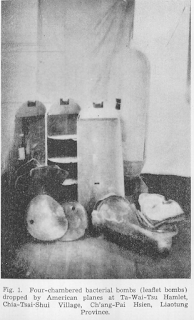
In the executive report, the ISC examined claims of a biological warfare attack in the town of "K'uan-Tien, which lies in the southeastern part of Liaotung province near the Yalu River," as well as a number of other "localities in the provinces of Liaotung and Liaohsi." They looked in depth at five "fatal human cases of respiratory anthrax and haemorrhagic anthrax," including "a railwayman, a tricycle-rickshaw driver, a housewife, a school-teacher, and a farmer." They considered the extreme, indeed, unprecedented appearance of this disease in that part of the world, and the fact that respiratory or inhalational anthrax had earlier been the subject of research by Ft. Detrick scientists. The analysis included laboratory examination from the bodies and from insects discovered in the area and believed to be spreading the disease, after being dropped by U.S. aircraft.

The ISC concluded (pg. 34 of the summary report, which can be accessed at end of this post):
On the basis of the evidence presented, and on their own searching and prolonged interrogation of a considerable number of witnesses, both medical and lay, the Commission was compelled to conclude that the delivery of various biological objects contaminated with anthrax bacilli to many places in the two Chinese provinces had taken place, and that this had given rise to a number of cases of a mortal infection hitherto unknown in the region, namely pulmonary anthrax and ensuing haemorrhagic meningitis. Eye-witness statements impossible to doubt indicated American airplanes as the vehicles of delivery of the infected objects.
The U.S. denied all biological warfare charges. They demanded the International Red Cross be allowed to independently examine the evidence and document the charges. But unknown to all, in secret meetings of top U.S. Pentagon, the CIA, and State Department officials, gathered together as the U.S Psychological Strategy Board, agreed that there never would be any independent investigation, as the Eighth Army was conducting operations during the Korean War which if they became known ("e.g. chemical warfare") "could do us psychological as well as military damage.” (See full article here.) The scholars Stephen Endicott and Edward Hagerman found similar evidence of an unwillingness to really examine the North Korean/Chinese/Soviet charges in their 1998 book on the BW controversy.

The controversy has simmered every since.

But convergent evidence of the charges was made in Chapter 13 of the 2006 book Deadly Cultures. Entitled "Allegations of Biological Weapons Use," the chapter was written by Martin Furmanski and Mark Wheelis. While these authors were highly dubious of the claims of U.S. biowarfare, they couldn't discount the anthrax charges. Primarily, they found that the description of inhalational anthrax made at this time - for instance, the wide range of incubational periods reported for the Chinese cases - came before a detailed scientific examination of such cases of anthrax had already been studied. But the ISC description was peculiarly apt and prescient. Furmanski and Wheelis concluded that the deaths documented by the ISC as due to inhalational anthrax had to be real and not faked.

"These results must have been from real human inhalation anthrax cases, since the information did not exist in 1952 to have allowed fabrication using textbook or medical literature sources," Furmanski and Wheelis wrote. (See pg. 260 of Deadly Cultures.)

But I should note, Furmanski and Wheelis in the end did not conclude this was full evidence of biological weapon attack. Indeed, they concluded it must have been of natural origin, though how such a coincidence of widely dispersed, unprecedented appearance of the disease occurred coinicentally with charges of biowar attack.

What they solely relied on for their conclusion was an April 2004 "personal communication" from a U.S. scientist that isolates from the B. anthracis samples from China, which by inference included those from the 1952 putative attack were "subjected to genomic analysis, and all were clearly indigenous to China." Furmanski and Wheelis believe that despite the "highly suspicious" nature of the inhalation anthrax cases discussed in the 1952 ISC Needham report, the genomic analysis proved that the anthrax cases reported to the ISC were of natural origin, and not from a U.S. biological warfare attack.

I have been in touch with all the people involved in this supposed genomic analysis, and while I find it odd that nothing was every published on this genomic or DNA analysis, I will leave a full analysis of the refutation of the ISC report on this score for a future and more scholarly essay. In the meantime, I have decided to publish the ISC documentation as in the West all we ever seem to get are what Cold War scholars publish. Even when critics of the U.S. historical account publish, the actual documentation is thin. This leaves us reliant on the authority of the scholars, which is an extraordinary situation.

[Update, December 21, 2017 - In spring 2017 I contacted U.S. anthrax expert Martin Hugh-Jones, whom Furmanski and Wheelis had referred to in their book as the source of a "genomic analysis" that showed the inhalation anthrax cases in China could not have come from U.S. stocks of anthrax. Professor Hugh-Jones referenced a Chinese scientist, Wang Bingxiang, who worked on bacterial vaccines at the Langhou Institute of Biological Products, who Hugh-Jones said had supplied samples of the 1952 anthrax cases to the Special Pathogens Lab (SPL) at the School of Veterinary Medicine at Louisiana State University.

I subsequently contacted both a U.S. scientist, Kimothy Smith, who Professor Hugh-Jones said worked on the identification of the anthrax strains brought from China to the SPL, and Mr. Wang in China. Neither of them backed up Hugh-Jones' story that the 1952 anthrax strain had been identified, much less worked on. Wang denied knowing anything even about it. Prof. Hugh-Jones subsequently told me in an email, "And as it seems that no one, including the Chinese, have any cultures from the 1952 'incident' (true or false) matters must remain at that. It was a time rife with governmental disinformation, especially by the Chinese & Soviets, so one must be cautious with any personal conclusions."

Professor Hugh-Jones did not reference any possible governmental disinformation from the U.S. side. But the failure to dismiss the inhalation anthrax accounts from the ISC, which Furmanski and Wheelis found so compelling that only the presence of supposed "genomic analysis" - now discredited - could dispel, means that hard evidence indeed exists to prove the presence of U.S. biological warfare attack upon China, and most likely North Korea, during the Korean War.

For his part, Professor Furmanski in correspondence to me maintains for other reasons that the North Korean and Chinese claims of germ warfare attacks were a hoax. He does this for a number of reasons, and seems among them to embrace the fairly recent publication of a Chinese official at the time, Wu Zhili, who had a posthumous publication stating the germ warfare attacks were a "false alarm," one which was then amped up for propaganda reasons into a full-scale campaign around the ostensibly false charges.

Few have embraced my main concerns, which center around the suppression of information in general around this historical incident. I cannot speak to North Korean or Chinese suppression, but I can document and obviously comment about the suppression by the U.S. and its allies, as information slowly is obtained about them. I can also encourage others to pursue original documents and do their own analysis, as I have done.

For his part, despite much professional obloquy, Dr. Needham maintained until the day he died that the U.S. had indeed used biological weapons against the North Koreans and the Chinese. His investigation went far beyond that detailed in this essay, and concerned more than the dissemination of anthrax.

Was there any fraud involved in Chinese, North Korean, or Soviet evidence of germ warfare attacks by the U.S.? I think it's possible there was, just as a suspicious patient might exaggerate symptoms to get the attention of a doctor they fear isn't taking them seriously. The importance of the suppressed ISC report is the attention given to many multiple sources of evidence. Sir Joseph Needham wasn't one of the leading scientists of his day for nothing. He understood the scientific approach to evidence.]

I hope that the publication of this material will lead to a greater effort by U.S. and European media and other commentators to assess the real history of U.S. and North Korean and Chinese relations, the better to counter the claims of the hawkish Trump administration and Pentagon spokespeople, who are threatening to plunge this country, and possibly the world, into a terrible new war, painting the North Koreans as unreasonable and dangerous people. But any fair historical account will see that while not by any means perfect, the North Korean regime has plenty to complain about and fear from U.S. intervention.


[Link to download PDF of the document above]

Original version of this article, without update, was published on April 26, 2017

Saturday, March 28, 2015

Book Review - "This Must Be the Place: How the U.S. Waged Germ Warfare in the Korean War and Denied It Ever Since"

There is no historical controversy as contentious or long-lasting as the North Korean and Chinese charges of U.S. use of biological weapons during the Korean War. For those who believe the charges to be false -- and that includes much of American academia, but not all -- they must assume the burden of explaining why the North Koreans or Chinese made up any bogus claims to attack the credibility of U.S. forces. Because they had no reason to do that.

It is a historical fact that the United States carpet-bombed and napalmed North Korea, killing nearly 3 million civilians thereby.

In other words, massive war crimes are already self-evident, and if there is any mystery, it is how historical amnesia and/or callous disregard for crimes such as those committed by the U.S. and its allies in Korea, or the millions killed by the U.S. in Southeast Asia, can go ignored today.

But the U.S. media and academia largely ignore evidence of U.S. use of weapons of mass destruction in its wars against independence struggles and for imperial dominance, or hock their wares to support propaganda that claims such crimes never took place. Evidence to the contrary, such as the 1950s International Scientific Commission investigation into U.S. use of bacteriological weapons in the Korean War, or the many confessions under interrogation by U.S. Air Force personnel, were generally suppressed. (I published myself the ISC's summary report earlier this year.)

The suppression of the ISC investigation was, as Chaddock points out, at least in part because ISC chair, Joseph Needham, was not shy in mentioning the connections between the US use of BW in Korea and China and Japanese use of biological experimentation and warfare against China during World War II. This was of high sensitivity to the U.S. as they publicly denied that, having made a deal with Shiro Ishii and the Japanese war criminals of Unit 731 to not prosecute them if US scientists from Fort Detrick and the CIA could get Japanese data and samples -- of human tissues gathered via vivisection! -- and use them for the US's own secretive BW program in the early years of the Cold War.

One man with evident integrity and unwilling to let the truth be buried is Dave Chaddock. His book, This Must Be the Place: How the U.S. Waged Germ Warfare in the Korean War and Denied It Ever Since, is a superb exercise in historical rebuttal. The falsifications and lies and secrets propounded by the U.S. on the issue of its crimes has been going on for decades now. For instance, the U.S. populace did not learn of its government's post-war deal with Nazis, or its amnesty of the Japanese Imperial Army's Unit 731, until nearly 40 years had passed from the time of these events. If the book seems partisan at times, it is understandably the passion of someone outraged at what he has discovered -- just as many who have served in America's imperial wars returned home outraged, and too often broken, by what they had seen and endured.

Chaddock builds on the seminal work of Stephen Endicott and Edward Hagerman, whose 1998 book, The United States and Biological Warfare: Secrets from the Early Cold War and Korea, laid out the best case we have thus far for proving the U.S. BW campaign really did take place. Chaddock takes on Endicott and Hagerman's critics, and has a particularly trenchant critique of the discovery of Soviet documents that indicate the BW evidence was "faked." The documents were oddly serendipitously discovered at the time Endicott and Hagerman were publishing their book. (The actual documents have not been publicly released, if they in fact exist.) Chaddock shows that the Soviet "fake", as presented, could not possibly have covered all the sites and evidence of biological weapons used in as short a time as given to create such a fantastic fraud.

Chaddock also takes on the controversy that surrounded the testimonies ("confessions") of downed flyers interrogated by North Korean and Chinese captors. The flyers' testimony was considered very convincing at the time, and the U.S. scrambled to find a way to discredit it. (The U.S. separated the flyers' upon repatriation, with one group claiming they were tortured, and the other insisting they told the truth. All were threatened with court-martial if they did not recant.)

This Must Be the Place is unique in delving into the actual matter of the U.S. flyers' confessions themselves. Chaddock makes a number of convincing observations. He notices that many of the flyers spoke to their shock at being told the U.S. was involved in germ warfare. One said he was shocked "beyond words," while Air Force Colonel Walker "Bud" Mahurin described how pilots in his command reacted to his revelations surrounding the U.S. "campaign of germ warfare" with looks of "great shock."

There is certainly more that could be unearthed about these confessions, and their aftermath, revelations that would add to Chaddock's heavily documented analysis. For one thing, it is of high interest that Boris Pash, then chief of the Army's Criminal Investigation Division (CID), and formerly a member of the secretive Counter Intelligence Corps (CIC), not to mention the head of security on the Manhattan Project and the leader of the mysterious Alsos Mission, AND also a CIA assassin, was involved in the interrogations of the returned flyers, and the threats to prosecute some of them. Also of high importance is the fact the record of those interrogations have been "lost" by the military.

The CIA and military created a cover-story that the men that confessed to use of BW had been "brainwashed." This so-called brainwashing was then used as an excuse to increase funding in their own mind-control programs, the most famous of which was MKULTRA. The CIA pushed the "brainwashing" story even though, as a memo by then CIA chief Allen Dulles showed the Agency knew there was "little scientific evidence to support brainwashing."

Nevertheless, CIA efforts to push the "brainwashing" charges included recruiting the leading members of a generation (or two) of social science and psychological/psychiatric academics and practitioners, whose experiments on use of drugs like LSD, and on sensory deprivation, and mock torture at government "survival" camps, led ultimately to an institutional use of torture by the U.S. government itself after 9/11. Chaddock details much of this history, and as with other topics he covers, refers readers to ample numbers of sources and references. His bibliography is an important assemblage of modern literature on the entire controversy.

Given the scare campaigns that are still used by the West about use of chemical or biological weapons by any country dubbed "evil" by the U.S., Chaddock's book takes on added relevance, if not urgency.

Chaddock's book is a real treasure. It presents in an entertaining and convincing fashion what Chaddock himself calls the "overwhelming evidence" of BW use by the Americans during the Korean War.

This is a time when independent thinking is in short supply. Curiosity and a zest for fact and truth are not traits highly valued today, particularly not when it comes to politics or historical controversies. But if you are someone who really wants to know the truth, who wants to see what someone who has spent a good deal of time researching this subject has to say, then Chaddock's book is just the thing for you.

Monday, December 9, 2013

CIA Document Suggests U.S. Lied About Biological, Chemical Weapon Use in the Korean War

According to a CIA document declassified in March 2006, the U.S. government lied publicly about pushing for a United Nations "on-the-spot" investigation into Soviet, Chinese and North Korean charges of U.S. use of biological weapons (BW) during the Korean War.

According to the document, a "Memorandum of Conversation" from the Psychological Strategy Board (PSB) dated July 6, 1953, the U.S. was not serious about conducting any investigation into such charges, despite what the government said publicly. The reason the U.S. didn't want any investigation was because an "actual investigation" would reveal military operations, "which, if revealed, could do us psychological as well as military damage."

The memorandum specifically stated as an example of what could be revealed "8th Army preparations or operations (e.g. chemical warfare)."

Psychological Strategy Board

The document in question was an enclosure to a memorandum to CIA director Allan Dulles from Horace S. "Pete" Craig. As CIA director, Dulles sat on the PSB board along with the Undersecretary of State and the Deputy Secretary of Defense, or their designated representatives. Craig was CIA and close to Dulles, working for CIA's Advisory Council on "comint" (communications intelligence). He seems to have been Dulles's representative for awhile at Board meetings. He later was a member of the Operations Coordinating Board, President Eisenhower's replacement for the PSB.

The July 6 meeting was attended by Craig, Wallace Irvin, Jr., Erasmus Kloman, and Richard L. Sneider. The group had many intelligence connections. This was not surprising as "psychological warfare" or "strategy" during the heyday of the early Cold War was, as one historian put it, "most of the time understood as synonymous with covert operations".

The PSB itself was meant to coordinate the activities of different U.S. agencies and departments. Controversial and disbanded about two years after it was founded in 1951, according to the Truman Library website, which has an extensive list of PSB holdings, its function was "to authorize and provide for the more effective planning, coordination, and conduct within the framework of approved national policies, of psychological operations."

Board member Sneider was at the time a State Department "policy analyst and intelligence expert" who also associated with the United Nations Association of the United States. Later he became Officer in Charge of Japanese Affairs. By the late 1960s, he was active on Nixon's National Security Council. From 1973 to 1978, he was U.S. ambassador to South Korea.

Irwin worked closely with UN Ambassador Henry Cabot Lodge in shepherding through the latter's "human rights" proposals at the United Nations in the early 1950s. The latter project was organized as a working group within the PSB, with Irwin acting as "Chair". Later, he became a speechwriter for George H.W. Bush, and became ensconced within the foreign policy establishment. He would ultimately become editor for the journal Foreign Policy.

"Ras" Kloman ran the meeting. In a brief telephone exchange I had with Mr. Kloman on November 18, he confirmed he had been with the PSB. He had no memory of the meeting in question, but told me he had been "the principal man on psychological warfare." Ill, and in a nursing home, Kloman declined answering any more questions. He is the only living member of the group who met that summer day 60 years ago.

Kloman had been a World War II Office of Strategic Services operative. He wrote a book about his experiences. An online biography states that Kloman also served in "the Central Intelligence Agency, Department of State, and Foreign Policy Research Institute at Penn, and as a corporate executive for AMAX and IBM. He was a Senior Research Associate at the National Academy of Public Administration from which he retired in 1985."

Trouble Countering Charges of Biological Warfare

The "memorandum of conversation" -- really the minutes of the meeting -- concerns a discussion of the difficulties U.S. psywar experts were having getting academics to back the government's own propagandistic critique of the World Peace Council-backed International Scientific Commission's (ISC) conclusion supporting Soviet, Chinese, and North Korean claims that the U.S. had used offensive biological weapons in Korea. The situation was crucial because the evidence was backed up by the statements of a number of captured U.S. airmen, including some officers, providing confessions of use of BW, and giving detailed descriptions of who ordered it and how it was done.

The U.S. responded to the airmen's confessions with claims they were coerced, false confessions. Some claimed (with CIA connivance, if not inspiration) the POWs were "brainwashed." The origins of the Bush-era "enhanced interrogation" torture program can be traced in part to CIA and military research meant to counter, supposedly, the possibility of such "brainwashing." But since they knew it wasn't actually "brainwashing," the whole explanation was really a cover story for the creation of a psychologically based torture program.

(For more on the history of the ISC, which was chaired by the famous British historian of Chinese science, Dr. Joseph Needham, click here.)

An Army epidemiologist, Col. Arthur Long, had been asked to submit a report on ISC's work. Long, of course, found the ISC's own report to be a "complete fabrication." According to Long, the problem was "very few of [the ISC]... particular items of scientific 'evidence' could be demolished as such."

So a committee was formed under Detlev Bronk, president of the National Academy of Sciences. But, Kloman bemoaned, the NAS committee had "accomplished very little of substance." Bronk had disappointed them. A letter he wrote to support Long's analysis was, according to Kloman, "pitched in an extremely low key -- so much so as to be of dubious effect." Even U.S. diplomats at the UN refused to promote Bronk's letter.

The State Department sent a "circular airgram," written by Kloman, to US embassies in all the countries represented by the ISC (Italy, France, Brazil, UK, Sweden), asking them to find scientists to refute ISC's report. But the U.S. was having very little luck. Even the British "were pleasant but did nothing."

Kloman was perturbed but somewhat understanding. The ISC scientists were, he said, "politics aside... highly competent people."

The meeting turned towards countering BW claims at the UN, via pushing a U.S. call for an investigation by the United Nations of the Korean charges. (Of course, North Korea and China were at war with UN forces at the time.) Sneider described the different proposals the U.S. was putting forward, condemning the BW charges and calling for an investigation, while analyzing the results of the UN votes on these proposals. But the results of this campaign were "obscure." There was a sense the U.S. had missed an opportunity to more effectively win propaganda points. Sneider told the group the State Department verdict on the anti-ISC campaign was "no victory and no defeat."

The meeting continued with a discussion of "future possibilities" for action, but it ended with a bombshell.

The Dangers of an "Actual Investigation"

The PSB memorandum (PDF link) concluded with a stunning admission of duplicity, and -- I cannot believe but the CIA's censors were asleep at the switch here, to all our benefit -- a revelation about U.S. military actions in the Korean War that from our standpoint in the 2010s have been buried for decades.
Mr. Kloman observed that US policy, while favoring the proposal for an on-the-spot investigation, does not favor an actual investigation. One reason for this, he said, is the feeling of the military that an investigating commission would inevitably come across the 8th Army preparations or operations (e.g. chemical warfare) which, if revealed, could do us psychological as well as military damage. This reasoning assumes that the commission would have authority to examine anything they liked on either side of the battle line."
While historians of the Korean War BW controversy will find it fascinating to analyze what this document means in the context of the long-standing feud between those who believe one side or the other, I think what is most important for us today is the reopening of the question of U.S. use of chemical weapons in that war.

Most people are probably unaware that there ever were charges of CW use by the U.S. in Korea. I know I was. Yet as early as March 1952, a Commission of the International Association of Democratic Lawyers (IADL) had visited North Korea to examine charges of war crimes, releasing a report that included documentation of chemical warfare.

"American planes have on various occasions used asphyxiating and other gases or chemical weapons at least since 6th May, 1951," the IADL commission wrote. "The commission took eye witness and expert testimony. Post-mortem examinations and autopsy results argued that some chemical had been used, with a "disagreeable smell, resembling the smell of chlorine.... In the affected area of the city it was noted that grass became yellow brown, objects containing an alloy of copper became blue green and rings of silver became black."

Victims of another alleged attack "felt an itching on the exposed parts of the body.... they observed red spots which grew to a size like haricot beans, which then swelled and were filled with pus." Some had injuries like "second-degree burns but with a much more, serious erosive action and taking a longer time to recover."

Critics of the IADL wrote off their findings as communist, fellow-traveller propaganda. Before long, the main controversy over US war crimes turned to the BW allegations, but the North Koreans have never withdrawn their allegations. In the 2001 Report and Final Judgment on US Crimes in Korea 1945-2001 by the Korea International War Crimes Tribunal, whose indictment was drafted by former U.S. Attorney General Ramsay Clark, the U.S. was found guilty of use of both chemical and biological warfare during the Korean War.

A Circumstantial Case, Records Destroyed

It's worth noting that the Chinese and North Koreans had ample reason to believe the U.S. capable of using biological or chemical warfare. The U.S. then had refused to sign the 1925 Geneva Protocol against use of chemical or biological weapons. The Chinese and Koreans knew the U.S. had amnestied the Japanese scientists of Unit 731, who had undertaken fatal experiments on both BW and CW on prisoners. Indeed, the ISC report had included a chapter on Unit 731.

Moreover, both Chinese and Koreans knew the Japanese had extensively used both biological, and even more so, chemical weapons during the Sino-Japanese War (coinciding in its last years with World War II).

An October 1988 article by historian Yuki Tanaka in the Bulletin of the Atomic Scientists, "Poison Gas: the Story Japan Would Like to Forget," described the CW campaign waged by Japan in China, and how the U.S. helped keep the subject from coming up in war crimes trials at the end of WWII. Meanwhile, the U.S. had become cozy with former Japanese war criminals, now being allowed back into Japanese civil and political life, while former collaborators with the Japanese were members of the U.S. backed Republic of Korea government.

The scope of Japan's chemical war unleashed in China can be ascertained by the damage left afterward. According to Nationalist Chinese sources in Taipei, approximately 700,000 chemical munitions were left abandoned in China after World War II. The Chinese government says that approximately 2,000 people still die each year from encounters with such ordinance. An ongoing clean-up of the chemical mess, in part paid for by Japan, is still ongoing in 2013.

A list of Japanese chemical ordinance and equipment that was captured by the U.S. at the end of WWII was recently declassified, and, revealing here for the first time, documentation shows the chemical weapons were shipped to the Army's Edgewood Arsenal "for detailed study."

Historians

U.S. historians either ignore the subject of chemical warfare entirely, or dismiss the charges of chemical warfare. "The United States did not use gas warfare in Korea although authority to do so was requested by some of our commanders in the field," wrote George Bunn in a 1969 article for the Wisconsin Law Review.

For whatever reason, a Chemical Mortar Battalion was sent from Edgewood Arsenal to the Korean theater, though I could not find evidence they had actually used chemical weapons. Perhaps this is evidence of the "preparations" Kloman alluded to and what Bunn meant by "requested authority." We won't know until the government opens up its archives completely. Meanwhile those who lived through the period are quickly passing from this world.

There are some documented, if circumstantial, pointers to possible CW activities. For instance, according to one document, the U.S. Air Force Psychological Warfare Board had a Biological-Chemical Warfare team under Lt. Col. L. N. Stead.

Meanwhile, it is also a fact that many documents of the Army Chemical Corps, which had responsibility for both chemical and biological weapons, were destroyed after recall from the National Archives in 1956. See Stephen Endicott and Edward Hagerman (York University), "United States Biological Warfare during the Korean War: rhetoric and reality."

Endicott and Hagerman are also the authors of a major analysis of the evidence for U.S. use of biological weapons during in Korea. See The United States and Biological Warfare: Secrets from the Early Cold War and Korea by Stephen Endicott and Edward Hagerman (1999, University of Indiana Press). A totally opposite point of view can be found Milton Leitenberg's "False Allegations of U.S. Biological Weapons Use during the Korean War", in Terrorism, War, or Disease? Unraveling the Use of Biological Weapons (2008, Stanford Security Studies, Anne L. Clunan, Peter R. Lavoy, and Susan B. Martin, eds).

Of course, chemical weapons of a sort were definitely used during the Korean War. The United States extensively used napalm in an extensive bombing campaign that destroyed most of North Korea's cities and killed hundreds of thousands of civilians. According to one source, "During the Korean War, the United States dropped approximately 250,000 pounds of napalm per day." Later, in the late 1960s, the U.S. sprayed the defoliant Agent Orange, also being used widely in the Vietnam War, near the demilitarized zone in Korea.

There is no book detailing the charges or refutation of charges of chemical warfare in the Korean War. It's never alluded to in Seymour Hersh's 1968 book, Chemical and Biological Warfare, nor in any book on U.S. chemical warfare that I've looked at, except perhaps in a very passing way. If I am wrong, I'm hoping someone will point that out to me.

"Whose Sarin?"

Seymour Hersh's article in The London Review of Books, "Whose Sarin?", set off a storm of commentary about his motives, his accuracy, and the significance of the revelations. Hersh claimed the Obama administration had been quick to "cherry-pick" intelligence findings. Obama had "failed to acknowledge something known to the US intelligence community: that the Syrian army is not the only party in the country’s civil war with access to sarin...."

For some reason, Hersh did not bring up the history he knows so well of U.S. secrecy and misdirection when it comes to use of chemical and biological weapons. Failing to do so only weakened his argument in what is otherwise a compelling analysis of events inside the Obama administration after news broke of the August 21, 2013 chemical weapons attack in a neighborhood near Damascus.

But the document and evidence I've laid out above should make anyone think twice, if not three times, about relying on U.S. assurances or propaganda regarding the use of chemical weapons by anybody. U.S. citizens should call for an opening of all archival material, which after 60 or more years cannot constitute a national security threat, though it may be an national shame and embarrassment for the U.S. government.

Crossposted at The Dissenter/FDL

Sunday, July 6, 2008

NYT Limited Hangout on SERE Torture & U.S. Biological Warfare

Ex-CIA high official Victor Marchetti wrote:
"A 'limited hangout' is spy jargon for a favorite and frequently used gimmick of the clandestine professionals. When their veil of secrecy is shredded and they can no longer rely on a phony cover story to misinform the public, they resort to admitting - sometimes even volunteering - some of the truth while still managing to withhold the key and damaging facts in the case. The public, however, is usually so intrigued by the new information that it never thinks to pursue the matter further."
Scott Shane's New York Times article, China Inspired Interrogations at Guantánamo (7/2/08), details the use of Albert Biderman's "Chart of Coercion" by members of the the military's Survival, Evasion, Resistance, Escape program, or SERE, program to teach torture techniques to interrogators. The article is a fine example of how to conduct a limited hangout, or selected revelation, of intelligence-related material. Its headline and story is disingenuous or betrays ignorance. The aim of the article is to demonstrate the nefariousness or deviance of those who taught SERE techniques to U.S. interrogators, and to hide the truth about the derivation of those techniques, and to the history of the their use by U.S. government agencies.

One only has to read my June 25 article on the same subject, Nuts & Bolts: How U.S. Organized Torture Program, and then compare it with Shane's article to understand the difference between an artfully constructed faux-expose and an in-depth study of an important story. (One commenter at Mathew Yglesias's blog over at The Atlantic suggested I had scooped The New York Times. I'll note for the record that some of the points in Shane's article first appeared in my essay; for instance, the linking of the Biderman chart to deprogrammers websites. I'll let the fact that the diary was the first to fully expose the Biderman charts techniques speak for itself.)

The only new information the Times article reported was the identification of the source material for Biderman's "Principles", adumbrated in a "Chart of Coercion" used as a didactic device by SERE instructors, described as first appearing in an article by Albert Biderman in a September 1957 issue of the Bulletin of the New York Academy of Medicine. The article was entitled Communist Attempts to Elicit False Confessions from Air Force Prisoners of War. (In my own article, I had noted -- erroneously, as it turns out -- that the chart had first appeared in a 1970s... but then I don't have the Times anonymous sources. As we shall see, Mr. Shane only discovered a part of the story.)

Mr. Shane's article writes:
The recycled chart is the latest and most vivid evidence of the way Communist interrogation methods that the United States long described as torture became the basis for interrogations both by the military at the base at Guantánamo Bay, Cuba, and by the Central Intelligence Agency.
What the author fails to mention:

1) The study of Communist interrogation methods was part of a decades-long research program in the effects of coercive interrogation techniques, including use of sensory deprivation, sleep deprivation, drugs, semi-starvation, isolation, and other techniques, conducted by the CIA and various military intelligence agencies to the tune of millions of dollars, and included the use of fake academic groups, university researchers, hospitals, and secret experimentation upon U.S. and other countries' civilian population (Mr. Shane could have referenced the New York Times in-house library, where he would have found the NYT August 2, 1977 article, "Private Institutions Used in CIA Effort to Control Behavior," by Nicholas M. Horrock). The findings of this ongoing research project into mind control and torture were implemented by the CIA, and possibly other military intelligence and/or police agencies, as even a cursory glance at the declassified version of the CIA's own 1963 counterintelligence interrogation manual demonstrates.

2) The Times article also is incorrect in its conclusion that particularly "Chinese methods [of interrogation and torture] had been recycled and taught at Guantánamo." Mr. Shane mistakes the fact that the Biderman-SERE chart originated in an article on POW reactions from the Chinese/Korean War with the U.S. for the full history of how U.S. torture was derived. In the Biderman article itself, Mr. Biderman made clear that there was nothing especially novel about Chinese methods of coercive interrogation (although it is true that the Chinese relied more heavily on group pressures and thought reform than other countries did). Biderman concluded (bold emphasis added):
It is that the finding of our studies which should be greeted as most new and spectacular is the finding that essentially there was nothing new or spectacular about the events we studied. We found, as did other studies such as those of Hinkle and Wolff, that human behavior could be manipulated within a certain range by controlled environments. We found that the Chinese Communists used methods of coercing behavior from our men in their hands which Communists of other countries had employed for decades and which police and inquisitors had employed for centuries.
Furthermore, the chart in question, labelled "Communist Coercive Methods for Eliciting Individual Compliance," was itself not the original version of this chart. Biderman himself, in the article cited by the Times notes that the chart of techniques is but a "condensed version" of an "outline" produced by the author before a U.S. Senate subcommittee investigating "Communist Interrogation, Indoctrination and Exploitation of American Military and Civilian Prisoners" in June 1956. As for Chinese use of these techniques, towards the end of his article, Biderman states:
It should be understood that only a few of the Air Force personnel who encountered efforts to elicit false confessions in Korea were subjected to really full dress, all-out attempts to make them behave in the manner I have sketched. The time between capture and repatriation for many was too short, and, presumably, the trained interrogators available to the Communists too few, to permit this.
Over and over, Mr. Shane's article tries to portray the torture of detainees at Guantanamo by U.S. interrogators and jailers as something derived from Chinese forms of torture, and he uses the Biderman chart to punctuate his argument. But the evidence from Biderman's own article, and the preponderance of evidence from both primary and secondary historically sources points to a more complex and nuanced view of the origins of U.S. torture. The emphasis upon so-called Chinese origins serves two purposes: it uses the scandal of U.S. torture to make propaganda points against the Chinese, and furthermore, it perpetuates a cover story regarding U.S. use of bacteriological warfare during the Korean War that ascribes its blown cover to the fiction that North Korean and Chinese interrogation were meant to produce "false confessions," as I explain below.

False confessions and the elicitation of information via torture

Published along with Biderman's essay in the September 1957 Bulletin is another article by government researchers, Lawrence Hinkle and Harold Wolff, who are referenced in the Biderman article mentioned above. This article -- The Methods of Interrogation and Indoctrination Used by the Communist State Police -- has as much, or more interest, to those who wish to study the development of governmental torture by the United States, has, for instance, its own very interesting charts, and examines the history of Russian state security procedures, going back to Czarist times. Wolff and Hinkle also describe key differences between Russian-Soviet and Chinese forms of interrogation. The latter's emphasis on re-education of political belief and the role of group pressures to produce the same is cited by both Biderman and Hinkle and Wolff as a chief difference between the two forms of communist-derived interrogation.

Wolff and Hinkle's article, based on studies they had conducted for the military and CIA -- their initial report had remained classified for a number of years -- also produced a number of charts. Two of them are as remarkable as the now more publicized version describing Biderman's so-called "principles." Entitled "A Typical Time Table - Easter European Secret Police Systems (Communist)", the table outlines a period of detention lasting up to 250 weeks. The outline describes an initial period of isolation, followed by the beginning of interrogation, all to be undertaken under a regimen of "progressive disorganization" of the prisoner's psyche. A second table, "The Detention Regimen" describes the procedures to be used, including "Total Isolation... No View Outside, Light in Ceiling Burns Constantly", sitting and sleeping in "fixed position", noting, "Pain May Result from Fixed Positions During Sleep and When Awake." Additionally, food is to be "Distasteful -- just Sufficient to Sustain Nutrition."

The point of all this is to produce a state within the prisoner that includes fear, uncertainty, fatigue, pain, humiliation, and therefore "Great Need to Talk" and "Great Need for Approval of Interrogator." Again, all of this is duplicated in the CIA's own 1963 manual, and subsequently in manuals produced by the CIA for training of foreign interrogators, armed forces and police in the mid-1980s.

Did all this torture, whether by Soviet, Chinese, Korean, or U.S. interrogators produce actionable intelligence? Did it produce "false confessions?

In order to answer these questions, we must be clear about what these techniques were meant to produce, and that was, as the Hinkle/Wolff essay makes clear, "progressive disorganization" of the prisoner. Under this weakened state of existence, and in a state of near-total dependency, the interrogator works the art of establishing rapport. The results themselves are related to what is meant to be produced.

When the Soviet Stalinist government of the 1930s meant to discredit old elements of the regime, labelling former cadre of the Communist Party "enemies of the state", the intended result was the "false confession." At that time, the Dewey Commission in the United States (named after the respected U.S. academic who chaired the investigation, John Dewey) investigated and cleared Leon Trotsky and other "old Bolsheviks" from the wild prosecutorial claims of the Russian prosecutors. It was the "confessions" of some of these former leaders of the Soviet Union that seemed so inexplicable at the time. The drama of the situation was captured by novelist Arthur Koestler in his famous novel, Darkness at Noon.

Much later, the supposed confessions of Hungarian Cardinal Josef Mindszenty after his 1948 arrest by the Stalinist police greatly puzzled Western observers. It was supposed that he was tortured, but even then, how had he been made to "confess" in such a relatively brief period of time?

The issue of false confessions elicited under torture had its largest airing when, in 1952-53, captured U.S. airmen told their captors that they had engaged in dropping biological weapons on North Korea and China as part of the U.S. air campaign against those countries. The accusation was vigorously denied by the United States, and a propaganda campaign was begun in the guise of investigating the "brainwashing" of U.S. prisoners. Wild stories of mind control drugs and secret interrogation techniques that could gain unique influence over the personalities of its victims were circulated. It was in this environment that Albert Biderman, Lawrence Hinkle, Harold Wolff, Robert Jay Lifton and others were enlisted to study how the Chinese had produced the "false confessions" of U.S. POWs.

Except, were the confessions false?

Publicly, that was the story. But when researchers met behind closed doors, or at professional meetings, a different story emerges. At a 1957 symposium organized by the Group for the Advancement of Psychiatry (GAP) on "Methods of Forceful Indoctrination: Observations and Interviews", Dr. Louis West noted that "the enemy had a considerable degree of success in obtaining intelligence information and in forcing prisoners to engage in propaganda activities" (emphasis added; the quote is from GAP Symposium No. 4, July 1957, published by GAP Publications Office).

(Robert Jay Lifton, quoted in Mr. Shane's New York Times argument as saddened that Chinese interrogation methods were used by the U.S., a "180-degree turn" by U.S. interrogators, was a prominent presenter at this same conference, along with Dr. Edgar Schein of MIT, and the aforementioned Dr. Lawrence Hinkle. When I asked Dr. Lifton some time ago, and in another context, if he had any "personal memories or thoughts" about the work of Drs. Biderman, Hinkle and others, he replied by e-mail that he had no personal memories of these individuals.)

After the airmen were repatriated back to the United States, they all recanted their "confessions", although they had to do so under threat of court martial, a remarkable threat to issue, if the confessions were on the surface of them false.

U.S. Biological Warfare in Korea?

The U.S. chemical and biological warfare program after World War II was one of the most expensive and secretive campaigns ever undertaken by the U.S. government, comparable to the Manhattan Project. The NYT article makes much over the production of "false confessions" to the use of biological weapons by the U.S. during the Korean War. But there is an alternate, studied case demonstrating that the execrable and illegal use of such weapons occurred. (Both chemical and biological warfare were banned by the 1925 Geneva Convention.)

While there is no smoking gun document, there is a great deal of circumstantial evidence, much of it detailed by Canadian academics Stephen Endicott and Edward Hagerman in their 1998 book, The United States and Biological Warfare (Indiana University Press). More recently, respected bioethicist Jonathan Moreno, Senior Policy and Research Analyst for the President Clinton's Advisory Committee on Human Radiation Experiments, has called Endicott and Hagerman's claims "compelling, if not conclusive", and the U.S. research program in biological warfare worthy of further investigation.

I cannot do justice to the full extent of information unearthed by Endicott and Hagerman, but the following is a brief summary of the data.

*** At the close of World War II, the United States, under the authority of General Douglas MacArthur granted immunity to members of Japanese Unit 731 "in exchange for data of research on biological warfare". Led by the infamous General Shiro Ishii, this covert branch of the Japanese Imperial Army, based in Manchuria, a conquered portion of China, engaged in the worst sort of experimentation, including live vivisection of POWs, deliberate infection of disease, and study of disease "vectors" of infection, as by fleas, to study the suitability of large-scale bacteriological warfare. According to Jonathan Moreno, in his book Undue Risk, according to recent research Unit 731 may have been responsible for the deaths of over 270,000 civilians.

*** In 1950, U.S. spending on biological warfare research was $5.3 million. In 1951-1953, the high-water mark of the Korean War, money spent on such development was $345 million -- a lot of cash in 2008 dollars. Truman's Secretary of Defense George Marshall approved the recommendation of the Stevenson Committee two weeks after the Chinese entry into the Korean conflict. Chaired by Earl Stevenson, and including representatives from U.S. Rubber, AT&T Co., Harvard Medical School, and a secretariat "drawn from the Defense Department, the Research and Development Board, the Chemical Warfare Service, and the Air Force" (Endicott & Hagerman, p. 45), the Committee recommended "an increase in funding and for research and development to bring biological weapons to operational readiness as soon as possible" (p. 47).

*** U.S. government documents, such as the memo, "Mechanism of Entry and Action of Insecticidal Compounds and Insect Repellents" (Oct. 26, 1952), attached to the 1953 Fiscal Year Budget, which included the following (p. 77):
Application to BW [Biological Warfare]: $25,000 (35% of $72,000).

Information on the mechanism of action of insecticides is applicable directly to problems involved in both the offensive application of and protection against insect dissemination of biological agents. Under project 465-20-001, insect strains resistant to insecticides are being developed. These represent a potentially more effective vehicle for the offensive use of BW of insect borne pathogens....
Another memo -- reproduced as an appendix to Endicott and Hagerman's book (p. 202) -- dated March 17, 1953, from the Air Force Chief of Plans to the Chiefs of War Plans and of Psychological Warfare, notes:
The Psychological Warfare Division will direct and supervise covert operations in the scope of unconventional BW and CW [Chemical Warfare] operations and programs and the psychological aspects of BW and CW....

The War Plans Division will... Integrate capabilities and requirements for BW and CW into war plans... Participate in the determination of munitions requirements for BW and CW to implement improved plans.
Why this document doesn't serve as a "smoking gun" in the eyes of most is beyond me. But extraordinary claims, as such are allegations of serious war crimes, demands a great deal of evidence. There is much more such evidence in Endicott and Hagerman's book, but I cannot reproduce it all here. One important discussion of the evidence occurred in The Bulletin of Atomic Scientists in May/June 1999. Another discussion, concerning the relevance of newly "discovered" Soviet documents and their effect upon the controversy, occurred in the Cold War International History Project Bulletin in Winter 1998.

*** Chinese documents, and the U.S. airmen confessions are another, if controversial, source of information. Altogether, 36 U.S. officers gave statements to the Chinese of involvement in U.S. operational use of biological weapons, including two colonels and two captains. Endicott and Hagerman's book lists a number of manuscript and Chinese government document sources. Also of significance is the Report of the International Scientific Commission for the Investigation of the Facts Concerning Bacteriological Warfare in Korea and China, published by the Chinese, which offered over 600 pages of documentary evidence. Needless to say, this report, which found plausible the charges of bacteriological warfare, examining spent bomb casings and medical documents, among other evidence, was not widely distributed in the U.S., though Time Magazine pilloried it when it appeared. The Commission was headed by Dr. Joseph Needham, a very respected British author and researcher.

Summary

The New York Times article, China Inspired Interrogations at Guantánamo, is a sophisticated use of journalism in the service of propaganda. While it attaches the recent use of torture and coercive methods of interrogation by the United States to some of its origins in the study of communist methods of interrogation, it does so in a one-sided way. It attributes methods of detention and treatment of prisoners that was not unique to China. If anything, the U.S. model of psychological torture is probably closer to that used by the Soviet secret police. In any case, this type of torture was not developed by the communists, but had its origins in the police procedures of autocratic governments, not least that of Czarist Russia.

The article also fails to mention the long interest of military and U.S. intelligence agencies in the use of these methods, nor their implementation by the U.S. government, long before the "war on terror" and the Iraq and Afghanistan wars were twinkles in the eye of the current administration. One wonders how SERE officers and personnel like being the scapegoats for a U.S. policy that goes back decades.

Finally, the article perpetuates a mythology as to the use of "false confessions" during the Korean War to mask the origins of U.S. research into mind control and coercive interrogation that go back at least to the U.S. Navy's Project Chatter in the late 1940s, and the CIA's Operation Bluebird in 1950, both well before the Korean War. The purpose of this form of propaganda is to cover-up very serious questions about the use of biological warfare approved by the highest levels of the U.S. government, a serious war crime if it in fact, as appears very probable, occurred. In any case, the destruction of documents by the United States over the years makes a reconstruction of our own history extraordinarily difficult. CIA director Richard Helms ordered all MKULTRA documents destroyed in 1973; luckily, one cache of these documents had been copied, and became available later, but much remains unknown, because destroyed.

Many of the Korean War documents were also destroyed, or remain classified or hidden. Endicott and Hagerman note that they were told that archivists at the U.S. National Archives say that some files of the Chemical Warfare Service were recalled by the Army and destroyed in the period 1956 to 1969 (p. 256).

We cannot know the entire story of U.S. covert operations, including the research into torture interrogations, and the use of chemical and biological weapons. The fact that decades after the fact it is difficult to access information on these subjects speaks for itself, as does the destruction of much of the documentation.

The New York Times prides itself as the paper of record in the United States, that publishes "all the news that's fit to print." But as in the run-up to the Iraq War, the NYT, like much of U.S. mainstream media, has acted as a conduit for the official "line" of the U.S. government, much as Pravda and Izvestia once did for the sclerotic Kremlin bureaucracy. The widespread disbelief in the Warren Commission explanation of the Kennedy assassination, and the popularity of conspiracy television shows like The X-Files reflects a nascent consciousness among the mass of the American population that the truth is too often hidden from them.

It is a shame to see with what alacrity the Chinese torture model has been taken as gospel by both bloggers and conventional media sources. Most seem to have never even purused the actual documents that are quoted. Others speak and write passionately about subjects they have barely even studied. In George W. Bush's America, there is nothing needed more than the ability to think clearly and analytically, with an independent and curious mind, and a willingness to take the truth, whatever it may be, wherever it will take us. If that means entering a dark territory where what one believed to be true and honorable turns out to be otherwise, then the sooner we travel such a journey the better.

Wednesday, March 12, 2008

Out of the Shadows? A Tale of Two Wars

The New York Times famously writes that it publishes "all the news that's fit to print." But there's a lot that doesn't get published, even on the Internet. Let's look at two examples.

Yesterday, the Pentagon made it official. According to a U.S. military study, Saddam Hussein had no links to Al Qaida. None. Nada. But like a pesky gopher that sticks its head up out of the ground, and then swiftly disappears down the hole into its dark tunnels, governmental truth made a very swift appearance yesterday. And now, it's going to be snatched back out of the light and stuffed into a deep governmental shaft. Here's the UK Guardian on subject (with a h/t to StuHunter at Daily Kos):
The Pentagon study based on more than 600,000 documents recovered after US and UK troops toppled Hussein in 2003, discovered "no 'smoking gun' (ie, direct connection) between Saddam's Iraq and al-Qaida", its authors wrote.
George Bush and his senior aides have made numerous attempts to link Saddam Hussein and Al Qaeda terror in their justification for waging war against Iraq.

Wary of embarrassing press coverage noting that the new study debunks those claims, the US defence department attempted to bury the release of the report yesterday.

The Pentagon cancelled a planned briefing on the study and scrapped plans to post its findings on the internet, ABC news reported. Unclassified copies of the study would be sent to interested individuals in the mail, military officials told the network.
The Pentagon played this trick a few years back, when it declared "secret" another report that showed negligence in planning for post-war Iraqi reconstruction. The document was deemed officially "of limited value." Yes, for the mandarins and demagogues that rule this country, the truth is "of limited value." At least for now, we have ABC's posting of an executive summary of the current Saddam-Al Qaida report.

But then we all knew there was no link between Saddam and Al Qaida, didn't we? I know the polls showed otherwise, and then there are the Rush Limbaughs of this world who will prattle on endlessly with little regard to facts or veracity anyway. But the report certainly isn't shocking.

Meanwhile, today's New York Times has more on the slowly emerging story of military-CIA videotaping of interrogations. As we first heard it some weeks ago, the CIA had taped the interrogations of two "high-profile" detainees, Abu Zubaydah and Abd al-Rahim al-Nashiri -- and then later destroyed those videotapes illegally. The investigation into the destruction of the tapes seems to be going nowhere, or moving at the glacial pace of congressional investigations that aren't related to baseball or steroids, which is the same thing. According to the NYT:
The Defense Department is conducting an extensive review of the videotaping of interrogations at military facilities from Iraq to Guantánamo Bay, and so far it has identified nearly 50 tapes, including one that showed what a military spokesman described as the forcible gagging of a terrorism suspect....

The review was intended in part to establish clearer rules for any videotaping of interrogations, Defense officials said. But they acknowledged that it had been complicated by inconsistent taping practices in the past, as well as uncertain policies for when tapes could be destroyed or must be preserved.
You can bet that there were a lot more than 50 videotapes, and as for audio tapes? Well, no one's even asking, so there must be hundreds. (The CIA 1960s interrogation manual, KUBARK, suggested taping interrogations as a routine matter.) But I suppose when the Pentagon finishes its "review" we won't be seeing it posted online or published anytime soon.

So this story might be a notch higher on the "shock" scale, but then, one generally expects the Pentagon and CIA to do these types of things. We're not liberal Pollyannas, are we?

But, sometimes there are shocking reports and studies, and these never see the light of day either. Nor is it always the government which censors. The editors and publishers of scholarly journals and establishment press also exert a real if impalpable influence on the nation's public discourse.

So I was surprised to see that an important 2002 article by the British scholars, Stephen Endicott and Edward Hagerman's "United States Biological Warfare during the Korean War: rhetoric and reality," has failed to date to find a scholarly publisher. Endicott and Hagerman were the authors of the 1998 book, The United States and Biological Warfare: Secrets from the Early Cold War and Korea (Bloomington, IN: Indiana University Press). The thesis of both the book and article is that the United States, all denial and protestations aside, experimented with biological warfare against North Korea and China during the Korean War.

From the 2002 article:
For half a century one of the most closely guarded state secrets of the United States government has been its large-scale field experiments with biological weapons during the Korean War. This secrecy is perhaps not surprising since, as a prominent American scholar has noted, if it is shown that the US engaged in germ warfare then it will also be shown that the US in the eyes of most of the world has committed a major international war crime... Such an admission would be an intolerable blow to the prestige of a government and a nation many of whose citizens believe that the United States is the natural moral and human rights leader of the world....

The Air Force was assigned the primary operational role in biological warfare. The directorate of the air force biological weapons program during the Korean War was divided into two parts, both parts reporting separately to Lt-Gen. T. D. White, deputy chief of staff for operations. The task of the first part, known as the US Air Force BW-CW Division (with an acronym AFOAT-BW) under Colonel Frank Seiler, was to establish an overt biological warfare capability for the emergency general war plan against the Soviet Union referred to earlier... Initial capability within this plan was phased in by March 1952 but it was plagued with difficulties, shortage of refrigeration facilities for the brucellosis pathogen and fell short of expectations.

But there was another part. The second part was hidden in the Psychological Warfare Division of the air force under the command of Colonel John J. Hutchison and its tasks were to direct and supervise covert operations 'in the scope of unconventional BW and CW operations and programs,' and to 'integrate capabilities and requirements' for biological warfare and chemical warfare into war plans... Our understanding about what was going on in the Korean War was the covert experimental testing of biological weapons within the objectives of the emergency war plan, with the added advantage these weapons might serve some tactical purpose in the war.
The article, like the book, is copiously documented, and the authors, admitting they have no "smoking gun" document, nevertheless build a powerful case for the use of these weapons. I'll spend some time in future articles giving more details to their thesis.

But the story caught my attention because of a footnote. Back in 1952-1953, the scandal over use of these weapons broke because U.S. fliers shot down over Korea and imprisoned as POWs gave confessions as to the use of biological warfare, leading to investigations by various boards, by Congress, and impassioned denials by the military and U.S. authorities. Out of the turmoil, a tom-tom of accusation of Chinese "brainwashing" was beat: U.S. soldiers had been tortured into giving false confessions. In the clandestine hallways of the CIA and military intelligence offices, millions of dollars poured into research programs to discover the secret to this so-called "brainwashing" program. And so was born the CIA program of research into mind control, MKULTRA. The U.S. instituted their SERE program (Survival, Evasion, Resistance, Escape), training military personnel how to withstand torture. Over 50 years later, this training was reverse-engineered in order to teach a new generation of American interrogators how to torture.

But what if these so-called false confessions were real? What if the fliers, under coercive interrogation, or otherwise, had told the truth? What if the U.S. had committed a serious war crime? Where would this leave the project to study brainwashing? Was torture about producing false confessions, or producing valid information? Did torture work or not?

As you can probably tell, these questions lead directly to the issues that haunt the nation today. Even bigger than the torture-brainwashing story is the truth behind the nature of the U.S. state, its military, its capability for great destruction, and its willingness to use it. (Hiroshima and Nagasaki were less than ten years before the Chinese crossing of the Yalu River.)

This is an important story. This story deserves to come out of the shadows. We deserve to know our history, how to think about our history. Endicott and Hagerman's study deserves wider dissemination.

Tonight I walked outside. There was a ghostly half-moon falling slowly in the western sky, fuzzy and indistinct behind a shredded grey cloud that skirted in front of it. The reality of the moon hit me, even as it was shrouded by dark nocturnal clouds. It's really there, I thought, this half-planet rotating for ages hundreds of miles from this blue-green Earth. That's reality, behind the mists.

Let's find our reality behind the mists, outside of the government imposed shadows of secrecy.

Search for Info/News on Torture

Google Custom Search
Add to Google ">View blog reactions

This site can contain copyrighted material, the use of which has not always been specifically authorized by the copyright owner. I am making such material available in my effort to advance understanding of political, human rights, economic, democracy, scientific, and social justice issues, etc. I believe this constitutes a 'fair use' of any such copyrighted material as provided for in section 107 of the US Copyright Law. In accordance with Title 17 U.S.C. Section 107, the material on this site is distributed without profit to those who have expressed a prior interest in receiving the included information for research and educational purposes. For more information go to: http://www.law.cornell.edu/uscode/17/107.shtml. If you wish to use copyrighted material from this site for purposes of your own that go beyond 'fair use', you must obtain permission from the copyright owner.