Sunday, January 12, 2014

How the Press, the Pentagon, and Even Human Rights Groups Sold Us an Army Field Manual that (Still) Includes Torture (updated)

I'm marking the 12th anniversary of the abomination that is Guantanamo with a couple of repostings related to how the Bush administration, with the connivance of key members of the press and the human rights community, sold a continuation of torture as an end to torture.

Such a reposting seems necessary as the entire press, human rights groups, and blogging world continues to ignore the ongoing issue of torture via interrogations. While indefinite detention, forced cell extractions aka beatings, and the painful forced-feeding of hunger strikers still garners attention, and rightly so, the fact the U.S. continues to have an official policy of torture in its interrogation manual continues to be ignored, even though it is the most important issue about torture facing America today.

Eschewing the worst-looking forms of torture, like waterboarding, in 2006, at the same time that "high-value detainees" like Khalid Sheik Muhammad and Abu Zubaydah were transferred out of the CIA black sites and sent to Guantanamo, the U.S. put out a new Army Field Manual (AFM) with instructions on interrogations that claimed to be "humane."

Origin of AFM Rewrite Out of Ashes of Abu Ghraib Scandal

Only recently have I found the possible origin of the new AFM's drafting in the August 2005 recommendations of a Joint Chiefs of Staff panel subsequent to the military investigations into the Abu Ghraib scandal. (See pg. 315-16 of this document.)
Recommend a policy-level review and determination of the status and treatment of all detainees, when not classified as EPWs [Enemy Prisoners of War]. This review needs to particularly focus on the definition of humane treatment, military necessity, and proper employment of interrogation techniques. (e.g. boundaries or extremes)....

Recommend study of the DoD authorized interrogation techniques to establish a framework for evaluating their cumulative impact in relation to the obligation to treat detainees humanely.
The study of "authorized interrogation techniques" was tasked to the Undersecretary of Defense for Intelligence, Stephen Cambone.

But a number of the new techniques that ultimately showed up in the newly written AFM were not humane at all. In fact, they amounted to torture and/or cruel, inhumane and degrading behavior. Over the years various human rights groups recognized this and came out publicly for changes to the AFM. (See here, and here, and here, and here, and here.)

The AFM made changes to its text that allowed wider latitude in use of drugs in interrogations, while eliminating prohibitions against sleep deprivation and stress positions that had been in the pre-2006 AFM. Even worse, a category of prisoners that were not considered subject to Geneva Convention POW protections was singled out for a special kind of interrogation "technique," as described in the manual's Appendix M.

Appendix M allowed for use of isolation for 30 days, and potentially indefinitely; sleep deprivation for up to 30 days, but potentially indefinitely; manipulation of environment and diet (so long as it wasn't "extreme"); and forms of sensory deprivation, so long as every form of sensory input wasn't affected.

There was very little interest in whether or not or how these new techniques were being used. In fact, no one had apparently even thought to ask the government until I did in January 2010 whether or not Appendix M had even been used. Not surprisingly, the Department of Defense confirmed it was using Appendix M interrogations at Guantanamo.

More surprising was my discovery, confirmed by a DoD spokesman, that the use of the Appendix M torture techniques was approved in a Bush-era Office of Legal Council memorandum, and left in place by the Obama administration despite claims that all such memos were withdrawn in January 2009. Even to this day, in a massive political failure, not one human rights group or legal organization has recognized this fact.

The Torture Never Stopped

Intense abusive interrogations continue. We know from a filing by Omar Khadr in his Canadian court case that prior to release from Guantanamo to Canadian authorities, and shortly after his plea deal with Military Commissions authorities in October 2010, Khadr was subjected to prolonged interrogation that likely was conducted, given the key presence of the use of isolation, to Appendix M parameters: "Following the Pre-Trial Agreement, the Americans transferred Omar to a maximum security detention facility restricted for prisoners convicted of offenses. Omar was thrown back into solitary confinement and continued to be subjected to months of prolonged interrogations consisting of a sequence of 9 hours of interrogation per day for 9 days at a time."

With an even dozen years of crimes at Guantanamo -- fully over 1/3 of them under the auspices of the Obama administration -- I think it's time to review just how consensus around torture takes place in actuality. As we shall see, it is a complex story, involving media manipulation, psychological effects such as denial, and subordination of human rights to party politics and an achingly slow platform of reformist change. I say "consensus" because silence about all this amounts to consensus.

The following was published at Alternet and my own blog, Invictus, in January 2009. (My first writing recognizing torture in the AFM goes back to the introduction of the new manual in September 2006, when I wrote under my pseudonym Valtin.) In a day or two, I will publish part two, which will look at how the foreign press saw through what DoD was doing, and how a major blogging news and opinion site helped cover that up.

++++++++++++

How the Press, the Pentagon, and Even Human Rights Groups Sold Us an Army Field Manual that (Still) Includes Torture

A January 17 [2009] New York Times editorial noted that Attorney General designate Eric Holder testified at his nomination hearings that when it came to overhauling the nation's interrogation rules for both the military and the CIA, the Army Field Manual represented "a good start." The editorial noted the vagueness of Holder's statement. Left unsaid was the question, if the AFM is only a "good start," what comes next?

The Times editorial writer never bothered to mention the fact that three years earlier, a different New York Times article (12/14/2005) introduced a new controversy regarding the rewrite of the Army Field Manual. The rewrite was inspired by a proposal by Senator John McCain to limit U.S. military and CIA interrogation methods to those in the Army Field Manual. (McCain would later allow an exception for the CIA.)

According to the Times article, a new set of classified procedures proposed for the manual was "was pushing the limits on legal interrogation." Anonymous military sources called the procedures "a back-door effort" to undermine McCain's efforts at the time to change U.S. abusive interrogation techniques, and stop the torture.

A Forgotten Controversy

Over the next six months or so, a number of articles in the New York Times, the Washington Post, and the L.A. Times described the course of the controversy. By mid-June 2006, the NYT was reporting that, under pressure from unnamed senior generals and members of Congress (including McCain, and Senators Warner and Graham), the Pentagon was rethinking its plan to have a classified annex to the AFM, which would include a different set of interrogation rules for "unlawful combatants," like the detainees at Guantanamo. Included in the discussion about these classified procedures were, reportedly, members of the State Department and various human rights organizations.

According to an article in the L.A. Times, this latest fight over the classified procedures went back at least to mid-May 2006. The manual itself had been written at the U.S. Army Intelligence Center at Ft. Huachuca, Arizona, roughly a year earlier, and then sent to the Pentagon for further evalution. Secretary of Defense Donald Rumsfeld's right-hand man, Stephen Cambone, was put in charge of its final draft. According the L.A. Times article, members of Congress were "keen to avoid a public fight with the Pentagon." The announcement that the controversial and still unknown procedures might not be included in the manual was seen as a success by human rights groups.

Yet the proverbial chickens never hatched, and by early September 2006 the new Army Field Manual was finally released. The section on special interrogation procedures for "unlawful combatants" was included as a special appendix (Appendix M), and published in unclassified format. According to a L.A. Times story on September 8, Cambone was crowing that the new Army Field Manual instructions would give interrogators "what they need to do the job." The article noted:
The new manual includes one restricted technique that will only be used on so-called unlawful combatants – such as Al Qaeda suspects – not traditional prisoners of war.

That technique, called “separation,” involves segregating a detainee from other prisoners. Military officials said separation was not the equivalent of solitary confinement and was consistent with Geneva Convention protections.
As for the proposed secrecy surrounding the new techniques, the Pentagon had decided it couldn't keep them secret forever. Senator Warner was also on record as against any classified annex to the manual.

Not long ago, I wrote about what was included in Appendix M, which purports to introduce the single technique of "separation." In fact, the Appendix M includes instructions regarding solitary confinement, sleep deprivation, sensory deprivation, and, in combination with other procedures included in the Army Field Manual, amounted to a re-introduction of the psychological torture techniques practiced at Guantanamo, and taught by Survival, Evasion, Resistance, and Escape, or SERE psychologists and other personnel at the Cuban base and elsewhere.

The rewrite of the Army Field Manual included other seemingly minor changes. It introduced dubious procedures, such as the "False Flag" technique, wherein interrogators could pretend they were from another country. It also redefined the meaning of "Fear Up," a procedure meant to exploit a prisoner's existing fears under imprisonment. Now, interrogators could create "new" fears. The AFM rewrite was a masterpiece of subterfuge and double talk, which could only have been issued from the offices of Rumsfeld and Cambone.

One would think this turnaround of the Pentagon's position regarding a removal of these controversial procedures would have been a matter of some note. But there was no protest from Congress, no mention of the past controversy in the press, and only vague comments at first and then acceptance by human rights organizations like Amnesty International and Human Rights Watch. Only Physicians for Human Rights protested the inclusion of the techniques listed in Appendix M. For the rest... silence.

[Author's Note, 1/13/2014: By 2009, Amnesty International had clearly come out against Appendix M, as we can see at this posting. In 2010, Open Society Foundations, Human Rights First and Human Rights Watch signed a letter to the Pentagon, along with other groups, asking for the removal of Appendix M. The letter stated, "we are concerned that Appendix M creates a legal precedent that may be used in the future by othergovernments to justify abusing captured U.S. personnel. As we make clear above, Appendix M can be interpreted to allow serious abuse, including months of abnormal sleep deprivation.]

DoD Rolls Out the New Model

On September 6, 2006, a news briefing was held by the Department of Defense, as part of the unveiling of the new Army Field Manual, in conjunction with the then-new Defense Department Directive for Detainee Programs (DoD Directive 2310.01E). Deputy Assistant Secretary of Defense for Detainee Affairs Cully Stimson and Army Deputy Chief of Staff for Intelligence (G-2) Lt. Gen. John Kimmons were the DoD presenters.

Much of the belief that the AFM provides an improvement over previous policies of the Department of Defense is likely due to a confusion between the two documents introduced that summer of 2006, the new Detainee Program Directive and the new Army Field Manual.

DoD Directive 2310.10E made a number of changes in regards to detainee operations and management. It made clear that "All persons subject to this Directive shall observe the requirements of the law of war, and shall apply, without regard to a detainee’s legal status, at a minimum the standards articulated in Common Article 3 to the Geneva Conventions of 1949..." The same type of language appears in the text of the Army Field Manual itself.

During the press briefing on September 6, and a different one the next day for the foreign press, reporters were not so easily fooled.

One unnamed reporter at the DoD briefing challenged Lt. Gen. Kimmons on the "single standard" issue:
Q General, why was the decision made to keep these categories -- the separate categories of detainees? You have traditional prisoners of war and then the unlawful enemy combatants. Why not treat all detainees under U.S. military custody the exact same way?
Kimmons's answer gives us insight into the kind of convoluted legal thinking that went into the Pentagon's rationale for the acceptability of coercive interrogation -- for some (emphasis added):
GEN. KIMMONS: Well, actually, the distinction is in Geneva through the Geneva Convention, which describes the criteria that prisoner -- that lawful combatants, such as enemy prisoners of war -- which attributes they possess -- wearing a uniform, fighting for a government, bearing your arms openly and so on and so forth. And it's all spelled out fairly precisely inside Geneva.

Geneva also makes clear that traditional, unlawful combatants such as in the -- 50 years ago, we would have talked about spies and saboteurs, but also now applies to this new category of unlawful -- or new type of unlawful combatant, terrorists, al Qaeda, Taliban.

They clearly don't meet the criteria for prisoner of war status, lawful combatant status, and so they're not entitled to the -- therefore to the extra protections and privileges which Geneva affords.
But Kimmon's clarification was not very helpful. In fact, if a prisoner is judged not a "lawful combatant", then he or she immediately becomes covered by Geneva IV, the "Civilian Convention," which protects anyone "who, at a given moment and in any manner whatsoever find themselves" held prisoner. According to the International Red Cross Commentary on the Geneva Conventions:
Every person in enemy hands must have some status under international law: he is either a prisoner of war and, as such, covered by the Third [POW] Convention, [or] a civilian covered by the Fourth Convention.... There is no intermediate status; nobody in enemy hands can fall outside the law.
Separation and Sensory Deprivation

One questioner took on the topic of the "Separation" technique. Wasn't it the same as solitary confinement, and wasn't solitary confinement "banned by Common Article 3 in the affront to human dignity, other provisions? "Are you confident," a reporter asked, "that separation is permitted under Common Article 3?"

The Deputy Assistant Secretary of Defense for Detainee Affairs responded by denying that separation amounted to solitary confinement, even though the AFM describes the technique as, among other things "physical separation" "limited to 30 days of initial duration." Extensions for such physical separation must be reviewed and approved the General Officer or Flag Officer who initially approved the original "separation."

Kimmons' reply was even more disingenuous:
We have always segregated enemy combatants on the battlefield at the point of capture and beyond, to keep them silent, segregate the officers from the enlisted, the men from the women, and so forth. That's traditional; it goes back to World War II and beyond.
So, is "separation" a matter of segregating prisoners, or what? In the Army Field Manual itself, one gets that same kind of double talk. At first it is presented thus:
The purpose of separation is to deny the detainee the opportunity to communicate with other detainees in order to keep him from learning counter-resistance techniques or gathering new information to support a cover story; decreasing the detainee's resistance to interrogation.
This description sounds a lot like segregation for security purposes, although there is that phrase "decreasing the detainee's resistance." A page or so later, however, we find the following (emphasis added):
The use of separation should not be confused with the detainee-handling techniques approved in Appendix D [Guide for Handling Detainees]. Specifically, the use of segregation during prisoner handling (Search, Silence, Segregate, Speed, Safeguard, and Tag [5 S's and a T]) should not be confused with the use of separation as a restricted interrogation technique.
Furthermore, we learn that "separation" requires an interrogation plan, and medical and legal review, as well, of course, as "physical separation." If this is not solitary confinement for the purposes of breaking a prisoner down for interrogation, then the English language has lost all purpose in explaining things.

Another line of questioning took on the AFM's contention that it banned sensory deprivation. The entire exchange at the September 6 hearing is worth reproducing here. It represents, among other things, the most thorough line of inquiry I have seen by any reporter in quite some time. The following quote contains added emphases.
Q General, as an expert in interrogations, do you believe that sensory deprivation was abusive, or did it ever prove to be helpful in interrogation?

GEN. KIMMONS: Sensory deprivation is abusive and it's prohibited in this Field Manual, and it's absolutely counterproductive, in my understanding of what we have used productively. Sensory deprivation, just to be clear -- and we define it in the Field Manual, but basically, it comes down to the almost complete deprivation of all sensory stimuli, light, noise, and so forth, and to the point where it can have an adverse mental, psychological effect on a -- disorienting effect on a detainee.

Q So could there be deprivation of light alone for extended periods of time, as opposed to complete sensory deprivation?

GEN. KIMMONS: I think the total loss of an external stimulus, such as deprivation of light, would not fit what we have described here as -- for example, if you're hinting about separation, separation does not involve the darkness or lack of that type of sensory stimulation.

Q That wasn't the question, though. Would sensory -- would the deprivation of light alone be permitted under the current manual, as opposed -- because you described sensory deprivation as total deprivation --

GEN. KIMMONS: That's correction.

Q -- of all senses. So deprivation of light alone for extended periods would be permitted?

GEN. KIMMONS: I don't think the Field Manual explicitly addresses it.

It does not make it prohibited.And it would have to be weighed in the context of the overall environment. If it was at nighttime during sleep hours, then it would make personal sense to turn the lights off.

Q You know what I'm talking about. I'm trying to get at -- because you said specifically total sensory deprivation -- so deprivation of any one sense might be permitted. Like light, for example. They could be kept in the dark for extended periods of time beyond the usual nighttime hours.
This is really too specific and challenging for the DoD briefers, and they turn on their double-talk machine:
MR. STIMSON: Jim, questions like this are good questions to ask. And what's important to remember is that interrogation plans are put together for a reason so that not just one person can decide what he or she wants to do and then run off and do it. They're vetted. It's laid out how they're vetted. General Kimmons could go into that in exhaustive detail. Typically, there would be a JAG, as I understand it, General Kimmons --

GEN. KIMMONS: That's correct.

MR. STIMSON: -- that would have to review that. It goes up through various chains of command. And so, you know, types of questions like this would have to be asked and then vetted through that process.
Burying the Story

With all the hard questioning by the press, you'd think the issues would have been aired in the media in the days and weeks following the introduction of the Army Field Manual. As should be evident by now, that's not what happened.

Here's how the L.A. Times covered it (9/6/06), getting the story exactly backwards (emphasis added):
Bowing to critics of its tough interrogation policies, the Pentagon is issuing a new Army field manual that provides Geneva Convention protections for all detainees and eliminates a secret list of interrogation tactics.

The manual, set for release today, also reverses an earlier decision to maintain two interrogation standards – one for traditional prisoners of war and another for “unlawful combatants” captured during a conflict but not affiliated with a nation’s military force.
There is no mention of Appendix M or any controversy over techniques. Jumana Musa, an "advocacy director for Amnesty International, is quoted as noting, "“If the new field manual embraces the Geneva Convention, it is an important return to the rule of law.'"

The 9/7/06 article in the Washington Post was, if anything, even more laudatory of the new AFM:
Pentagon officials yesterday repudiated the harsh interrogation tactics adopted since the Sept. 11, 2001, terrorist attacks, specifically forbidding U.S. troops from using forced nudity, hooding, military dogs and waterboarding to elicit information from detainees captured in ongoing wars.

The Defense Department simultaneously embraced international humane treatment standards for all detainees in U.S. military custody, the first time there has been a uniform standard for both enemy prisoners of war and the so-called unlawful combatants linked to al-Qaeda, the Taliban and other terrorist organizations.
The article falsely claims the AFM bans manipulation of sleep patterns. Regarding any controversy, the article explains:
Three expanded techniques -- good cop, bad cop; pretending to be an official from another country; and detention in a separate cell from others -- are allowed but require approval from senior officers. Officials originally considered keeping those three techniques classified but decided to make them public for the sake of full transparency.
The Post article also briefly mentions the generally positive response of human rights groups:
"This is the Pentagon coming full circle," said Tom Malinowski, Washington advocacy director for Human Rights Watch. "This is very strong guidance."
As for the human rights organizations, Amnesty International later essentially signed off on the AFM. In an article from the Winter 2007 issue of Amnesty International Magazine, Jumana Musa, quoted in the L.A. Times article above, had this to say about the new AFM:
AIUSA also worked with U.S. representatives and senators to introduce legislation to create a single, transparent standard for interrogations and to limit the CIA to approved interrogation techniques outlined in the Army Field Manual.
In a telephone interview for this article, Mr. Malinowski said he supported using the Army Field Manual as a replacement for the CIA "enhanced interrogation techniques," and described the question of abuse in Appendix M as not entirely clear. The language in Appendix M was "ambiguous," and open to criticism due to a "lack of clarity." He maintained, however, that using the current Army Field Manual as a model was merely a beginning, and that a new overhaul of interrogation techniques was on the agenda.

A call made to Amnesty International's press contact regarding this issue, and an e-mail sent to Jumana Musa, were both unreturned.

Conclusion

Two conclusions can be drawn from the above examination of the "selling" of the Army Field Manual to the American public in the late summer of 2006 and beyond. One is that reporters on the beat were very aware of the origins and implications of the issues surrounding Geneva and the AFM, and the controversies surrounding the use of isolation and other techniques under the rubric of "Separation." The extremely muted or non-existent discussion in the mainstream press of these issues after the AFM was introduced means that a decision to suppress these issues was made at an editorial level, and were not the result of laziness or dilatory reporting on behalf of reporters.

Secondly, the role of some human rights organizations in promoting the new Army Field Manual -- in particular, the actions of Amnesty International and Human Rights Watch -- are curious, to say the least. Press reports and the interview with Malinowski show that inclusion of certain human rights organizations in the vetting of the AFM started at the very beginning. We may not be able to find out what went on in the editorial offices of the nation's top newspapers, but we should know more about the discussions within the human rights organizations on how they advised, or were fooled, by talks with Bush administration and Pentagon personnel.

Meanwhile, other human rights organizations, such as the Nobel Prize-winning Physicians for Human Rights, have criticized the language and techniques described in Appendix M of the Army Field Manual, and called for rescission of the offending text. In a letter to Secretary of Defense Robert Gates in May 2007, Leonard S. Rubenstein, Executive Director of PHR, and retired Brigadier General Stephen N. Xenakis, MD, former Commanding General of the Southeast Regional U.S. Army Medical Command, wrote:
The new Army Field Manual on human intelligence gathering... explicitly prohibits several SERE-based techniques, yet Appendix M of the manual explicitly permits what amounts to isolation, along with sleep and sensory deprivation. The manual is silent on a number of other SERE-based methods, creating ambiguity and doubt over their place in interrogation doctrine....

PHR, therefore, respectfully urges you to take the following actions:

1. Fully implement the OIG’s recommendation to “preclude the use of Survival, Evasion, Resistance, and Escape physical and psychological coercion techniques” in all interrogations. (Id, pp. 29-30.) This includes rescission of Appendix M of the new Army Field Manual and specific prohibition, by name, of each of the known SERE-based methods and their equivalents.
It seems likely that the Army Field Manual, whether by executive order (most likely) or by legislation, will become the new "single standard" for U.S. interrogation. Press reports hint that the Obama administration may yet allow a loophole for CIA interrogators. I don't know how that will sit with the many military lawyers and officers who have been instrumental in opposing Bush/Rumsfeld's torture policies from the beginning. I'm thinking of people like Alberto Mora and Antonio Taguba, or the new nominee for DoD General Counsel, Jeh Charles Johnson, who apparently intends to seriously change the policies set by his predecessor, Jim Haynes.

[Author's note, 1/12/2014: Johnson never did change the Army Field Manual/Appendix M policies. Last month, he was confirmed by the Senate as Secretary of Homeland Security.]

In any case, the full history and controversy behind torture and U.S. interrogation policy deserves a full airing. What happened, for instance, between June and September 2006, allowing for Pentagon acceptance of the Appendix M abusive procedures? When it comes to the implementation of a host of torture and cruel, inhumane interrogation techniques by the U.S. government, both an investigation and prosecutions are needed.

It will be a challenge for our society to bring out the full story, while also bringing to justice those individuals who broke both domestic law and international treaty. We will need both investigations and prosecutions in order settle scores with the past, to understand where we stand now, and what we need to change to move forward.

Sunday, December 29, 2013

CIA Cannot Confirm or Deny Having Files on Infamous Nazi Doctor

Some things never fail to surprise. And surprise was my reaction to my recent FOIA request at the MuckRock website on a notorious Nazi doctor who had been tried at Nuremberg. The CIA returned a "Glomar" response to my FOIA on Doctor Kurt Blome.


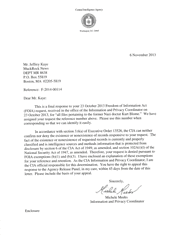
The CIA wrote, "In accordance with section 3.6(a) of Executive Order 13526, the CIA can neither confirm nor deny the existence or nonexistence of records responsive to your request."

Towards the end of the article, and quoted in full, is my appeal of this decision to the CIA. It is published here as a public service, to educate the public about an aspect of the war fought by the "greatest generation," that is not fully explored in a Tom Hanks movie or even a decent World War II history book. (A "no responsive records" on a similar FOIA to the FBI is also being appealed. A FOIA request to the Army has not received any response thus far.)

Glomar responses are considered in cases of "sensitive national security." Just how sensitive a national security issue can it be to admit the CIA has or does not have files on Kurt Blome? For those who are trying to get the truth out of the government on a multitude of different issues, beyond which whistleblowers like Edward Snowden or Chelsea (formerly "Bradley") Manning have been able to provide us, the fact that information more than 60 years old is so sensitive that the government can't admit or deny knowledge of it boggles the imagination.

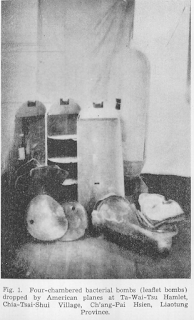
As readers may or may not be aware, I've been researching the allegations that the U.S. used biological weapons during the Korean War. The charges are still considered valid in China and North Korea, and along with the connivance of the United States in covering up Japanese biological and chemical warfare and medical experimentation in China during World War II, the truth or falsity of these charges are still a hot-button issue in Asia. (My recent article on the subject showed documentary proof that the U.S. was lying, at least in part, publicly about what was going on, and also showed that the U.S. was possibly involved in chemical warfare in Korea as well!)

A South Korean newspaper, The Chosunilbo, responding to Japan's latest provocation -- a visit by Prime Minister Abe to the notorious Yakasuna war shrine, where war criminals from World War II are buried -- reported, "By visiting Yasukuni, Abe has made it clear that he does not intend to back down from a diplomatic and even military confrontation with South Korea and China over the issue of whitewashing his country's wartime atrocities, Tokyo's flimsy colonial claim to South Korea's Dokdo islets and other territorial issues. It is obvious that he will push ahead with his rightwing agenda at all costs."

But what's all this got to do with Nazis, you may ask?

The research took me to the issue of the Nazis' own biological warfare program. According to the Nuremberg trial record, and the few histories on the subject written since, the Nazi doctor Kurt Blome was in charge of the National Socialists' "bacteriological warfare" program. He had built a testing facility in Posen, Poland, reportedly not too different from the Unit 731 facility in Ping Fan. It was captured by the Soviets, but Blome got away. He was later captured by the Americans, and interrogated by the secretive ALSOS group. He was tried as part of the famous Doctors' Trial at Nuremberg, but was acquitted. Some have implicated a deal was made with him for his BW information, and what he could tell the Americans about other Nazi scientists.

My research into the Unit 731 story had led me to track down the intelligence (OSS/Central Intelligence Group) connections of one primary figure involved in the decision to give amnesty to the Japanese BW war criminals, in exchange for getting BW (and other) data from them for use by U.S. scientists working at Ft. Detrick (and likely, too, for the Special Operations Division there, working on poisons and mind control research for the CIA). (This is the subject of an article to come, so I'm not going to give many details on who that intelligence person was.)

So I thought I should at least send a FOIA on Kurt Blome to the CIA. After all, according to historians Ute Deichmann, Linda Hunt, and Tom Bower, Blome had been a candidate for Army's Operation Paperclip, which sought out Nazi scientists to bring to the U.S. (like Werner von Braun). But presumably the U.S. Foreign Office or State Department balked on bringing this Nazi zealot to the America. After he was released from U.S. custody, he was interviewed by Ft. Detrick scientists, and subsequently, was said to be employed by the United States as a "camp doctor" at the European Command Intelligence Center at Oberursel, West Germany.

Now why, I wondered, was a Nazi doctor hired at the largest U.S. interrogation facility in post-World War II Europe? Moreover, why did Blome's trail end there? (A few sources state he was later arrested by the French and jailed, but I can find no clear documentary evidence of this.)

For the record, and I believe the readers' interest, I'd like to quote a bit from the June 16, 1947 closing brief at the Doctors Trial at Nuremberg for the United States of America versus Kurt Blome:
Blome was Deputy Reich Health Leader and Deputy Leader of the Reich Chamber of Physicians and the National Socialist Physicians' Association. He was a close collaborator of [Reich Health Leader, Leonardo] Conti, who was in direct charge of the civilian health service. By virtue of these positions, Blome held considerable power and influence. He knew that concentration camp inmates were being systematically used in criminal medical experiments. 

As the responsible head of bacteriological warfare, Blome personally suggested and carried out criminal experiments in that field. In the same connection he had poisons tested on human subjects and reported to Himmler on this matter.

Blome had full knowledge of the murderous freezing experiments by [SS doctor Sigmund] Rascher, supported his efforts to gain admission as an academic lecturer on that subject, and, as a member of the Reich Research Council, personally issued a research assignment to Rascher for further freezing experiments. He collaborated with Rascher in the Polygal experiments, during which inmates were shot and killed. He also issued a research assignment to Rascher in support of these experiments.

Blome had knowledge of [August] Hirt's [mustard] gas experiments in Natzweiler and furthered his work by issuing an assignment from the Reich Research Council.

As Deputy Reich Health Leader, Blome worked with the murderer [Arthur Karl] Greiser, Gauletier of Warthegan, who among other things assisted in the extermination of Jews in that area of Poland....
Historian, Michael H. Kater, in his book Doctors Under Hitler, said that Blome was one of a number of German doctors who were "instrumental not only in developing and introducing the Nuremberg race legislation but also in creating the severity with which its various enactments affected German Jews and the murderous ramifications thereafter" (p. 182)

Despite the crimes involved here, the story of U.S. government refusal to release records, and particularly obfuscation by the CIA, is nothing new. According to a 2005 Reuters story, "the CIA has refused to disclose documents about its postwar dealings with former Nazis who have not been accused of war crimes but belonged to organizations like the German Nazi party and the SS, congressional officials said. Some of the material is believed to deal with former Nazis who joined the allied Cold War effort against the Soviet Union in Europe, the officials said."

Former New York Congresswoman Elizabeth Holtzman told UPI at the same time as the Reuters article, "I think that the CIA has defied the law, and in so doing has also trivialized the Holocaust, thumbed its nose at the survivors of the Holocaust and also at Americans who gave their lives in the effort to defeat the Nazis in World War II."

What follows is the text of my FOIA appeal to the CIA:
December 12, 2013

Agency Release Panel
c/o Susan Viscuso
Information and Privacy Coordinator
Central Intelligence Agency
Washington, DC 20505

Reference: F-2014-00114

Dear Agency Release Panel:

This letter constitutes an administrative appeal to the Agency Release Panel, such appeal being guaranteed by Section 3.5(e) of Executive Order 13526.

I am writing to appeal the determination by the Central Intelligence Agency (CIA) with regard to my FOIA request filed on October 23, 2013, reference number F-2014-00114, for "all files pertaining to the former Nazi doctor Kurt Blome.”

The CIA response of November 6, 2013 indicated that, in accordance with section 3.6(a) of Executive Order 13526, the CIA could “neither confirm nor deny the existence or nonexistence of records responsive” to my request. CIA’s notification continued, “The fact of the existence or nonexistence of requested records is currently and properly classified and is intelligence sources and methods information that is protected from disclosure by section 6 of the CIA Act of 1949, as amended, and section 102A(i)(l) of the National Security Act of 1947, as amended.” This will be referred hereafter in this appeal by the popular name given to such a rejection, i.e., as a “Glomar” response.

The following are my reasons for appeal:

1) Some information related to cooperation Kurt Blome gave to both the military and intelligence agencies of the US government have already been released and are in the public record, and is further discussed below.

2) In her book, "Secret Agenda: The United States Government, Nazi Scientists and Project Paperclip, 1945-1990" (St. Martin’s Press, 1991), Linda Hunt noted that Kurt Blome had been interrogated as part of the Alsos missions at the end of World War II. Alsos was jointly staffed by the Office of Naval Intelligence, the Office of Scientific Research and Development, the Manhattan Project, and Army Intelligence (G-2), and mandated to investigate enemy scientific developments. The investigation included biological weapons. From the Nuremberg trial, where Blome was a defendant, we know that he was involved in biological weapons research for the Nazi government.

3) The record of Blome’s Alsos interrogation is in the public domain. See Alsos interrogation at the National Archives in the Kurt Blome INSCOM dossier XE001248. Arrest reports: in Blome's Nuremberg arrest file, Record Group (RG) 238, NARS.

INSCOM stands for U.S. Army Intelligence and Security Command.

Blome’s status as an accused defendant in the Nuremberg proceedings is well-known. The records of that trial are public domain, and it is difficult to believe that the CIA has no files or records or reports that discuss Blome in relation to the war crimes charges or the trial itself.

At the trial, it came out that Blome admitted at the Nuremberg Trial that he had been head of an institute in Posen that did research on biological warfare for the Nazis. Experiments had been carried out on Soviet prisoners-of-war as part of this research. See The Nuremberg Medical Trial, 1946/47 (Walter de Gruyter, 2001), p. 56.

4) Kurt F. L. Blome (F. L. for Friedrich Ludwig, the middle names of the same Kurt Blome who is the subject of my FOIA request and this appeal) is mentioned by name in a declassified list of “Foreign Scientist Case Files, 1945-1958”, part of the scientists who signed up to work for the U.S. government as part of Operation Paperclip, or the later Project 63. See URL: http://www.archives.gov/iwg/declassified-records/rg-330-defense-secretary/foreign-scientist-case-files.pdf

5) After Blome was acquitted at the Nuremberg Doctors’ Trial in August 1947, according to Hunt’s book, two months later, “four representatives of Fort Detrick -- the Maryland army base that was also headquarters of the CIA's biological warfare program -- interviewed Blome about biological warfare…. During a lengthy interview Blome identified biological warfare experts and their locations and described different methods of conducting biological warfare.” (p. 180) Blome was ultimately given a position working for the Americans at Camp King interrogation center, Oberursel, West Germany.

The Fort Detrick interrogation is known from Blome’s INSCOM dossier and his Joint Intelligence Objectives Agency (JIOA) dossier, RG 330, NARS.

According to the National Archives website, JIOA was “was established in 1945 as a subcommittee of the Joint Intelligence Committee (JIC) of the Joint Chiefs of Staff (JCS). The JIC served as the intelligence arm of the JCS, responsible for advising the JCS on the intelligence problems and policies and furnishing intelligence information to the JCS and the Department of State. The JIC was composed of the Army's director of intelligence, the chief of naval intelligence, the assistant chief of Air Staff-2, and a representative of the Department of State.”

“The JIOA was given direct responsibility for operating the foreign scientist program, initially code-named Overcast and subsequently code-named Paperclip.” (URL: http://www.archives.gov/iwg/declassified-records/rg-330-defense-secretary/)

Hence, the fact that Blome acted as an “intelligence source” for U.S. intelligence circles is no secret.

6) Some of the information that Blome could have given interrogators has been pieced together from German archives. The German historian, Ute Deichmann in her book, "Biologists Under Hitler" (Harvard Univ. Press, 1996) mentions, as an example of this kind of information, the Wolfram Sievers at the Institut fur Zeitgeschichte (MA 1406/1).

In these diaries, Blome is described as having conducted neutron radiation experiments, as well as making plans to carry out experiments with bacterial pathogens (p. 417).

7) According to BBC television producer Tom Bower in his book, "The Paperclip Conspiracy: The Hunt for the Nazi Scientists" (Little, Brown & Company, 1987), it is public record that Kurt Blome was hired by the U.S. Chemical Corps in August 1951 and certified by U.S. High Commissioner for Germany, John McCloy, as “not likely to become [a] security threat to the US” (p. 254) Bower gives as citation for this material RG 330 JIOA case file, “Blome,” in the National Archives.

8) The Nazi War Crimes Disclosure Act (P.L. 105-246, 5 U.S.C. § 552) mandated that Government agencies, including the CIA, take necessary steps necessary to declassify and open remaining classified records related to Nazi war criminals and criminality. This included “any person with respect to whom the United States Government, in its sole discretion, has grounds to believe ordered, incited, assisted, or otherwise participated in the persecution of any person because of race, religion, national origin, or political opinion, during the period beginning on March 23, 1933, and ending on May 8, 1945, under the direction of, or in association with…. the Nazi government of Germany”.

This law included an exception that would “reveal the identity of a confidential human source, or reveal information about the application of an intelligence source or method, or reveal the identity of a human intelligence source when the unauthorized disclosure of that source would clearly and demonstrably damage the national security interests of the United States.

While there is an exception made similar to that which the CIA claimed in its “Glomar” response to my FOIA request, I would argue from the information above that there is already a good deal about Kurt Blome in the public record that likely is in CIA files, and withholding such information because of a possible revelation re an intelligence or methods source is a moot issue.

While there may be aspects of the request that could still be denied under one or another FOIA exemption, I would ask that the elements of the files and other information from my original request that can segregably be released, be so released.

In conclusion, I ask that the Agency Release Panel reconsider its “Glomar” decision to neither confirm nor deny the existence or nonexistence of records responsive to my request.

I have shown that there is already a documentary of both the interrogation and employment of Kurt Blome by U.S. military and intelligence sources. I have shown that Kurt Blome is known to have been a used as an intelligence and/or methods resource after he came under U.S. custody. I have further shown that some of Kurt Blome’s expertise in scientific matters that may have been of interest to U.S. intelligence, and hence the CIA, has already been made public in German archives.

Finally, I would argue that lacking any reason to consider information on Kurt Blome something subject to a “Glomar” denial, it is also important to consider that it was the legislative intent of the United States Congress, in a law signed by the President of the United States, to release information related to Nazi war criminals or possible criminality by such persons.

According to the CIA’s own website, the Nazi War Crimes Disclosure Act was “the largest congressionally mandated, single-subject declassification effort in history, and a special website at the CIA was set aside to openly display documents the CIA released under this act. (URL: http://www.foia.cia.gov/collection/nazi-war-crimes-declassification-act)

In the spirit of that Act, and of the CIA’s own efforts to release information according to such lawful request and special effort, and given that so much about Kurt Blome has already gone into the public record concerning his activities as an intelligence and/or methods resource, and, finally, given the blood and treasure the citizens of the United States spent in fighting the Nazis, I ask that the “Glomar” exception be removed and my FOIA request appropriately processed.

I look forward to receiving your decision on this appeal in a timely fashion. If you have any questions, or believe discussion of this matter would be beneficial, please contact me or MuckRock News.

Sincerely,

J.K.
My thanks to both Jason Leopold and NSA Archive for their assistance, online and off, for help in understanding the Glomar experience!

[Update, 2/9/2014: In a letter dated January 22, 2014, the CIA responded to my appeal letter with the statement, "Your appeal has been accepted and arrangements are being made for its consideration by the Agency Release Panel."]

Monday, December 9, 2013

CIA Document Suggests U.S. Lied About Biological, Chemical Weapon Use in the Korean War

According to a CIA document declassified in March 2006, the U.S. government lied publicly about pushing for a United Nations "on-the-spot" investigation into Soviet, Chinese and North Korean charges of U.S. use of biological weapons (BW) during the Korean War.

According to the document, a "Memorandum of Conversation" from the Psychological Strategy Board (PSB) dated July 6, 1953, the U.S. was not serious about conducting any investigation into such charges, despite what the government said publicly. The reason the U.S. didn't want any investigation was because an "actual investigation" would reveal military operations, "which, if revealed, could do us psychological as well as military damage."

The memorandum specifically stated as an example of what could be revealed "8th Army preparations or operations (e.g. chemical warfare)."

Psychological Strategy Board

The document in question was an enclosure to a memorandum to CIA director Allan Dulles from Horace S. "Pete" Craig. As CIA director, Dulles sat on the PSB board along with the Undersecretary of State and the Deputy Secretary of Defense, or their designated representatives. Craig was CIA and close to Dulles, working for CIA's Advisory Council on "comint" (communications intelligence). He seems to have been Dulles's representative for awhile at Board meetings. He later was a member of the Operations Coordinating Board, President Eisenhower's replacement for the PSB.

The July 6 meeting was attended by Craig, Wallace Irvin, Jr., Erasmus Kloman, and Richard L. Sneider. The group had many intelligence connections. This was not surprising as "psychological warfare" or "strategy" during the heyday of the early Cold War was, as one historian put it, "most of the time understood as synonymous with covert operations".

The PSB itself was meant to coordinate the activities of different U.S. agencies and departments. Controversial and disbanded about two years after it was founded in 1951, according to the Truman Library website, which has an extensive list of PSB holdings, its function was "to authorize and provide for the more effective planning, coordination, and conduct within the framework of approved national policies, of psychological operations."

Board member Sneider was at the time a State Department "policy analyst and intelligence expert" who also associated with the United Nations Association of the United States. Later he became Officer in Charge of Japanese Affairs. By the late 1960s, he was active on Nixon's National Security Council. From 1973 to 1978, he was U.S. ambassador to South Korea.

Irwin worked closely with UN Ambassador Henry Cabot Lodge in shepherding through the latter's "human rights" proposals at the United Nations in the early 1950s. The latter project was organized as a working group within the PSB, with Irwin acting as "Chair". Later, he became a speechwriter for George H.W. Bush, and became ensconced within the foreign policy establishment. He would ultimately become editor for the journal Foreign Policy.

"Ras" Kloman ran the meeting. In a brief telephone exchange I had with Mr. Kloman on November 18, he confirmed he had been with the PSB. He had no memory of the meeting in question, but told me he had been "the principal man on psychological warfare." Ill, and in a nursing home, Kloman declined answering any more questions. He is the only living member of the group who met that summer day 60 years ago.

Kloman had been a World War II Office of Strategic Services operative. He wrote a book about his experiences. An online biography states that Kloman also served in "the Central Intelligence Agency, Department of State, and Foreign Policy Research Institute at Penn, and as a corporate executive for AMAX and IBM. He was a Senior Research Associate at the National Academy of Public Administration from which he retired in 1985."

Trouble Countering Charges of Biological Warfare

The "memorandum of conversation" -- really the minutes of the meeting -- concerns a discussion of the difficulties U.S. psywar experts were having getting academics to back the government's own propagandistic critique of the World Peace Council-backed International Scientific Commission's (ISC) conclusion supporting Soviet, Chinese, and North Korean claims that the U.S. had used offensive biological weapons in Korea. The situation was crucial because the evidence was backed up by the statements of a number of captured U.S. airmen, including some officers, providing confessions of use of BW, and giving detailed descriptions of who ordered it and how it was done.

The U.S. responded to the airmen's confessions with claims they were coerced, false confessions. Some claimed (with CIA connivance, if not inspiration) the POWs were "brainwashed." The origins of the Bush-era "enhanced interrogation" torture program can be traced in part to CIA and military research meant to counter, supposedly, the possibility of such "brainwashing." But since they knew it wasn't actually "brainwashing," the whole explanation was really a cover story for the creation of a psychologically based torture program.

(For more on the history of the ISC, which was chaired by the famous British historian of Chinese science, Dr. Joseph Needham, click here.)

An Army epidemiologist, Col. Arthur Long, had been asked to submit a report on ISC's work. Long, of course, found the ISC's own report to be a "complete fabrication." According to Long, the problem was "very few of [the ISC]... particular items of scientific 'evidence' could be demolished as such."

So a committee was formed under Detlev Bronk, president of the National Academy of Sciences. But, Kloman bemoaned, the NAS committee had "accomplished very little of substance." Bronk had disappointed them. A letter he wrote to support Long's analysis was, according to Kloman, "pitched in an extremely low key -- so much so as to be of dubious effect." Even U.S. diplomats at the UN refused to promote Bronk's letter.

The State Department sent a "circular airgram," written by Kloman, to US embassies in all the countries represented by the ISC (Italy, France, Brazil, UK, Sweden), asking them to find scientists to refute ISC's report. But the U.S. was having very little luck. Even the British "were pleasant but did nothing."

Kloman was perturbed but somewhat understanding. The ISC scientists were, he said, "politics aside... highly competent people."

The meeting turned towards countering BW claims at the UN, via pushing a U.S. call for an investigation by the United Nations of the Korean charges. (Of course, North Korea and China were at war with UN forces at the time.) Sneider described the different proposals the U.S. was putting forward, condemning the BW charges and calling for an investigation, while analyzing the results of the UN votes on these proposals. But the results of this campaign were "obscure." There was a sense the U.S. had missed an opportunity to more effectively win propaganda points. Sneider told the group the State Department verdict on the anti-ISC campaign was "no victory and no defeat."

The meeting continued with a discussion of "future possibilities" for action, but it ended with a bombshell.

The Dangers of an "Actual Investigation"

The PSB memorandum (PDF link) concluded with a stunning admission of duplicity, and -- I cannot believe but the CIA's censors were asleep at the switch here, to all our benefit -- a revelation about U.S. military actions in the Korean War that from our standpoint in the 2010s have been buried for decades.
Mr. Kloman observed that US policy, while favoring the proposal for an on-the-spot investigation, does not favor an actual investigation. One reason for this, he said, is the feeling of the military that an investigating commission would inevitably come across the 8th Army preparations or operations (e.g. chemical warfare) which, if revealed, could do us psychological as well as military damage. This reasoning assumes that the commission would have authority to examine anything they liked on either side of the battle line."
While historians of the Korean War BW controversy will find it fascinating to analyze what this document means in the context of the long-standing feud between those who believe one side or the other, I think what is most important for us today is the reopening of the question of U.S. use of chemical weapons in that war.

Most people are probably unaware that there ever were charges of CW use by the U.S. in Korea. I know I was. Yet as early as March 1952, a Commission of the International Association of Democratic Lawyers (IADL) had visited North Korea to examine charges of war crimes, releasing a report that included documentation of chemical warfare.

"American planes have on various occasions used asphyxiating and other gases or chemical weapons at least since 6th May, 1951," the IADL commission wrote. "The commission took eye witness and expert testimony. Post-mortem examinations and autopsy results argued that some chemical had been used, with a "disagreeable smell, resembling the smell of chlorine.... In the affected area of the city it was noted that grass became yellow brown, objects containing an alloy of copper became blue green and rings of silver became black."

Victims of another alleged attack "felt an itching on the exposed parts of the body.... they observed red spots which grew to a size like haricot beans, which then swelled and were filled with pus." Some had injuries like "second-degree burns but with a much more, serious erosive action and taking a longer time to recover."

Critics of the IADL wrote off their findings as communist, fellow-traveller propaganda. Before long, the main controversy over US war crimes turned to the BW allegations, but the North Koreans have never withdrawn their allegations. In the 2001 Report and Final Judgment on US Crimes in Korea 1945-2001 by the Korea International War Crimes Tribunal, whose indictment was drafted by former U.S. Attorney General Ramsay Clark, the U.S. was found guilty of use of both chemical and biological warfare during the Korean War.

A Circumstantial Case, Records Destroyed

It's worth noting that the Chinese and North Koreans had ample reason to believe the U.S. capable of using biological or chemical warfare. The U.S. then had refused to sign the 1925 Geneva Protocol against use of chemical or biological weapons. The Chinese and Koreans knew the U.S. had amnestied the Japanese scientists of Unit 731, who had undertaken fatal experiments on both BW and CW on prisoners. Indeed, the ISC report had included a chapter on Unit 731.

Moreover, both Chinese and Koreans knew the Japanese had extensively used both biological, and even more so, chemical weapons during the Sino-Japanese War (coinciding in its last years with World War II).

An October 1988 article by historian Yuki Tanaka in the Bulletin of the Atomic Scientists, "Poison Gas: the Story Japan Would Like to Forget," described the CW campaign waged by Japan in China, and how the U.S. helped keep the subject from coming up in war crimes trials at the end of WWII. Meanwhile, the U.S. had become cozy with former Japanese war criminals, now being allowed back into Japanese civil and political life, while former collaborators with the Japanese were members of the U.S. backed Republic of Korea government.

The scope of Japan's chemical war unleashed in China can be ascertained by the damage left afterward. According to Nationalist Chinese sources in Taipei, approximately 700,000 chemical munitions were left abandoned in China after World War II. The Chinese government says that approximately 2,000 people still die each year from encounters with such ordinance. An ongoing clean-up of the chemical mess, in part paid for by Japan, is still ongoing in 2013.

A list of Japanese chemical ordinance and equipment that was captured by the U.S. at the end of WWII was recently declassified, and, revealing here for the first time, documentation shows the chemical weapons were shipped to the Army's Edgewood Arsenal "for detailed study."

Historians

U.S. historians either ignore the subject of chemical warfare entirely, or dismiss the charges of chemical warfare. "The United States did not use gas warfare in Korea although authority to do so was requested by some of our commanders in the field," wrote George Bunn in a 1969 article for the Wisconsin Law Review.

For whatever reason, a Chemical Mortar Battalion was sent from Edgewood Arsenal to the Korean theater, though I could not find evidence they had actually used chemical weapons. Perhaps this is evidence of the "preparations" Kloman alluded to and what Bunn meant by "requested authority." We won't know until the government opens up its archives completely. Meanwhile those who lived through the period are quickly passing from this world.

There are some documented, if circumstantial, pointers to possible CW activities. For instance, according to one document, the U.S. Air Force Psychological Warfare Board had a Biological-Chemical Warfare team under Lt. Col. L. N. Stead.

Meanwhile, it is also a fact that many documents of the Army Chemical Corps, which had responsibility for both chemical and biological weapons, were destroyed after recall from the National Archives in 1956. See Stephen Endicott and Edward Hagerman (York University), "United States Biological Warfare during the Korean War: rhetoric and reality."

Endicott and Hagerman are also the authors of a major analysis of the evidence for U.S. use of biological weapons during in Korea. See The United States and Biological Warfare: Secrets from the Early Cold War and Korea by Stephen Endicott and Edward Hagerman (1999, University of Indiana Press). A totally opposite point of view can be found Milton Leitenberg's "False Allegations of U.S. Biological Weapons Use during the Korean War", in Terrorism, War, or Disease? Unraveling the Use of Biological Weapons (2008, Stanford Security Studies, Anne L. Clunan, Peter R. Lavoy, and Susan B. Martin, eds).

Of course, chemical weapons of a sort were definitely used during the Korean War. The United States extensively used napalm in an extensive bombing campaign that destroyed most of North Korea's cities and killed hundreds of thousands of civilians. According to one source, "During the Korean War, the United States dropped approximately 250,000 pounds of napalm per day." Later, in the late 1960s, the U.S. sprayed the defoliant Agent Orange, also being used widely in the Vietnam War, near the demilitarized zone in Korea.

There is no book detailing the charges or refutation of charges of chemical warfare in the Korean War. It's never alluded to in Seymour Hersh's 1968 book, Chemical and Biological Warfare, nor in any book on U.S. chemical warfare that I've looked at, except perhaps in a very passing way. If I am wrong, I'm hoping someone will point that out to me.

"Whose Sarin?"

Seymour Hersh's article in The London Review of Books, "Whose Sarin?", set off a storm of commentary about his motives, his accuracy, and the significance of the revelations. Hersh claimed the Obama administration had been quick to "cherry-pick" intelligence findings. Obama had "failed to acknowledge something known to the US intelligence community: that the Syrian army is not the only party in the country’s civil war with access to sarin...."

For some reason, Hersh did not bring up the history he knows so well of U.S. secrecy and misdirection when it comes to use of chemical and biological weapons. Failing to do so only weakened his argument in what is otherwise a compelling analysis of events inside the Obama administration after news broke of the August 21, 2013 chemical weapons attack in a neighborhood near Damascus.

But the document and evidence I've laid out above should make anyone think twice, if not three times, about relying on U.S. assurances or propaganda regarding the use of chemical weapons by anybody. U.S. citizens should call for an opening of all archival material, which after 60 or more years cannot constitute a national security threat, though it may be an national shame and embarrassment for the U.S. government.

Crossposted at The Dissenter/FDL

Sunday, December 8, 2013

Top US Psychologist Allegedly Met with James Mitchell in Weeks Before Zubaydah Torture

America 2013: A top U.S. psychologist touting "Positive Psychology" is to be a keynote speaker at a huge Southern California conference on psychotherapy. Other speakers include psychiatry heavies Aaron Beck, Irvin Yalom, as well as Nobel laureate Gerald Edelman, and big media names like James Foley and Alanis Morissette.

The famous psychologist -- Martin Seligman from the University of Pennsylvannia -- has been linked to the CIA's Bush torture program. The charges lack a smoking gun, but there is lots of circumstantial evidence. What is reported below shows that Seligman wasn't fully open about his contacts with those accused of waterboarding Abu Zubaydah, Khalid Sheik Mohammed, and torturing various CIA "black site" prisoners circa 2002-2006. Why did he hide this information?

A Forgotten Book

A 2011 book written by Georgetown academic and ethics expert M. Gregg Bloche (currently co-director for the Georgetown-Johns Hopkins Joint Program in Law and Public Health) broke important new ground about the origins of the post-9/11 CIA torture program. Unfortunately, he did so just as the Obama administration's policy of non-investigation and non-prosecution of those involved in U.S. torture had gained ascendency among both press and the public.

Bloche described a hitherto unreported meeting between Martin Seligman and James Mitchell during the crucial period when Mitchell, the former Survival, Evasion, Resistance, Escape program (SERE) psychologist, was involved with both the CIA and the Pentagon in setting up a torture program for prisoners captured in what the U.S. was calling the "war on terror."

Various reports say that Seligman met Mitchell and Jessen twice before, in December 2001 and May 2002. What hasn't been reported previously was that Seligman also allegedly met with Mitchell literally days before Mitchell and another CIA psychologist, Kirk Hubbard, were called to fly to Thailand, where the CIA was holding a very special "high-value" prisoner, the terribly injured Abu Zubaydah.

While Seligman has discussed his interactions with Mitchell numerous times before (here's one such link), he never mentioned this other meeting -- in late March or early April 2002 -- whose timing was so suspicious. Within days, Mitchell arrived in Thailand to take over Zubaydah's interrogation from FBI agents and institute his "new" version of "enhanced interrogation" that relied on a theory -- "learned helplessness" -- associated with Seligman himself.

According to Ali Soufan's book, The Black Banners, Mitchell (called Boris in Soufan's book) arrived when Zubaydah was still in the hospital recovering from wounds received during his capture in Pakistan. Scandalously, much of Soufan's account was censored by the government.

I emailed Seligman to ask him to confirm or deny Bloche's allegation, and offered him plenty of space in this article to explain himself. I never heard back from him. Meanwhile, the major media, for reasons of their own, passed by this story, even though I know it was offered to them.

[Update, 12/9/13, 8:50am PST: Dr. Seligman has emailed me this morning with a reply to this article. It states, in full:

"Dr. Kaye: Your allegation is entirely fiction.

"To the best of my knowledge, I have met Mitchell exactly twice. Once at my home in December of 2001, and once at the SERE meeting. There was no other meeting BEFORE or after the SERE meeting.

"Once again, I disapprove of torture. I have never and would never aid or abet it.

"Martin Seligman"]

"Learned Helplessness"

Buried in two chapters towards the end of his book, The Hippocratic Myth, Bloche described a narrative of events surrounding Mitchell and his SERE associate Bruce Jessen. Bloche obtained the new information in a series of email exchanges with a key CIA player in the torture scandal, psychologist Kirk Hubbard, who was Chief of Operations, and later Chief of the Research and Analysis Branch for the CIA's shadowy Operational Assessment Division (OAD).

(In July 2003, Hubbard would be in charge of putting together a CIA/Rand/American Psychological Association workshop on detecting deception that would investigate new ways to utilize drugs and sensory bombardment techniques to break down prisoners for interrogation. His partner in organizing the event was then-White House senior scientist Susan Brandon. Today, Brandon is head of Obama's HIG interrogation research program.)

Bloche wrote that Hubbard's work at the CIA brought him into contact with "an informal network of military and civilian psychologists and psychiatrists with shared interests in psyops, Special Forces selection, resistance training, and the reliability of 'humint' (human intelligence)" (p. 135).

Hubbard apparently knew Mitchell from this milieu. (I've written before about the military/special ops/SERE/contractor environment Mitchell sprang from.) According to Bloche, "in the weeks after 9/11" Hubbard brought Mitchell to the attention of higher-ups in the CIA (p. 136). Perhaps he introduced Mitchell's SERE colleague Bruce Jessen at the same time, though Bloche is unclear on this. Hubbard does say, however, he introduced both Mitchell and Jessen to his Agency superiors as "potential assets."

Mitchell reportedly had long been interested in the behavioral theory of "learned helplessness," which was associated with the academic work of Martin Seligman. "Learned helplessness" (LH) was an animal model of breakdown via uncontrollable stress which was later used to help understand the clinical manifestation of depression in humans. Mitchell believed using a combination of physical and psychologically extreme pressures would reduce a prisoner to a state of compliance, similar to the helpless state produced by LH. This would make a prisoner or interrogatee extremely dependent on an all-powerful interrogator "god," someone who could be easily "exploited" by government forces.

The rationale for all this was described in notes Mitchell's SERE associate, Bruce Jessen, wrote when he and Capt. Michael Kearns, then head of operations for Air Force Intelligence’s Special Survival Training Program, were forming in 1989 a survival class for "Special Mission Units," i.e., for secret "black" operations personnel. This course, SV-91, meant to help U.S. Special Forces survive torture and captivity by a brutal enemy, became the template for the kinds of techniques Mitchell and Jessen would flip to use now on U.S. prisoners.

Meeting Mitchell

Bloche writes that Seligman admitted being invited by the CIA to speak at a May 2002 SERE conference before an audience that included Mitchell and Jessen. Subsequently, Scott Shane wrote in the New York Times that Mitchell met Seligman in a small meeting at the latter's house in December 2001.

In an article by Mark Benjamin at Salon.com, Seligman confirmed the December meeting, describing it as (as Benjamin described it) "a small gathering of professors and law enforcement personnel as well as at least one 'Israeli intelligence person,' to conduct an academic discussion about the so-called war on terror." Seligman told Benjamin the meeting at his house had nothing to do with interrogation. What Mitchell was doing at such a meeting, when he had no academic expertise on the "war on terror" or "Jihad" or moderate Islam, no one has ever said.

Here's how Bloche described the meeting between Seligman and Mitchell just before the latter left for Thailand.
[Seligman] acknowledged only that he spoke on learned helplessness at a JPRA meeting in May 2002 and that Mitchell and Jessen were in the audience:
I was invited to speak about how American... personnel could use what is known about learned helplessness to resist torture and evade successful interrogation by their captors. This is what I spoke about.
Seligman added:
I have had no professional contact with Jessen and Mitchell since then....
It is important to point out that Seligman here only denies contact with Mitchell and Jessen after May 2002. He doesn't say anything about contact with them prior to that period. He simply never mentions anything about the late March or early April meeting. Bloche continued:
But sometime in the spring of 2002, according to a CIA source, Seligman met with Mitchell, Jessen, and Hubbard in Philadelphia. “The fact that we had a meeting in Philadelphia,” said the source, a meeting participant [possibly Kirk Hubbard -- JK], “means that Mitchell/Jessen were at least thinking about interrogation strategies.” Seligman wanted to help and understood what Mitchell had in mind. But having built his reputation as a clinical pioneer — the man who’d discovered learned helplessness, then transformed depressed people’s lives through “learned optimism” — he didn’t want to be seen as telling CIA operatives how to break people by inducing despair. So he walked a careful line, keeping to the question of what the science did and didn’t support while abstaining from how-to advice. Seligman, said the CIA source, had a “classic approach-avoidance conflict regarding helping us"....

By the time of the Philadelphia meeting, CIA preparations for “enhanced” interrogation had reached high intensity, energized by what looked like an extraordinary opportunity.
[Bloche M.D., M. Gregg (2011-03-15). The Hippocratic Myth: Why Doctors Are Under Pressure to Ration Care, Practice Politics, and Compromise their Promise to Heal (p. 141). Palgrave Macmillan. Kindle Edition. -- bold emphases added]
The opportunity was the capture of Abu Zubaydah in a joint U.S.-Pakistan raid on March 28, 2002. Zubaydah had been taken to a hospital with life-threatening wounds, though that didn't stop FBI interrogators from beginning their interrogation of Zubaydhah while still hospitalized.

According to Bloche, "Months would pass before final Justice Department approval for what Mitchell had in mind. But once approval seemed likely, CIA leadership made the call. Kirk Hubbard answered it, quite literally, on the way back from Philadelphia. “I received a phone call indicating ‘they’ wanted Mitchell to depart that night along with others from CTC [Counter-Terrorism Center],” Hubbard remembers. “Mitchell had about twelve hours’ notice that he was being flown to meet AZ [Zubaydah].” Exactly when Mitchell began his brutish efforts with Zubaydah (and based on what sort of approval) remains a matter of dispute." (p. 142)

Zubaydah's Torture

According to Soufan's account in Black Banners, the abuse began right away, with Zubaydah subjected to nudity, loud music, white noise (a form of sensory deprivation), and sleep deprivation. Weeks later Mitchell stepped up the abuse to the level of full-on physical torture. This was probably in early to mid-May, around the time even Soufan, who'd been playing good-cop to CIA's bad-cop, left the CIA black site, apparently disgusted with Mitchell's techniques, though his FBI partner, Special Agent Stephen Gaudin, stayed on for some weeks more, and may have even participated in some of the "enhanced interrogation," according to a Department of Justice Inspector General report.Hubbard told Bloche that Mitchell and Jessen, who joined the CIA at the Thailand black site after he retired from the Air Force later in the year, were not running a "maverick" operation.

“Jim Mitchell, et al. didn’t take a pee without written approval from headquarters..." Hubbard said. "CIA leadership approved and is responsible for all that occurred" (p. 142). Mitchell's appointment had been supported by CTC's director, Cofer Black, and CIA director George Tenet, against some push-back from CTC's chief operational psychologist, R. Scott Shumate. (Shumate also served at the Thailand black site, leaving supposedly in protest at Mitchell's EIT program later in the year.)

Bloche's book also specifically states that James Mitchell was the author of the psychological assessment of Abu Zubaydah that was used to justify the torture techniques to the Office of Legal Counsel. As Bloche put it, Mitchell's assessment was based on “direct interviews with and observations of the subject,” and "gave the OLC cover to conclude that waterboarding wouldn’t cause Zubaydah 'severe mental pain or suffering.'" According to the written evaluation, Mitchell relied also on Zubaydah's written diaries, which were captured with him.

But with the release of Zubaydah's pre-capture diaries, obtained by Jason Leopold at Al Jazeera America, we know that much of what was written in Mitchell's psychological report was bogus. Claims of Zubaydah's massive influence were exaggerated, as the diaries make clear.

In addition, there is no mention of Zubaydah's serious medical problems and previous neurological injuries, which would have likely disqualified Zubaydah for the "enhanced interrogation" torture, even under the CIA's morally dubious criteria. Nor was there any mention of Zubaydah's previous torture, or an assessment of how that affected him. Leopold, who wrote a number of article analyzing the AZ diaries, has written up the story of Zubaydah's tortureby Pakistani authorities during a pre-9/11 arrest.

How bad was Zubaydah's torture by the CIA? Zubaydah described it to representatives of the International Committee of the Red Cross (ICRC). The ICRC report was leaked to Mark Danner in 2010, and the following is a small representative sample of what Mitchell did, using his version of learned-helplessness via "enhanced interrogation":
After the beating I was then placed in the small box. They placed a cloth or cover over the box to cut out all light and restrict my air supply. As it was not high enough even to sit upright, I had to crouch down. It was very difficult because of my wounds....

I was then dragged from the small box, unable to walk properly and put on what looked like a hospital bed, and strapped down very tightly with belts. A black cloth was then placed over my face and the interrogators used a mineral water bottle to pour water on the cloth so that I could not breathe. After a few minutes the cloth was removed and the bed was rotated into an upright position. The pressure of the straps on my wounds was very painful. I vomited.... I struggled against the straps, trying to breathe, but it was hopeless. I thought I was going to die. I lost control of my urine. Since then I still lose control of my urine when under stress.
A Long Tradition

Breaking down prisoners to make them compliant, to either use them for "exploitation" or to gain information, was a subject of great interest for the CIA going back to the beginning of the Cold War. One of the researchers from decades earlier, Albert Biderman, created a "chart of coercion" which was later taught by SERE associates of Mitchell to interrogators at Guantanamo in December 2002. (To see the actual chart, go to pg. 51 of supporting documentsin the Senate Armed Services 2008 report on detainee abuse.)

There is no evidence that Seligman's original research on learned helplessness, which made him famous, was associated with the CIA research into torture, even though other prominent behavioral researchers at the time, such as psychiatrist Louis West, and psychologist Harry Harlow (who was also an American Psychological President at one point), had created by the late 1950s a theory of breaking down human beings psychologically by inculcating dependency, debility and dread into them. The CIA incorporated this into their KUBARK manual for interrogation, and a version of these techniques even informs current practicein the Army's current Field Manual for interrogation.Seligman's research on LH, which went back to the 1960s, made him famous. In 1997, he was elected president of the American Psychological Association (serving his term a year later).

Whither Psychology? Wither America?

On December 15, 2013 Seligman will be one of a handful of keynote speakers at the Milton H. Erickson Foundation's "Evolution of Psychotherapy" meeting in Anaheim, California, where he will speak on "Positive Psychology," his 21st century enthusiasm. His Positive Psychology work garnered Seligman a huge "no-bid" contractwith the Department of Defense a few years ago.

There's been precious little interest in recent years in pushing harder to get to the bottom of the CIA/Pentagon torture scandal.

Many Americans, including those on the left, believe that President Obama ended torture, and on that basis supported his call to ignore the past crimes of the Bush administration, and trusted that the current political regime had eschewed torture and such cruelty forever.

But that's not true, and disinterest in pursuing investigation into the torture story further has a political agenda at its root, i.e., protecting the Democratic Party's image as an alternative to the GOP on matters of national security, while also protecting top Pentagon and CIA brass.

While Guantanamo remains an embarrassment for Obama and occasionally makes the press -- mostly due to the actions of the prisoners there who have gone on hunger strike over and over again to bring the world's attention to their plight -- there is precious little interest in bringing the former or current torturers to any real accountability. That must change, because the logic and morality of torture calls for its resurrection as needed. Already, the US public has been fooled into believing there is no torture, even as the country's primary military and intelligence manual allows use of isolation, sleep deprivation, sensory deprivation, instillation of fear and manipulation of phobias, not to mention use of drugs.

Only an informed and impassioned public can make the difference between the continuing barbarism of torture and the civilized and humane practices that our country pretends to believe in.

Cross-posted at ShadowProof

Tuesday, December 3, 2013

Poland knew about CIA torture prison on its soil, secret court session hears

The following is a press release today from the UK prisoners support group, Reprieve, which has been in the forefront in exposing the crimes of torture and rendition. The story concerns a very important case in Poland concerning torture that took place at a CIA black site prison on Polish soil. The CIA's presence was apparently known and allowed by Polish authorities. As described below, Abu Zubaydah and his attorneys have sued Poland in the European Court of Human Rights for allowing the torture prison.

Abu Zubaydah, who is currently held as a "high-value detainee" at Guantanamo's Camp Seven, is also in the news because of the blockbuster release of all six of his pre-capture diaries, published by Al Jazeera America. Jason Leopold has been analyzing these diaries in a number of articles that are important reading for a deep look into the mind and struggles of this man, who was so often vilified in the early days of the "war on terror," and horrifically tortured as part of an experimental program by the CIA. -- I'll have more to write about these diaries myself in coming days.

Reprieve's press release:
A court has heard “overwhelming and uncontested evidence” of the existence on European soil of a CIA “black site,” used to torture prisoners – with the knowledge of host-government Poland.

Sitting in a secret session closed to public and press, the European Court of Human Rights yesterday heard from a range of expert witnesses – who cannot currently be named – that a CIA torture prison existed in Poland, and that the Polish Government was aware of it and the uses to which it was being put.

The account of yesterday’s secret hearing is provided by Reprieve investigator Crofton Black, who has been researching the issue of secret prisons in Europe during the ‘War on Terror’ and was allowed access.

Dr Black said: “We have now heard overwhelming and uncontested evidence that the CIA was running a secret torture prison on Polish soil, with the Polish Government’s knowledge. Despite being given many opportunities to do so, the Polish Government has failed to contest that it knew prisoners were being held beyond the rule of law and tortured by the CIA inside their own country. It has also become clear that the Polish Government’s investigation into the issue was in reality nothing more than a smoke-screen, which was neither designed nor intended to get to the truth.

“European support for the CIA’s torture programme is one of the darkest chapters of our recent history – it is encouraging that the court now looks set to bring it to light, where the government has sought to sweep it under the carpet.”

Abu Zubaydah v. Poland is the first time a European country has been taken to court for allowing the CIA to run a torture site on its territory. Declassified US government documents and Reprieve’s renditions investigations demonstrate that current Guantanamo detainee Mr Zubaydah was flown from a CIA prison site in Thailand to one in Poland in Dec. 2002. The fact that Poland knowingly hosted this prison means that it is directly responsible for the violations of his rights that took place there in 2002-2003.

Today (3 December) saw the second day of a two-day hearing, the first day of which was held in a closed court.

Search for Info/News on Torture

Google Custom Search
Add to Google ">View blog reactions

This site can contain copyrighted material, the use of which has not always been specifically authorized by the copyright owner. I am making such material available in my effort to advance understanding of political, human rights, economic, democracy, scientific, and social justice issues, etc. I believe this constitutes a 'fair use' of any such copyrighted material as provided for in section 107 of the US Copyright Law. In accordance with Title 17 U.S.C. Section 107, the material on this site is distributed without profit to those who have expressed a prior interest in receiving the included information for research and educational purposes. For more information go to: http://www.law.cornell.edu/uscode/17/107.shtml. If you wish to use copyrighted material from this site for purposes of your own that go beyond 'fair use', you must obtain permission from the copyright owner.