Frank H. Schwable was the highest ranking prisoner of war to confess in detail about the U.S. biological warfare campaign in North Korea and China during the Korean War. He describes in the three "confessions" or depositions below how that campaign evolved, what the men undertaking it felt about the campaign, the "effectiveness" of the use of bioweapons, and the security surrounding the covert use of bacteriological weapons.
This unique document has been suppressed in the West for decades. Schwable, and others who also gave information on germ warfare to their captors, were said to be "brainwashed," tortured, and to have otherwise produced untruthful false confessions. After the war, Schwable and other prisoners who "confessed" were repatriated to the United States and threatened with court martial if they did not renounce their testimony. They all did so.
To my knowledge this is the first posting online in any blog or news site of these astonishing documents. Col. Schwable's statements regarding U.S. bacteriological warfare are posted here in the spirit of truthful inquiry and an airing of all facts.
In the instance of fairness, and for purposes of historical analysis, Col. Schwable's written recantation of these statements is
available for viewing here. Every reader will be able to be compare this latter statement with the depositions you can read below.
While critics of the premise of U.S. biological warfare in Korea cite the supposed coercion or torture of the captured airmen, few mention that upon repatriation they were subjected to a great deal of stress to recant. Upon Schwable's return, Marine Corps commandant, General Lemuel Shepherd, ordered the Colonel's appearance before a court of inquiry.
Although in the end, Schwable received no formal disciplinary action, his military career was all but ended. Meanwhile, all the returning airmen who confessed to use of biological weapons were subjected to psychiatric evaluations and multiple interrogations after their return to U.S. military authorities. (See Raymond B. Lech,
"Broken Soldiers", Univ. of Illinois Press, 2000 - While Lech is a proponent of the "menticide" view of how the North Koreans and Chinese treated their captives, his is maybe the most full account of what the returnees faced.)
The following three depositions were printed in a “
Supplement to ‘People’s China,’ March 16, 1953, pgs. 3-13. Photostats of them can be found online at URL:
http://massline.org/PeoplesChina/PC1953/PC1953-06-MissingP15-18-OCR.pdf
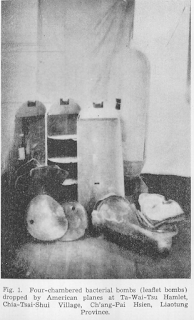
These transcriptions follow the spelling, punctuation, and grammar (including use of commas) in the original. Note: there are some accompanying photos at the original link above.
 |
| Col. Frank Schwable as POW, from People's China, March 16, 1953 |
__________________________________
DEPOSITIONS BY COLONEL FRANK H. SCHWABLE,
FORMER CHIEF OF STAFF OF THE 1ST MARINE
AIRCRAFT WING, U.S. MARINE CORPS
MAIN DEPOSITION OF COLONEL FRANK H. SCHWABLE
North Korea
I am Colonel Frank H. Schwable, 04429, and was Chief of Staff of the First Marine Aircraft Wing until shot down and captured on July 8, 1952.
My service with the Marine Corps began in 1929 and I was designated an aviator in 1931, seeing duty in many parts of the world. Just before I came to Korea, I completed a tour of duty in the Division of Aviation at Marine Corps Headquarters.
Directive of the Joint Chiefs of Staff
I arrived in Korea on April 10, 1952, to take over my duties as Chief of Staff of the First Marine Aircraft Wing. All my instructions and decisions were subject to confirmation by the Assistant Commanding General, Lamson-Scribner. Just before I assumed full responsibility for the duties of Chief of Staff, General Lamson-Scribner called me into his office to talk over various problems of the Wing. During this conversation he said: "Has Binney given you all the background on the special missions run by VMF-513?" I asked him if he meant "suprop" (our code name for bacteriological bombs) and he confirmed this. I told him I had been given all the background by Colonel Binney.
Colonel Arthur A. Binney, the officer I relieved as Chief of Staff, had given me, as his duties required that he should, an outline of the general plan of bacteriological warfare in Korea and the details of the part played up to that time by the First Marine Aircraft Wing.
The general plan for bacteriological warfare in Korea was directed by the United States Joint Chiefs of Staff in October, 1951. In that month the Joint Chiefs of Staff sent a directive by hand to the Commanding General, Far East Command (at that time General Ridgway), directing the initiation of bacteriological warfare in Korea on an initially small, experimental stage but in expanding proportions.
This directive was passed to the Commanding General, Far East Air Force, General Weyland, in Tokyo. General Weyland then called into personal conference General Everest, Commanding General of the Fifth Air Force in Korea, and also the Commander of the Nineteenth Bomb Wing at Okinawa, which unit operates directly under FEAF.
The plan that I shall now outline was gone over, the broad aspects of the problem were agreed upon and the following information was brought back to Korea by General Everest, personally and verbally, since for security purposes it was decided not to have anything in writing on this matter in Korea and subject to possible capture.
Objectives
The basic objective was at that time to test, under field conditions, the various elements of bacteriological warfare, and to possibly expand the field tests, at a later date, into an element of the regular combat operations, depending on the results obtained and the situation in Korea.
The effectiveness of the different diseases available was to be tested, especially for their spreading or epidemic qualities under various circumstances, and to test whether each disease caused a serious disruption to enemy operations arid civilian routine or just minor inconveniences, or was contained completely, causing no difficulties. Various types of armament or containers were to be tried out under field conditions and various types of aircraft were to be used to test their suitability as bacteriological bomb vehicles.
Terrain types to be tested included high areas, seacoast areas, open spaces, areas enclosed by mountains, isolated areas, areas relatively adjacent to one another, large and small towns and cities, congested cities and those relatively spread out.
These tests were to be extended over an unstated period of time but sufficient to cover all extremes of temperature found in Korea.
All possible methods of delivery were to be tested as well as tactics developed to include initially, night attack and then expanding into day attack by specialized squadrons. Various types of bombing were to be tried out, and various combinations of bombing, from single planes up to and including formations of planes, were to be tried out with bacteriological bombs used in conjunction with conventional bombs.
Enemy reactions were particularly to be tested or observed by any means available to ascertain what his counter-measures would be, what propaganda steps he would take, and to what extent his military operations would be affected by this type of warfare.
Security measures were to be thoroughly tested – both friendly and enemy. On the friendly ride, all possible steps were to be taken to confine knowledge of the use of this weapon and to control information on the subject. On the enemy side, every possible means was to be used to deceive the enemy and prevent his actual proof that the weapon was being used.
Finally, if the situation warranted, while continuing the experimental phase of bacteriological warfare according to the Joint Chiefs of Staff directive, it might be expanded to become a part of the military or tactical effort in Korea.
Initial Stage
The B-29s from Okinawa began using bacteriological bombs in November, 1951, covering targets all over North Korea in what might be called random bombing. One night the target might be in North east [sic] Korea and the next night in North west [sic] Korea. Their bacteriological bomb operations were conducted in combination with normal night armed reconnaissance as a measure of economy and security.
Early in January 1952, General Schilt, then Commanding General of the 1st Marine Aircraft Wing, was called to 5th Air Force Headquarters in Seoul, where General Everest told him of the directive issued by the Joint Chiefs of Staff, and ordered him to have VMF-513 – Marine Night Fighter Squadron 513 of Marine Aircraft Group 33 of the 1st Marine Aircraft Wing – participate in the bacteriological warfare program. VMF-513 was based on K8, the Air Force base at Kunsan of the 3rd Bomb Wing, whose B-26s had already begun bacteriological operations. VMF-513 was to be serviced by the 3rd Bomb Wing.
While all marine aircraft (combat types) shore based in Korea operate directly under the 5th Air Force, with the 1st Marine Aircraft Wing being kept in- formed of their activities, when a new or continuing program is being initiated, the 5th Air Force normally has initially informed the Wing as a matter of courtesy.
Towards the end of January, 1952, Marine night fighters of Squadron 513, operating as single planes on night armed reconnaissance, and carrying bacteriological bombs, shared targets with the B-26s covering the lower half of North Korea with the greatest emphasis on the western portion. Squadron 513 coordinated with the 3rd Bomb Wing on all these missions, using F7F aircraft (Tiger Cats) because of their twin engine safety.
K8 (Kunsan) offered the advantage of take off directly over the water, in the event of engine failure, and both the safety and security of over water flights to enemy territory.
For security reasons, no information on the types of bacteria being used was given to the 1st Marine Aircraft Wing.
In March 1952, General Schilt was again called to 5th Air Force Headquarters and verbally directed by General Everest to prepare Marine Photographic Squadron One (VMJ-1 Squadron) of Marine Aircraft Group 33, to enter the program. VMJ-1 based at K-3, Marine Aircraft Group-33's base at Pohang, Korea, was to use F2H-2P photographic reconnaissance aircraft (Banshees).
The missions would be intermittent and combined with normal photographic missions and would be scheduled by the 5th Air Force in separate, Top Secret orders.
The Banshees were brought into the program because of their specialized operations, equipment, facilities and isolated area of operations at K-3. They could penetrate further into North Korea as far as enemy counter-action is concerned and worked in two-plane sections involving a minimum of crews and disturbance of normal missions. They could also try out bombing from high altitudes in horizontal flight in conjunction with photographic runs.
During March, 1952, the Banshees of Marine Photographic Squadron One commenced bacteriological operations, continuing and expanding the bacteriological bombing of North Korean towns, always combining these operations with normal photographic missions. Only a minimum of bomb supplies were kept on hand to reduce storage problems, and the 5th Air Force sent a team of two officers and several men to K-3 (Pohang) to instruct the Marine specialists in handling the bombs.
The Navy's part in the program was with the F9F’s (Panthers), AD’s (Skyraiders) and standard F2H’s (Banshees), which as distinct from the photographic configuration, using carriers off the east coast of Korea.
The Air Force had also expanded its own operations to include squadrons of different type aircraft, with different methods and tactics of employing bacterio- logical warfare. This was the situation up to my arrival in Korea. Subsequent thereto, the following main events took place.
Operational Stage
During the latter part of May, 1952, the new Commanding General of the 1st Marine Aircraft Wing, General Jerome, was called to 5th Air Force Headquarters and given a directive for expanding bacteriological operations. The directive was given personally and verbally by the new Commanding General of the 5th Air Force, General Barcus.
On the following day, May 25, General Jerome outlined the new stage of bacteriological operations to the Wing staff at a meeting in his office at which I was present in my capacity as Chief of Staff.
The other staff members of the 1st Marine Aircraft Wing present were: General Lamson-Scribner, Assistant Commanding General; Colonel Stage, Intelligence Officer (G-2); Colonel Wendt, Operations Officer (G-3) and Colonel Clark, Logistics Officer (G-4).
The directive from General Barcus, transmitted to and discussed by us that morning, was as follows:
A contamination belt was to be established across Korea in an effort to make the interdiction program effective in stopping enemy supplies from reaching the front lines. The Marines would take the left flank of this belt, to include the two cities of Sinanju and Kunuri and the area between and around them. The remainder of the belt would be handled by the Air Force in the center and the Navy in the east or right flank.
Marine Squadron 513 would be diverted from its random targets to this concentrated target, operating from K-8 (Kunsan) stiff serviced by the 3rd Bomb Wing using F7Fs (Tiger Cats) because of their twin engine safety. The squadron was short of these aircraft but more were promised.
The responsibility for contaminating the left flank and maintaining the contamination was assigned to the commander of Squadron 513 and the schedule of operations left to the squadron's discretion, subject to the limitations that:
The initial contamination of the area was to be completed as soon as possible and the area must then be recontaminated or replenished, at periods not to exceed 10 days.
Aircraft engaged on these missions would be given a standard night armed reconnaissance mission, usually in the Haeju Peninsula. On the way to the target, however, these planes would go via Sinanju or Kunuri, drop their bacteriological bombs and then complete their normal missions. This would add to the security and interfere least with normal missions.
Reports on this program of maintaining the contamination belt would go direct to the 5th Air Force, reporting normal mission numbers so-and-so had been completed "via Sinanju" or "via Kunuri" and stating how many "Super-Propaganda" bombs had been dropped.
Squadron 513 was directed to make a more accurate "truck count" at night than had been customary in order to determine or detect any significant change in the flow of traffic through its operating area.
General Barcus also directed that Marine Aircraft Group 12 of the 1st Marine Aircraft Wing was to prepare to enter the bacteriological program. First the AD’s (Skyraiders) and then the F4U’s (Corsairs) were to take part in the expanded program, initially, however, only as substitute for the F7F’s. When called upon, these planes were to fly out of K-6, their base at Pyontaek, Korea, and bomb up at K-8, the Air Force base at Kunsan. Later, if formations were involved with special bombs, planes could then rendezvous with the remainder of their formations on the way to the target. This was to delay as long as possible, the need of establishing a bacterteriological bomb supply at K-6.
General Jerome further reported that the 5th Air Force required Marine Photographic Squadron One to continue their current bacteriological operations, operating from K-3 (Pohang). At the same time, Marine Aircraft Group-33 at K-3 was placed on a stand-by, last resort, basis. Owing to the distance of K-3 from the target area, large scale participation in the program by Marine Aircraft Group 33 was not desired. Because the F9Fs (Panthers) would only be used in an emergency, no special bomb supply would be established over and above that need [sic] to supply the photographic reconnaissance aircraft. Bombs could be brought up from Ulsan in a few hours if necessary.
The plans and the ramifications thereof were discussed at General Jerome's conference and arrangements made to transmit the directive to the officers concerned with carrying out the new program.
It was decided that Colonel Wendt would initially transmit this information to the commanders concerned and the details could be discussed by the cognizant staff officers as soon as they were worked out.
1st MAW's Operations
Marine Night Fighter Squadron-513
The next day then, 26 May, Colonel Wendt held a conference with the Commanding Officer of Squadron 513 and, I believe, the K-8 Air Base Commander and the Commanding Officer of the 3rd Bomb Wing and discussed the various details.
The personnel of the 5th Air Force were already cognizant of the plan, having been directly informed by 5th Air Force Headquarters.
Since the plan constituted, for Squadron 513, merely a change of target and additional responsibility to maintain their own schedule of contamination of their area, there were no real problems to be solved.
During the first week of June, Squadron 513 started operations on the concentrated contamination belt, using cholera bombs. (The plan given to General Jerome indicated that at a later, unspecified date – depending on the results obtained, or lack of results – yellow fever and then typhus in that order would probably be tried out in the contamination belt.)
Squadron 513 operated in this manner throughout June and during the first week in July that I was with the Wing, without any incidents of an unusual nature.
An average of five aircraft a night normally covered the main supply routes along the western coast of Korea up to the Chong Chon River but with emphasis on the area from Pyongyang southward. They diverted as necessary to Sinanju or Kunuri and the area between in order to maintain the 10-day bacteriological replenishment cycle.
We estimated that if each airplane carried two bacteriological bombs, two good nights were ample to cover both Sinanju and Kunuri and a third night would cover the area around and between these cities.
About the middle of June, as best I remember, the Squadron received a modification to the plan from the 5th Air Force via the 3rd Bomb Wing.
This new directive included an area of about 10 miles surrounding the two principal cities in the squadron's schedule, with particular emphasis on towns or hamlets on the lines of supply and any by-pass roads.
Marine Aircraft Group-12
Colonel Wendt later held a conference at K-6 (Pyongtaek) at which were present the Commanding Officer, Colonel Gaylor, the Executive Officer and the Operations Officer of Marine Aircraft Group 12. Colonel Wendt informed them that they were to make preparations to take part in the bacteriological operations and to work out security problems which would become serious if they got into daylight operations and had to bomb up at their own base, K-6. They were to inform the squadron commanders concerned but only the absolute barest number of a additional personnel, and were to have a list of a limited number of hand-picked pilots ready to be used on short notice. Colonel Wendt informed them that an Air Force team would soon be provided to assist with logistic problems, this team actually arriving the last week in June.
Before my capture on July 8th, both the AD’s (Skyraiders) and the F4U’s (Corsairs) of Marine Aircraft Group-12 had participated in very small numbers, once or twice, in daylight bacteriological operations as a part of regular scheduled, normal, day missions, bombing up at K-8 (Kunsan), and rendezvousing with the rest of the formation on the way to the target. These missions were directed at small towns in Western Korea along the main road leading south from Kunuri and were a part of the normal interdiction program.
Marine Aircraft Group-33
Colonel Wendt passed the plan for the Wing's participation in bacteriological operations to Colonel Condon, Commanding Officer of Marine Aircraft Group 33, on approximately May 27-28.
Since the Panthers (F9F’s) at the Group's base at Pohang would only be used as last resort aircraft, it was left to Colonel Condon's discretion as to just what personnel he would pass the information on to, but it was to be an absolute minimum.
During the time I was with the Wing, none of these aircraft had been scheduled for bacteriological missions, though the photographic reconnaissance planes of the Group's VMJ-1 Squadron continued their missions from that base.
Scheduling and Security
Security was far the most pressing problem affecting the 1st Marine Aircraft Wing, since the operational phase of bacteriological warfare, as well as other type combat operations, is controlled by the 5th Air Force.
Absolutely nothing could appear in writing on the subject. The word "bacteria" was not to be mentioned in any circumstances in Korea, except initially to identify "Super Propaganda" or "Suprop."
Apart from the routine replenishment operations of Squadron 513, which required no scheduling, bacteriological missions were scheduled by separate, Top Secret, mission orders (or "FRAG" Orders). These stated only to include "Super Propaganda" or "Suprop" on mission number so-and-so of the routine, secret "FRAG" order for the day's operations.
Mission reports went back the same way, by separate, Top Secret despatch, stating the number of "Suprop" bombs dropped on a specifically numbered mission.
Other than this, Squadron 513 reported their bacteriological missions by adding "via Kunuri" or "via Sinanju" to their normal mission reports.
Every means was taken to deceive the enemy and to deny knowledge of these operations to friendly personnel, the latter being most important since 300 to 400 men of the Wing are rotated back to the United States each month.
Orders were issued that bacteriological bombs were only to be dropped in conjunction with ordinary bombs or napalm, to give the attack the appearance of a normal attack against enemy supply lines. For added security over enemy territory, a napalm bomb was to remain on the aircraft until after the release of the bacteriological bombs so that if the aircraft crashed it would almost certainly burn and destroy the evidence.
All officers were prohibited from discussing the subject except officially and behind closed doors. Every briefing was to emphasize that this was not only a military secret, but a matter of national policy.
I personally have never heard the subject mentioned or even referred to outside of the office, and I ate all of my meals in the Commanding General's small private mess, where many classified matters were discussed.
Assessment of Results
In the Wing, our consensus of opinions was that results of these bacteriological operations could not be accurately assessed. Routine methods of assessment are by (presumably) spies, by questioning POWs, by watching the nightly truck count very carefully to observe deviations from the normal, and by observing public announcements of Korean and Chinese authorities, upon which very heavy dependence was placed, since it was felt that no large epidemic could occur without news leaking out to the outside world and that these authorities would, therefore, announce it themselves. Information from the above sources is correlated at the Commander-in-Chief, Far East level in Tokyo, but the over-all assessment of results is not passed down to the Wing level, hence the Wing was not completely aware of the results.
When I took over from Colonel Binney, I asked him for results or reactions up to date and he specifically said: "Not worth a damn."
No one that I know of has indicated that the results are anywhere near commensurate with the effort, danger and dishonesty involved, although the Korean and Chinese authorities have made quite a public report of early bacteriological bomb efforts. The sum total of results known to me are that they are disappointing and no good.
Personal Reactions
I do not say the following in defense of anyone, myself included, I merely report as an absolutely direct observation that every officer when first informed that the United States is using bacteriological warfare in Korea is both shocked and ashamed. I believe, without exception, we come to Korea as officers loyal to our people and government and believing what we have always been told about bacteriological warfare – that it is being developed only for use in retaliation in a Third World War.
For these officers to come to Korea and find that their own government has so completely deceived them by still proclaiming to the world that it is not using bacteriological warfare, makes them question mentally all the other things that the government proclaims about warfare in general and in Korea specifically.
None of us believes that bacteriological warfare has any place in war, since of all the weapons devised bacteriological bombs alone have as their primary objective casualties among masses of civilians – and that is utterly wrong in anybody's conscience. The spreading of disease is unpredictable and there may be no limits to a fully developed epidemic. Additionally, there is the awfully sneaky, unfair sort of feeling dealing with a weapon used surreptitiously against an unarmed and unwarned people.
I remember specifically asking Colonel Wendt what were Colonel Gaylor's reactions, when he was first informed and he reported to me that Colonel Gaylor was both horrified and stupefied and said he’d like to “turn in his suit.” Everyone felt like that when they first heard of it, and their reactions are what might well be expected from a fair minded, self respecting nation of people.
Tactically, this type of weapon is totally unwarranted – it is not even a Marine Corps weapon – morally it is damnation itself; administratively and logistically as planned for use, it is hopeless; and from the point of view of self respect and loyalty, it is shameful.
F. H. Schwable, 04429
Colonel, U.S.M.C.
6 December, 1952
SECOND DEPOSITION OF COLONEL FRANK H. SCHWABLE
North Korea
General Jerome’s Conference
Brigadier General Jerome, Commanding General, 1st Marine Aircraft Wing, called a conference of staff officers of the Wing on 25 May, 1952. This was on the day after General Barcus, Commanding General, 5th Air Force, had directed General Jerome to extend the bacteriological warfare conducted by the 1st Marine Aircraft Wing into its operational stage.
This conference was held behind closed doors in the Commanding General’s office at Wing Headquarters. No notes were taken nor written material involved and discussion was in moderate tones of voice. Present, in addition to General Jerome, were: Brigadier General Lamson-Scribner, Assistant Commanding General; myself, Chief of Staff; Colonel Stage, Intelligence Officer; Colonel Wendt, Operations Officer and Colonel Clark, Logistics Officer.
The conference was extremely informal. As I have said, no notes were taken, but he following is a substantially correct account of what took place as best I remember it seven months later.
General Jerome opened by saying: “Yesterday I talked for some time with General Barcus, with only Colonel Mason [5th Air Force Operations Officer] present. What I have to tell you will shock you as it did me; nevertheless we have to continue to carry out 5th Air Force orders while shore based in Korea.”
He then checked whether everyone present was familiar with the current bacteriological warfare program of “Super Propaganda” (or “Suprop”) bombing of random targets. All hands either nodded or said, “Yes Sir,” and he went on:
“You are aware that F7F’s [Tiger Cats] have been carrying out a Suprop program since early this year, and that this spring our F2H’s [photographic reconnaissance, Banshees] entered the program as well as certain other Air Force squadrons with which I am not familiar. The program, up to this point, has been using random bombing in an effort to cover all types of terrain features.”
“Now a radical shift of operations has been directed! General Barcus stated that a contamination belt is to be established across the central part of North Korea with the 1st Marine Aircraft Wing assuming responsibility for the left flank, to include Sinanju and Kunuri, and the area around and between these cities. The Air Force will take the larger center area from the Kunuri to within about 30 miles of the east coast, and the Navy will take the right flank. Gentlemen, this means we are shifting to the operational stage in this miserable kind of warfare!”
The General paused for a moment and no one uttered a word. He went on to describe the details, which went like this: “The Marine part of this program will be conducted initially by VMF 513 – for them, it is actually only a shift of target, from miscellaneous bombing to bombing in a concentrated area. They have the additional responsibility of maintaining the recontamination of the area at intervals not to exceed once in every ten days.
“VMF 513 will be responsible for maintaining this schedule on their own and specific missions for this contamination program will not show up on “Frag” orders. [Frag orders are merely fragments of a complete operation order, but contain the detailed missions for individual units.] VMF 513 mission reports for these routine flights will merely report their normal night armed reconnaissance, adding the words, ‘via Sinanju’ or ‘via Kunuri,’ for those missions which include special weapons. VMF 513 is to commence these operations as soon as possible using all the normal facilities at K-8 [Air Force Base at Kunsan] as they have been doing, and coordinating as necessary with the 3rd Bomb Wing. Only twin engine F7F’s [Tiger Cats] will be used and all previous safety precautions will continue in effect, like flying over water where possible and dropping Suprop bombs only in conjunction with other bombs and so on.”
General Jerome continued, in effect: “That part of the program presents no particular problems. It is a shift of targets. The F2H [Banshee] aircraft will continue to be assigned intermittent missions in the program in the ‘Frag’ orders as in the past.
“The real problems, while not immediate, are nevertheless critical and are occasioned by the fact that this hitherto confined program will now involved [sic] the Groups, their air bases and the many personnel concerned.” There was a decided stirring around by all officers present as this information of the meaning of extended bacteriological warfare hit like a bolt of lightning.
General Jerome then outlined the further arrangements needed to carry out the part of the expanded bacteriological warfare program assigned to the Wing. He said that Marine Aircraft Group Twelve had to prepare to take part with a limited number of AD’s [Skyraiders] and F4U’s [Corsairs] but that, until otherwise directed, these planes would only be used as substitutes for the F7F’s. As to Marine Aircraft Group 33, they were to be placed on a standby basis to be called on only in an emergency as a last resort.
“For the time being,” General Jerome said, “our operations will continue at night, but daylight operations are in the offing and we may be called on to include ‘Suprop’ bombs in daylight strikes later. In this connection, General Barcus specifically said to me: ‘If the government decides to announce the use of bacteriological warfare publicly, then it will become a part of all major strikes, and will be so announced in an effort to keep workers away from repairing bomb damage through fear of entering contaminated areas.’ So you can see for yourselves the possible extent of such operations and preparations necessary.”
However, General Jerome went on, “I do not believe we have to worry about such large scale actions for some time and what I have outlined to you is the essence of the new program.” Then he turned to Colonel Wendt and said:
“As I have pointed out, VMF 513’s operations become routine with responsibility for their execution in the hands of the squadron C.O. He has been, or will be, notified of the new plan direct by 5th Air Force and warned that the ‘Frag’ orders will make no mention of it. However, I want you to go and see the C.O. personally and tell him that I have been informed and that, while I do not relish the program, it must be carried out as directed. Tell him that he has been given special responsibility for seeing that the contamination of the area is maintained in the 10-day cycles, and if he runs into any trouble and needs help, he is to call on the Wing.”
Still addressing Colonel Wendt, he said: “Then as soon as convenient, I want you to talk to both Gaylor and Condon so that if they get a ‘Frag’ order specifying ‘Suprop’ some day, they wont [sic] be caught short.” Colonels Gaylor and Condon were the then Commanding Officers of Marine Aircraft Groups 12 and 33 respectively.
This was the main substance of General Jerome’s opening remarks on the new program and they were followed by an open discussion.
General Lamson-Scribner inquired whether the program of maintaining the contamination of the area would not interfere with Squadron 513’s normal night armed reconnaissance missions which were so important. Colonel Wendt said that he felt it would ease up 513’s problems because formerly 513 had conducted bacteriological bombing missions all over the southern half of North Korea, clear over to the east coast at times, while still trying to maintain patrols over the Haeju Peninsula. Now, he said, although more special bombs would be involved, all the efforts of 513 would be concentrated in the south western part of North Korea and this should produce more efficient results.
Colonel Wendt estimated that, after the initial contamination by 513 squadron, if five aircraft each carried two bacteriological bombs a night, they could maintain the replenishment of the area with bacteria in about 3 or 4 nights out of each ten, leaving the remaining nights free from the bother of Suprop. Even on those nights the aircraft would only be temporarily diverted from the main routes they had to cover.
General Jerome intervened at this point to stress that General Barcus had stated that the establishment of a contamination belt across Korea “would assure the success of the interdiction program.” This implied that, far from interfering with the armed reconnaissance flights, the bacteriological operations would increase the effectiveness of the total effort to stop the lines of supply.
This remark of General Barcus started a whole field of discussion by all hands in the use of bacteriological weapons in an interdiction program. If my memory is correct, I led off this discussion. Anyway, I said that the Air Force was getting pretty hard up if they had to turn to special weapons to make their interdiction work. I expressed frankly my ideas that a contamination belt could easily be countered by a determined enemy; that it was a prostitution of a strategic weapon to use it tactically; that it was a dreadful thing to use uncontrollable germs and sickness against large manufacturing areas in a major war, but it was even more ruthless and wanton to spread disease clear across the width of a whole country with the meager and indefinite hopes of stopping truck traffic.
Finally, I said that if we established an effective disease are, I believed the enemy would rush their supplies through with whatever safeguards they have, but with the effect that the disease might well spread to our side since an epidemic is quite impersonal as to whom it affects.
Colonel Wendt added that two large conventional bombs, in place of two Suprop bombs, on the wings of our night fighters, could do much more effective work if they could be dropped accurately on a bridge, than the whole squadron’s efforts to spread disease in Korea.
Colonel Clark argued that any concentrated use of Suprop bombs in an area could only lead to complete exposure of the myth that the United States was not using bacteriological warfare. We would make liars out of ourselves and get nothing worthwhile in exchange.
Everybody started to talk at one time. It was pointed out that Marine aviation is neither organized, trained, nor equipped to use bacteriological warfare since it is not a part of amphibious operations, and that it did not, therefore, seem right that we should be required to use it here in Korea merely because we were under the operational control of the 5th Air Force temporarily. Finally General Jerome held the floor to say that he honestly felt the Air Force was desperate over the interdiction program.
Several officers added that if we had to use the stuff here, our government should admit it since through POWs, the enemy would find out soon enough. To use Korean people and towns to test bacteriological materials was bad enough, but to progress to the operational stage in a war the size of the Korean war, was simply outrageous because bacteriological warfare is a strategic weapon directed solely on human mass populations – that means mostly civilians – in an effort to stop war production, which does not apply in Korea.
It was about this point that General Jerome reminded us that we were not there to discuss the pro’s and con’s of using bacteriological warfare in Korea – that decision having already been made “higher up” – but we were to discuss the plan itself and the measures required of the Wing to implement it.
Then Colonel Clark asked what were the intentions regarding bomb supplies and facilities for the AD’s (Skyraiders). General Jerome reported that he had told General Barcus he would do all in his power to avoid large-scale bombing-up at K-6 (Marine Aircraft Group 12’s base at Pyongtaek) and hoped that General Barcus would keep that in mind when “Frag” orders were written up. He had asked General Barcus for a trained team from the Air Force to handle the bombs initially from K-6. He said that if Marine Aircraft Group 33 was only to be used as a last resort, and was near the basic bomb supply area at Ulsan, he was not going to establish any bomb supply at their base at K-3 (Pohang) over and above that which was being used by the F2H’s (Banshees).
Colonel Wendt added that if single Skyraiders were substituted for Tiger Cats at night, they would have to go to K-8 (Kunsan) for briefing anyhow and could bomb up there. Even in daylight strikes of a small number of aircraft, there would be no strain in sending them to K-8 for their bacteriological bombs and then having them rendezvous with the rest of the planes en route to the target.
General Jerome said that a very small number of Marine Aircraft Group 12’s staff officers were to be made cognizant of the possibility of the Skyraiders entering the program, and a handful of specially qualified, hand picked, reliable and loyal pilots informed, so that they could participate at a moments notice without confusion. As to Maine Aircraft Group 33, he would leave it up to Colonel Condon as to whom he would inform but that the number must be small and a list of specially qualified pilots must be kept current.
Colonel Wendt asked as to whom on our own staff should know and referred particularly to the medical officer. I opposed violently letting the medical officer know on the basis that he did not have a real “need-to-know” in order for the program to function properly. I proposed that no one not present be informed without specific individual clearance by me and the Commanding General, except that both Operations Officer and Logistics Officer, but not the Intelligence Officer, should be authorized to inform the barest minimum number of officers required for efficient functioning of their own sections; that these officers must be majors and above, regulars and not reserves if at all possible and officers who had some time still to do in Korea.
This brought up the matter of security in general which we all recognized as being one of the main problems.
General Jerome said: “Tell all those involved that everybody from the top on down, including Barcus and now me, says that this is a matter of national policy, not just military security.” He reported that General Barcus had said that nothing must appear in writing on this program and that the use of the words “bacteriological or germ warfare” or similar terms, was forbidden except for initial identification with the program.
The discussion on security was long and detailed and ended by General Jerome saying that security was an “all hands’ affair,” that everybody was responsible and everybody had to play their part – that it was a chain of many links and one broken link could destroy the chain. Some officer pointed out that the Chinese had already claimed that the United States was using bacteriological warfare and that since the early days of its use by the B-29’s, many pilots had become prisoners of war and that surely, therefore, the enemy must know by now of its use.
We all recognized this truth, but, as the General pointed out, if the government chose to deny its use, we in the military had no choice other than to do our best to try and maintain this fiction. He said that, with 300 to 400 men of the Wing being rotated back to the United States each month, it was only a question of time before the truth would be known, and meanwhile, every effort was to be made to make the propaganda fiction as realistic as possible.
It was generally agreed in this instance that security, as so often is the case, was more to keep knowledge from our own people than it was to conceal facts from the enemy.
The General closed the conference with a directive summary that went about like this, as best as I can remember:
Speaking to Colonel Wendt, he said: “You will see VMF 513 tomorrow and tell them that Barcus has cut me in and to go ahead at the earliest on the program. Stress security but, above all, stress the necessity of maintaining the ten-day contamination cycle because this responsibility is being passed directly to them. See Galor and Condon as soon afterwards as you can so that they can start thinking the problems over. Impress Gaylor with the fact that I think that his part will be a small scale effort for some time to come.” To Colonel Clark he said: “You check with Gaylor and see what help he needs in getting a small bomb facility ready.” His last words, addressed to Colonel Stage were: “Keep your ears and eyes wide open, security is essential.”
F. H. Schawble, 04429
Colonel, U.S.M.C.
19 December, 1952
THIRD DEPOSITION OF COLONEL FRANK H. SCHWABLE
North Korea
Security
When the bacteriological warfare program was expanded, all security matters were reviewed at General Jerome’s May 25 conference.
The one thing that was emphasized in every stage of bacteriological warfare was security and this constituted one of the major problems confronting the 1st Marine Aircraft Wing. While we had no operational authority, security is an administrative matter for which we were responsible to the 5th Air Force.
Every means possible was taken to mislead the enemy and to deny knowledge of these operations to our own personnel.
Among our own personnel, should they become curious, the aim was to create the impression that the special missions were strictly a form of highly specialized propaganda which could not be disclosed because of the loss of value if prematurely released, and because the sources had to be safeguarded.
On the enemy side, bacteriological bombs were to be dropped only in conjunction with ordinary bombs so that the specialized nature of the attack could not be detected – or if detected, could not be proved. Any evidence found on the ground would be claimed by our side to be either legitimate propaganda material or flare parachutes and cases.
At the conference on 25 May, 1952, General Jerome, assisted by General Lamson-Scribner, went over the security measures that would be enforced unless specifically modified.
Absolutely nothing was to appear in writing referring to the program in its true nature. “Bacteria,” “germ,” etc. were words that we were forbidden to use, as well as the type names of the diseases, except to identify them initially with the program. Official conversations substituted such words as “Super-Propaganda,” “Suprop,” special weapons, special bombs, special missions, etc.
Mission reports were handled in two ways:
The routine flights made by Squadron 513 after the commencement of the concentration on the contamination belt, were covered in the Squadron’s normal, secret, mission reports – by dispatch – reporting the targets covered, mission numbers, times, and damage assessed.
Then the words would be added “via Sinanju” or “via Kunuri,” whichever was pertinent. This would convey to the proper authorities that Squadron 513 had conducted one of its reoccurring, standard missions to maintain the bacteriological contamination in its assigned area in the 10-day cycle.
The other units, whose missions were intermittent, were scheduled by indicating “Suprop” for, say, mission number so-and-so in Top Secret orders, and would use the “Suprop” code for their reports. They would send in their standard, secret dispatch stating mission numbers, type of aircraft, target coordinates, time over target, bombs dropped (conventional type) or photographic exposures made, flak encountered and any other information. Immediately after, a Top Secret dispatch would also be sent to 5th Air Force by the unit reporting, which would say: “Mission number so-and-so, so many ‘Suprop’.” By this method they reported in code, the number of special bombs dropped on an otherwise normal mission.
Any reports of aircraft performance, tactics, etc., relative to the bacteriological program, would be reported verbally to the Operations Officer (G-3) and bomb difficulties to the Logistics Officer (G-4) who would further report verbally to the Commanding General who would then decide whether he or another appropriate staff officer would report to 5th Air Force.
Only those who absolutely needed to know about the program to ensure its efficient functioning, were to be informed. Normally a staff officer and his assistant are cognizant of all matters within their section, so that if one officer is absent, the other can attend to any pertinent matters. It was not so with this program. If the cognizant officer was absent and an urgent matter came up, the question was to be taken to the Chief of Staff, Executive Officer, Commanding Officer or other senior staff officer. The reason I opposed informing the Wing Medical officer was that the program could function without his knowing about it.
The entire subject was mentioned only in official business when it was necessary to discuss it, and then only behind closed doors and in guarded tones and terms. No “Suprop” mission was mentioned in the General’s daily staff briefing.
Violations of security in this matter, like violations of security of any regulation of equal importance, were to be the subject of a general court martial.
Only twin engine aircraft were to be used until the 5th Air Force scheduled the use of AD’s (Skyraiders).
Only night operations and high-altitude photographic reconnaissance flights would employ special weapons until the AD’s were ordered to participate in daylight.
Flights would be made to the maximum extent over water and avoiding friendly territory, and bombs were to be jettisoned only in deep water at sea. Bombing-up would be confined to the minimum number of fields – in our case K-8 (Squadron 513’s base at Kunsan) and K-3 (Marine Aircraft Group 33’s base at Pohang) only, until large-scale operations were ordered fromK-6 (Marine Group 12’s base at Pyongtaek).
Where practicable, a napalm bomb would be carried on the attacking aircraft and retained until the bacteriological bombs were away, in order to ensure the destruction of the plane by fire, if it had to crash.
General Jerome further directed that only a very limited number of pilots in the operating units were to be involved and they should be the more senior, mature, responsible men; that they should preferably be regular officers making the service their career, and above all, must be men of unquestioned loyalty.
He also stressed that officers and men involved must be impressed with the vital nature of the security problem, its effects on national prestige and its effects of current enemy action. Pilots must be made to feel that they were a very select group, hand picked for capability and reliability. The point was emphasized to: “Forget it in Korea whenever you can, and when you go home, you never heard of it.”
Pilots were to be assured of their personal safety from the effects of the materials used in order to avoid a possible breach of security through fear of personal contamination.
For the same reason, pilots were to be given a brief summary of the general operations to date, to avoid possible breaches of security because of the moral factor if they should think they were the first ones to use this unorthodox form of warfare.
Dropping of a “Suprop” bomb on the wrong target was to be reported immediately. Pilots were to be made to feel that this was a vital responsibility – not so that disciplinary action would or could be taken, but to keep an accurate record of what areas had been contaminated.
Breaches of security were to be reported immediately and verbally. Any officer or man who appeared to be persistently curious about the propaganda program, was to be watched very carefully and reported direct to the General. Any pilot included in the program who appeared to be “breaking” in any manner, i.e. who appeared to become careless, rebellious, frightened, hesitant, etc., though combat fatigue or for any other reason, was to be removed immediately from the flight schedule and reported to the General. Any person who appeared to be acting in a suspicious or unnatural manner, was likewise to be reported to the General.
F. H. Schwable, 04429
Colonel, U.S.M.C.
19 December, 1952



 Posts
Posts